
Solutions
LED screens for airports and stations
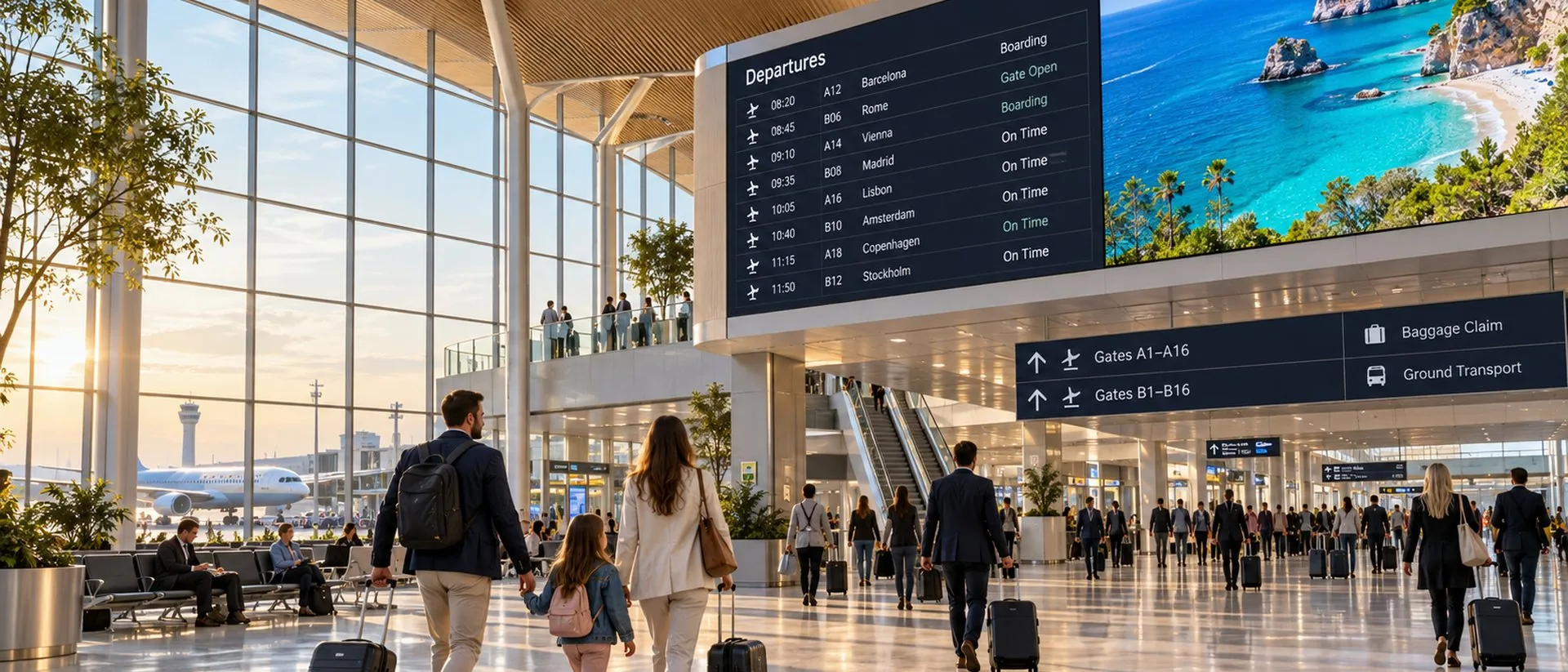
Screens read on the move from twenty metres: timetables, wayfinding, advertising in the passenger flow.
In a terminal the screen hangs high and is viewed from afar — pitch P2.5–P4 and a large area matter more than fine grain.
Our screens at Almaty and Karaganda airports run non-stop: content changes remotely, status is visible from one workstation.
The scene visualisation is generated; the project photos below are real.
What matters here
- 1
Readable from afar
Pitch P2.5–P4, large timetable type.
- 2
Remote management
Content and health monitoring from one program.
- 3
Columns and walls
Flexible modules for round supports.
Which screens fit
Models from the price list
 P2.5
P2.5Indoor displays
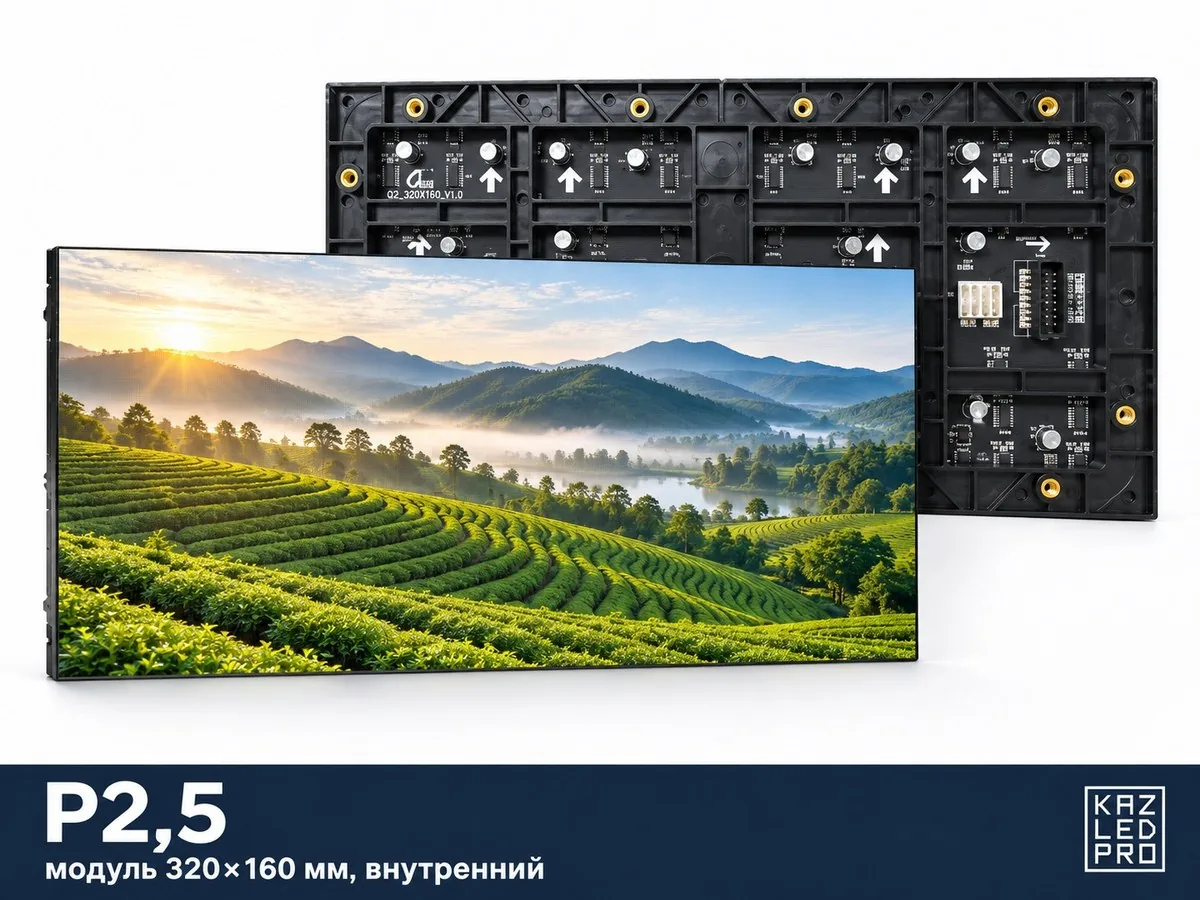
LED screen P2.5 for indoor use — 320×160 mm module
Indoor screen P2.5 (320×160 mm module), pixel density 160 000 dots/m². Comfortable viewing from 2 m.
- Brightness
- 350–550 cd/m²
- Density
- 160 000 dots/m²
- Protection
- IP 31
Details →
 P3
P3Flexible displays
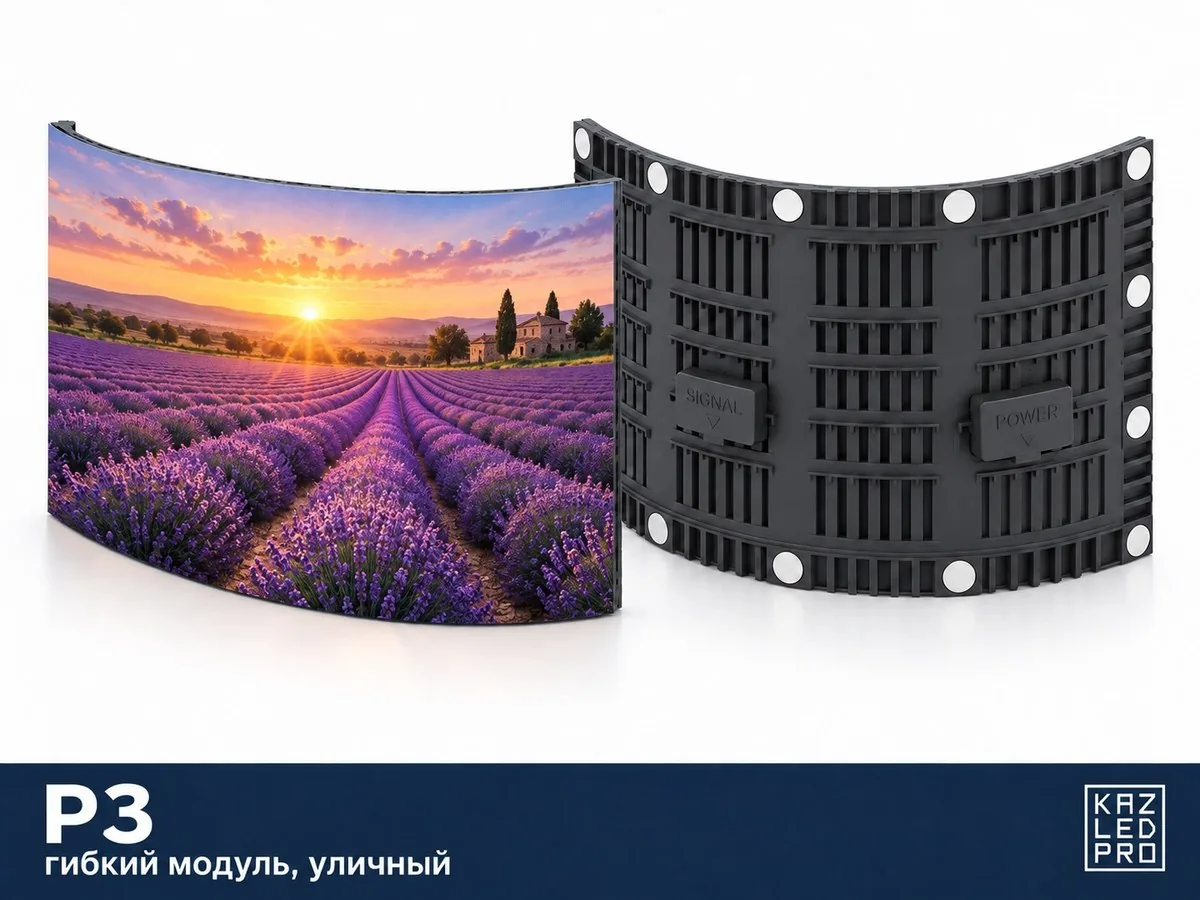
Flexible LED screen P3 for outdoor use
Flexible module P3 for outdoor use: bends to a radius, holds on magnets. Columns, waves and rounded façades.
- Brightness
- 5500–7800 cd/m²
- Density
- 105 625 dots/m²
- Protection
- IP 68
Details →
 P0.93
P0.93Indoor displays
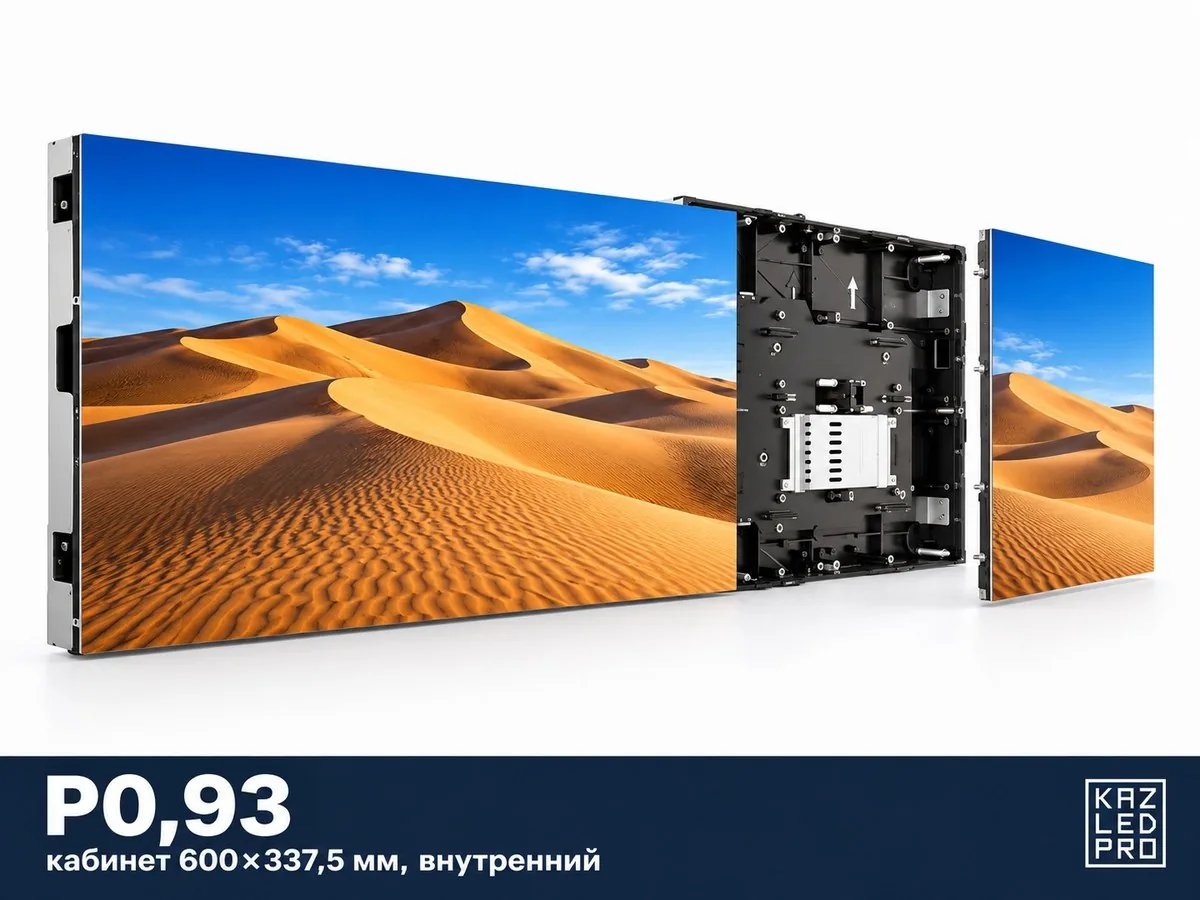
LED screen P0.93 for indoor use — 600×337.5 mm cabinet
Indoor screen P0.93 (600×337.5 mm cabinet), pixel density 1 137 778 dots/m². Comfortable viewing from 1 m.
- Brightness
- 600 cd/m²
- Density
- 1 137 778 dots/m²
- Protection
- IP40 (indoor version)
Details →
In an airport or a railway station the screen is read on the move, suitcase in hand, from twenty metres away. What matters here is not fine grain but area, brightness headroom and legible type: departure and arrival boards, terminal wayfinding, carrier announcements and advertising in the passenger flow. One canvas covers all of that and is divided into zones instead of breaking up into a dozen separate monitors with bezels.
KazLedPro has worked with LED screens since 2012. We installed the LED screen in the hall of Karaganda airport in October 2020: 256×256 mm modules, a minimum viewing distance of four metres, with site video on the case page. Comparable high-traffic halls include the Forum shopping centre in Almaty (48 m², P3, 2023) and Aport Mall (64 m², P3, 2023), and from the transport sector the Academy of Logistics and Transport in Almaty (2022).
Model selection, steel structure, installation by our own crew, commissioning and service come under one contract. A module stock in Almaty, more than 1,000 projects across Kazakhstan, 62 of them with photos on the site. Board size and resolution for your hall can be estimated with the calculator on the site, and a commercial proposal with the equipment list is ready within a day.
Pixel pitch and line height for a hall read on the move
Pitch is chosen by the farthest point of the hall, not by the front row. At two to three metres, at a check-in desk or a boarding gate, P2.5 works — a density of 160,000 dots/m². For a waiting hall or a gallery viewed from four metres and beyond, P3 or P4 is enough: a 256×256 mm module gives 62,500 dots/m², and exactly those modules run at Karaganda airport. The P3 320×160 mm module has a 160 by 160 degree viewing angle, so a line stays readable from an oblique walkway along the gallery.
Legibility is counted in pixels, not by eye. In our practice a timetable line reads confidently when the character height is at least twenty-five pixels: ten centimetres at P4, six at P2.5. That sets the minimum canvas height — eight flight rows with line spacing need about three hundred pixels vertically. We run this calculation before the contract and show in the proposal how many rows will actually fit.
- Check-in desk and boarding gate — P2.5, viewing from 2 m
- Waiting hall and gallery — P3 or P4, viewing from 3–4 m
- Timetable board — at least 25 pixels of character height
- Round-the-clock duty — LED life from 100,000 hours
Timetable, wayfinding and advertising on one canvas
The canvas is split into zones by the video processor: a window with the flight information system on the left, wayfinding and announcements on the right, a ticker at the bottom. The signal comes from an ordinary computer or media player — to it the screen is a monitor with an HDMI or DVI input, and no special protocol is required. The playlist switches by time of day: the morning departure wave, daytime advertising, a night mode at reduced brightness.
A terminal runs around the clock, so lifespan and remote management matter. Rated LED life is from 100,000 hours and the refresh rate is from 3,840 Hz, so security and broadcast cameras pick up no banding off the screen. Content and status of every screen in the terminal are visible from one workstation: the playback schedule, cabinet temperature and power, and the failure of an individual module. Changing a clip on ten screens takes minutes and needs no walk around the building.
Glazing, columns and the forecourt
Terminal halls are glazed and full of daylight. Such places call for models with headroom: 500×1000 mm cabinets at P2.6 and P2.9 give 1,000 cd/m², P1.95 gives from 900 cd/m², and automatic brightness control eases the screen into a soft mode by evening. Transparent mesh goes onto the glazing itself: at a 2.6 by 5.2 mm pitch it passes 70 per cent of light, weighs 7.5 kg per 1000×1000 mm cabinet and is 40 mm thick — the glazing stays glazing while the building works as a medium from outside.
Round terminal columns are clad in flexible 320×160 mm modules: they bend to a radius and hold on magnets, so the advertising is visible from any side of the flow. Outside, on the forecourt and above the drop-off, go 960×960 mm outdoor cabinets with 5,500–7,800 cd/m², IP68 protection and an operating range from minus forty to plus fifty degrees — a Kazakh winter and summer sun are normal duty for them.
How the project goes
- 1
Enquiry and site survey
You send the terminal plan with mounting points, suspension height and photos of the locations. We clarify the farthest viewing point and the source of flight data. In Almaty we come out to measure; in other cities we work from drawings.
- 2
Board calculation and proposal
We calculate pitch, canvas size and resolution, check how many timetable rows will fit, and select the video processor and mount. A commercial proposal with the equipment list is ready within a day.
- 3
Approval and delivery
We prepare the specification for a tender or contract, fabricate the steel structure allowing for suspension and wind load on the outdoor part, and agree the electrics with the airport maintenance service.
- 4
Installation in a live terminal
We work at night or in windows between flights, with the work zone fenced off. Assembling the canvas, running cable, connecting the source and setting up the zones takes one to three days depending on area.
- 5
Launch, training and service
We set the playback schedule and auto-brightness, train the duty operator to change content, and hand over documents and a 2–5 year warranty depending on the model. Spare modules are kept at the Almaty stock.
What the price depends on
The cost of an LED screen for an airport or station depends on area and pixel pitch, the brightness needed for a glazed hall, the type of structure and the conditions of installing in a live terminal. We calculate an exact estimate from your plan and the farthest viewing point: the calculator on the site gives a guide, and a commercial proposal is sent within a day.
Pitch and area
Pitch is set by the far end of the hall: P4 at 62,500 dots/m² is noticeably more affordable than P2.5 at 160,000. Area follows from the number of timetable rows that must be readable at once.
Brightness and build
A glazed hall needs models at 900–1,000 cd/m² rather than the usual 350–550. An outdoor section with IP68 protection and 5,500–7,800 cd/m² costs more than an indoor one of the same area.
Cabinet, module or mesh
500×1000 mm cabinets assemble faster, 320×160 mm modules fit an existing opening more precisely, and transparent mesh on glazing is priced separately — it has its own suspension design.
Structure and mounting height
Suspension under a gallery ceiling, cladding a round column with flexible modules and a cantilever above the drop-off need different frames, load calculations and lifting equipment. Night shifts in a live terminal also enter the estimate.
Electrics and control
The number of power lines, UTP signal lines, a video processor with multi-zone layout and a remote management system for a network of screens are line items of the design.
Warranty and service
The warranty is 2–5 years depending on the model. For a round-the-clock site a stock of spare modules and power supplies is held on site so a replacement does not wait for delivery.
Questions and answers
Which pixel pitch suits a terminal board?
Start from the farthest point of the hall. At a check-in desk approached from two or three metres, P2.5 is used. A waiting hall or gallery is fine with P3 or P4: Karaganda airport runs 256×256 mm modules with viewing from four metres. Large, legible type matters more here than fine grain.
How many timetable rows fit on the screen?
We count in pixels. A confidently readable character is at least twenty-five pixels high, so a row with spacing takes about thirty-five. A canvas three hundred pixels high holds eight flight rows plus a header. We run this calculation before the contract and show the result in the proposal.
How does flight data reach the screen?
To the source the screen is an ordinary monitor with an HDMI or DVI input. A computer running your information system, or a media player, outputs the picture, and the video processor splits it into zones: flights, wayfinding, advertising, ticker. No special protocol or system rework is needed.
Is the screen visible against sun through the glazing?
Yes, if the model suits the hall. Ordinary indoor models give 350–550 cd/m², while glazed halls call for cabinets at 900–1,000 cd/m². Automatic control keeps a comfortable level: brighter by day, softer at night. Transparent mesh passing 70 per cent of light can be hung on the glazing itself.
The terminal runs 24 hours — how long will the screen last?
Rated LED life is from 100,000 hours of continuous operation. Power supplies and receiving cards are replaced as consumable units while the canvas stays in place. Modules come off the front, so replacement needs no dismantling of the structure and no closing of the area for a day.
Can it be installed without stopping the terminal?
Yes. We work at night or in windows between flight waves, fence off the work zone and clear up before opening. A large canvas is assembled in sections over several night shifts. The schedule is agreed with the maintenance service in advance and written into the contract.
What goes on columns and on the forecourt?
Round columns take flexible 320×160 mm modules that bend to a radius and hold on magnets. Outdoors, at the drop-off and on the forecourt, we install 960×960 mm cabinets with 5,500–7,800 cd/m², IP68 protection and an operating temperature from minus forty to plus fifty degrees.
Do you work through tenders and in other cities?
Yes. The company is in the registry of domestic manufacturers under the KTP industrial certificate, which is a price preference in public procurement, and we prepare the technical specification for the tender. We travel across Kazakhstan: Karaganda airport, projects in Astana, Shymkent, Aktobe, Aktau, Taraz and Taldykorgan.
A turnkey screen: quote, installation, launch.
Send us the dimensions and location — a quote today. WhatsApp around the clock.