Solutions
LED screens for bars and night clubs
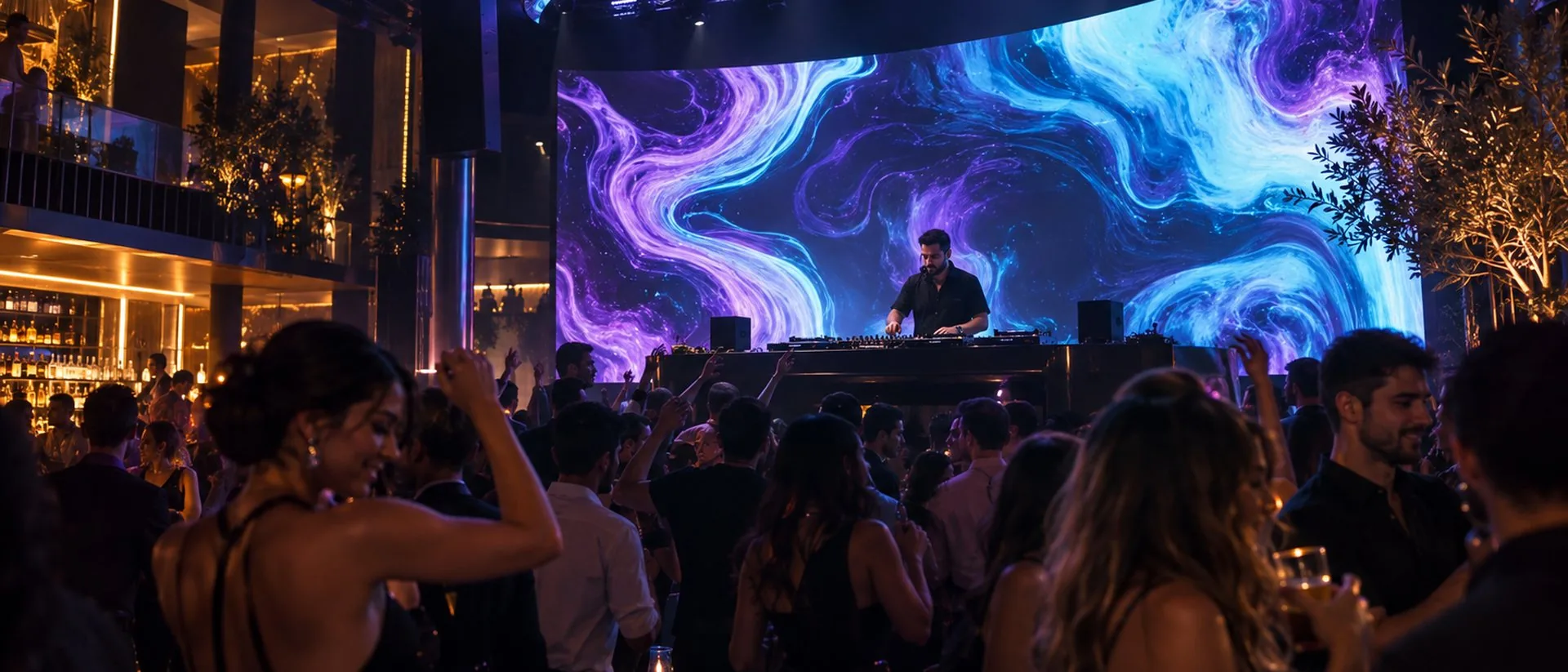
A screen behind the DJ, a wall by the dance floor, a ceiling of modules — light and picture in time with the music.
In a club the screen is part of the light show. Pitch P2.5–P4, brightness to spare and content synced to the lighting desk over DMX.
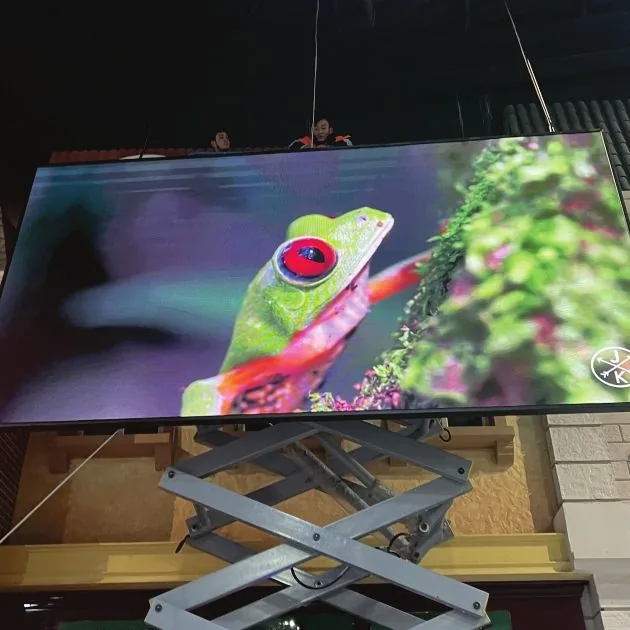
We built screens for Casino Montana and Almaty clubs, together with light and sound.
The scene visualisation is generated; the project photos below are real.
What matters here
- 1
In sync with the lights
DMX, sound activation, scenes at a button.
- 2
Any shape
Waves, columns, ceilings of flexible modules.
- 3
Light and sound together
One contractor for screen, fixtures and speakers.
Which screens fit
Projects with such screens
Models from the price list
 P2.5
P2.5Indoor displays
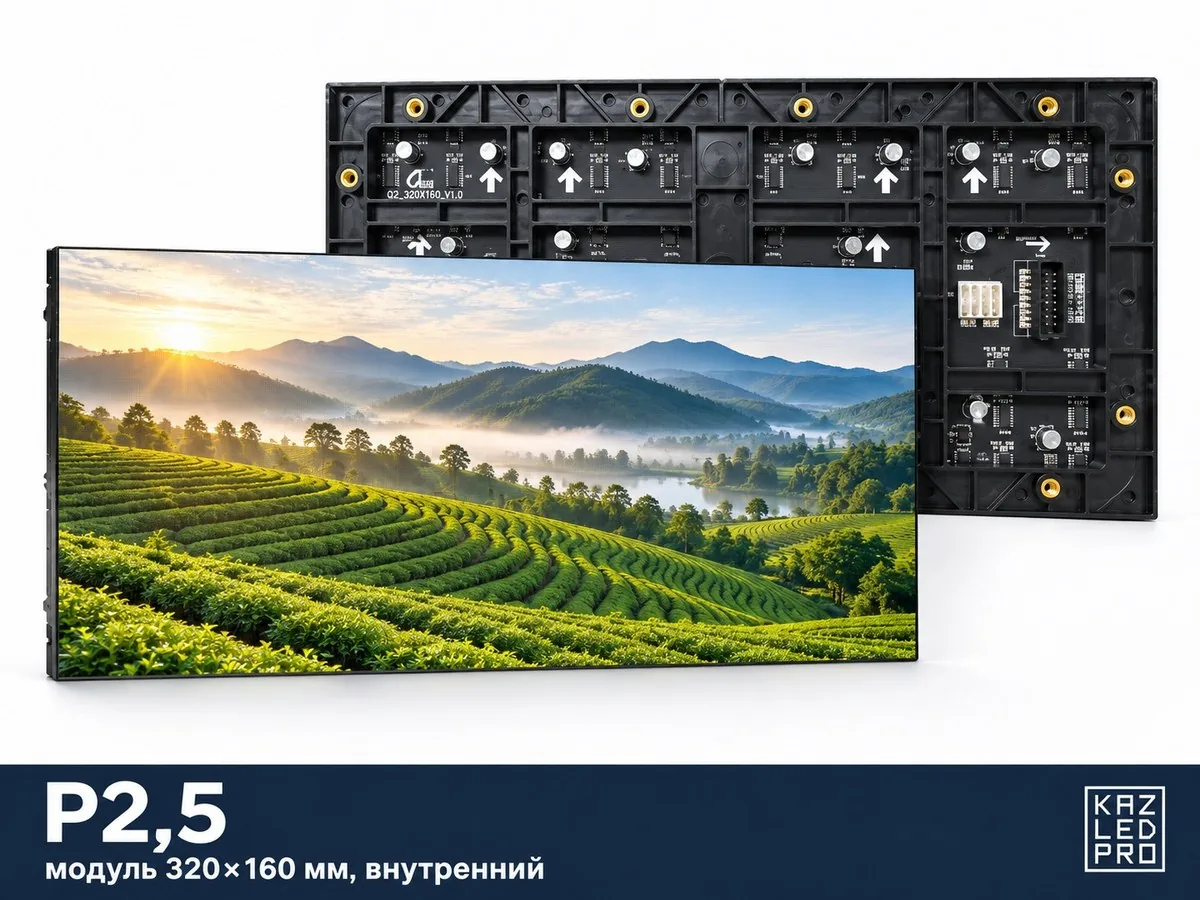
LED screen P2.5 for indoor use — 320×160 mm module
Indoor screen P2.5 (320×160 mm module), pixel density 160 000 dots/m². Comfortable viewing from 2 m.
- Brightness
- 350–550 cd/m²
- Density
- 160 000 dots/m²
- Protection
- IP 31
Details →
 P3
P3Flexible displays
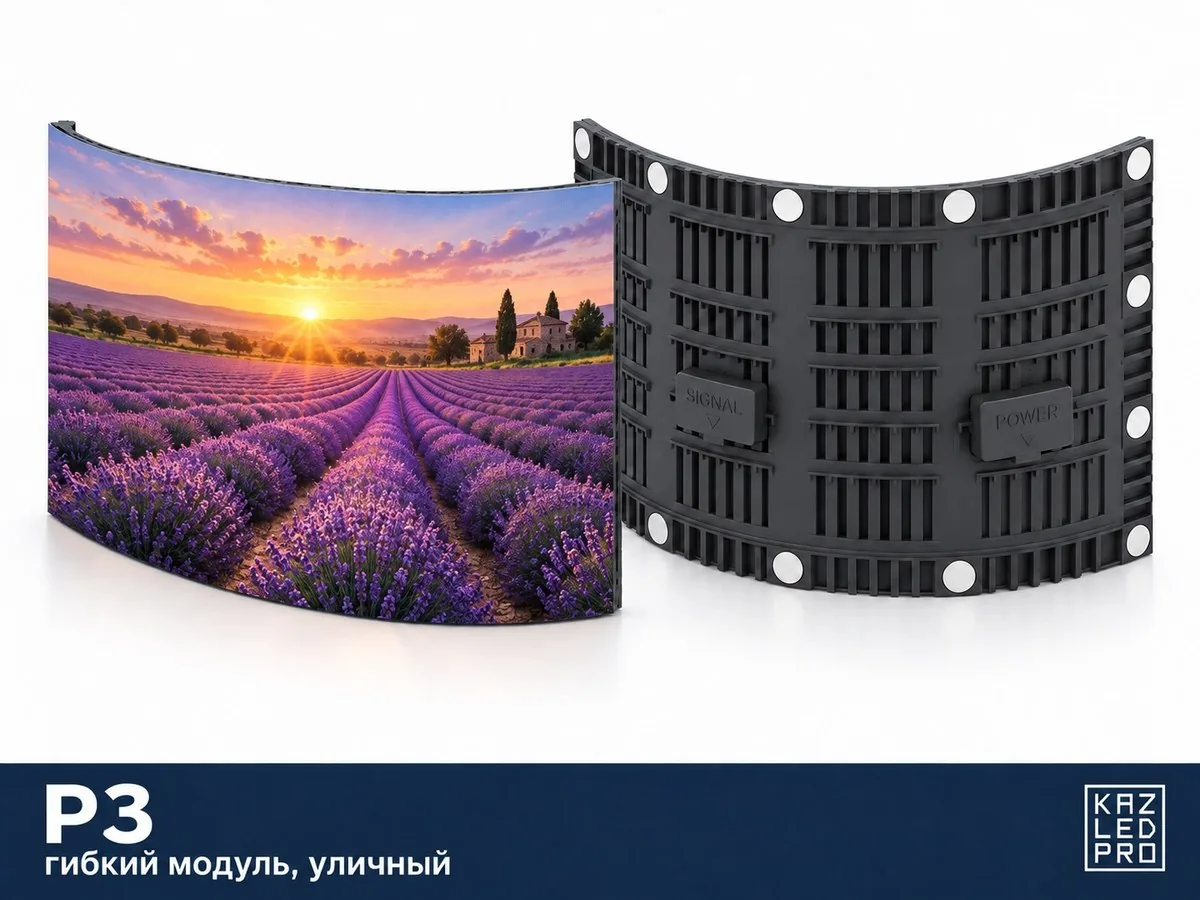
Flexible LED screen P3 for outdoor use
Flexible module P3 for outdoor use: bends to a radius, holds on magnets. Columns, waves and rounded façades.
- Brightness
- 5500–7800 cd/m²
- Density
- 105 625 dots/m²
- Protection
- IP 68
Details →
 P2.9
P2.9Indoor displays
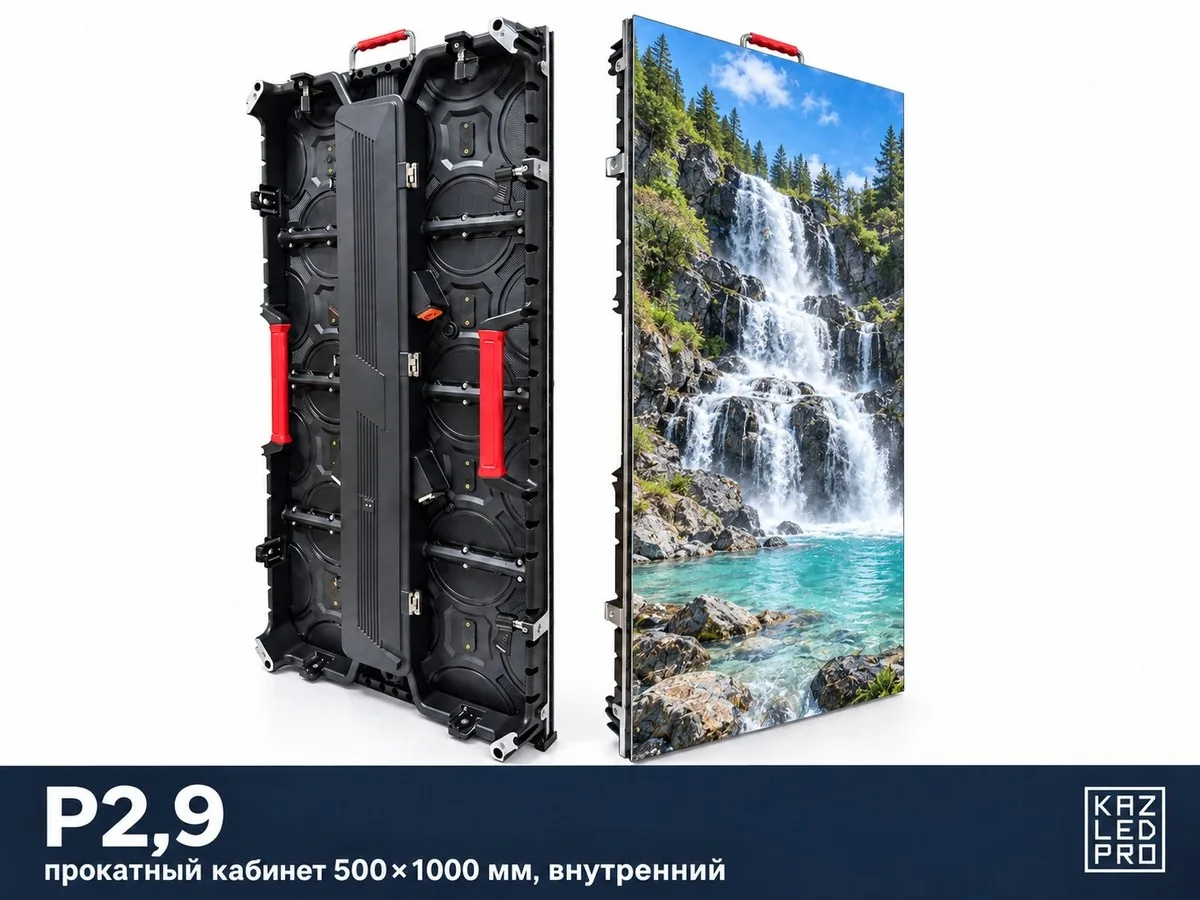
LED screen P2.9 for indoor use — 500×1000 mm cabinet
Indoor screen P2.9 (500×1000 mm cabinet), pixel density 118 336 dots/m². Comfortable viewing from 3 m.
- Brightness
- 1000 cd/m2
- Density
- 118 336 dots/m²
- Protection
- IP40
Details →
In a bar or a night club the screen is not a television but part of the light show: a wall behind the DJ, a strip along the dance floor, a ceiling wave above the bar, vertical inserts between columns. The picture runs in time with the music, changes together with the lights and ends up in every video guests shoot on their phones. In karaoke the task is calmer — readable song lyrics and a backdrop seen from two or three metres.
KazLedPro has worked with LED screens since 2012 and installs them together with light and sound as a single contractor. We installed the LED screen in the lobby of Casino Montana in Kapchagay in October 2021 (256×256 mm modules), a screen of 500×500 mm cabinets for broadcasts and stage backdrop in the Klub T restaurant in Almaty (November 2021), and a canvas of 320×160 mm modules in an Almaty entertainment park (2022). In the Tumar banquet hall a P4 screen works together with light effects on truss.
Model selection, structure and rigging, installation by our own crew, commissioning and service come under one contract. A module stock in Almaty, more than 1,000 projects across Kazakhstan, 62 of them with photos on the site. Screen size for your room can be estimated with the calculator on the site, and a commercial proposal with the equipment list is ready within a day.
Pitch, brightness and refresh rate: a screen that gets filmed on phones
Pitch follows the distance to the nearest guest. The wall behind the DJ and the screen by the dance floor are seen from four or five metres, so P3 and P4 fit: a 256×256 mm module gives 62,500 dots/m², a 320×160 mm module at P2.5 gives 160,000 dots/m², and there is no need to overpay for fine grain where a crowd stands. In a karaoke room, or at a bar where the screen is two metres from the counter, P1.86 or P2 is used — at that distance lyrics and a menu read cleanly.
In a dark room brightness is kept low: the rated 350–550 cd/m² of indoor models is plenty, and the screen does not punch a hole in the lighting design. What really matters here is refresh rate. From 3,840 Hz the canvas films on a phone with no bands across the frame — otherwise half the stories shot in your club come out with a striped screen in the background. Viewing angles are 140 by 140 degrees, 160 by 160 on some models, so the picture holds from the side of the bar.
- Wall behind the DJ and dance floor — P3 or P4, viewing from 4 m
- Bar and karaoke room — P1.86 or P2, viewing from 2 m
- Refresh from 3,840 Hz — phone footage without banding
- Working brightness in a dark room is far below rated
Room shape: DJ wall, ceiling wave, mesh above the bar
A flat wall is built from 640×640, 640×480 and 640×320 mm cabinets: cast aluminium, 65 mm deep, 12–16 kg, magnetic front service. Curved pieces are made with flexible 320×160 mm modules — they bend to a radius and hold on magnets, forming a ceiling wave, the cladding of a round column or a rounded stage corner. Above the bar counter transparent mesh works well: at a 2.6 by 5.2 mm pitch it passes 70 per cent of light, weighs 7.5 kg per 1000×1000 mm cabinet and is only 40 mm thick — the backlit bottles behind it stay visible.
If the installation is meant to change from party to party, the screen is built from 500×1000 mm rental lock cabinets: any size in half-metre steps, tool-free assembly, even seams. Indoor rental models come at P2.6, P2.9 and P3.91 with brightness up to 1,000 cd/m² — the same set travels to a summer terrace or an off-site event.
Light, sound and control in time with the music
A club screen rarely lives apart from the lighting. We install LED Beam fixtures, moving LED heads, wash light and PAR: DMX-512 control over signal cable, master and slave modes, built-in programs and sound activation that drives the fixtures from the beat of the track. Sound means speakers, a mixing desk and radio microphones for karaoke and the host. One contract for screen, light and audio removes the question of who is to blame when the scenes do not match the music.
Service in a club is front-side only: behind the screen there is usually a wall or scenery with no way in from the back. Modules come off the front on magnets and a replacement takes minutes between shifts. Keep the smoke machine and bubble generator away from the canvas — indoor models are rated IP31, which handles dust and drips, not settling liquid. Once a season the front should be blown out and wiped: a bar leaves more on it than an office does.
How the project goes
- 1
Enquiry and survey
You send the room plan, photos of the DJ wall and the stage, ceiling height and rigging points. We measure during the day while the venue is closed. In other cities we work from drawings and photos.
- 2
Calculation and proposal
We calculate size and pitch for the distance to guests, resolution, video processor, structure and rigging. Light and sound are quoted separately if needed. A commercial proposal is ready within a day.
- 3
Contract and preparation
We fabricate the frame or truss for your ceiling and wall and agree the electrics and cable routes. Cabinets and modules in common pitches come from the Almaty stock; the rest is ordered.
- 4
Installation between shifts
We assemble the screen during the day or on the venue's day off, rig the fixtures and run power and signal lines. A canvas of a few square metres goes up in one or two days.
- 5
Setup and training
We match brightness and colour, program DMX scenes and sound activation and build the playlist for the evening. We train the DJ and the technician and hand over documents and a 2–5 year warranty depending on the model.
What the price depends on
The cost of an LED screen for a bar or night club depends on area and pixel pitch, the shape of the structure, the rigging and whether you take light and sound along with the screen. We calculate an exact estimate from the room plan: the calculator on the site gives a guide, and a full proposal is sent within a day.
Pixel pitch
A DJ wall and dance floor are usually fine with P3 or P4, which costs noticeably less than P2 over the same area. A fine pitch is taken only where people come right up to the screen: the bar, karaoke, the entrance area.
Area and shape
A flat cabinet wall is priced by square metre. A wave, a column or a rounded corner in flexible modules needs more installation hours and its own supporting structure, so the metre costs more there.
Cabinet, flexible module or mesh
640×640 cabinets assemble faster, 500×1000 lock cabinets let you change the size of the installation, and transparent mesh above the bar is priced separately — it has its own frame and rigging.
Rigging and height
Fixing to a solid wall is cheaper than suspension from the slab or a truss over the dance floor. Ceiling height, access for equipment and work in the venue's night windows all affect the estimate.
Light, sound and sync
LED Beam fixtures, moving heads, PAR, a lighting desk, speakers and microphones are separate items, as is programming DMX scenes and sound activation.
Warranty and service
The warranty is 2–5 years depending on the model. For a club it is sensible to budget spare modules from the start: the venue works evenings and nobody wants to wait for delivery over a single module.
Questions and answers
Which pixel pitch should a club choose?
Look at the distance to the nearest guest. The wall behind the DJ and the dance-floor screen are seen from four or five metres, where P3 and P4 work. At a bar or in a karaoke room two metres from the screen, P1.86 or P2 is used. A finer pitch does not pay for itself in a dark room full of movement.
Why does the screen band on phone video?
That is a low refresh rate: the camera captures faster than the screen refreshes the frame. Our indoor models run from 3,840 Hz, and at that rate there is no banding on a phone or a professional camera. If an existing screen bands, the cause is in the receiving cards and settings rather than the panels.
Can the screen be synced with the lighting desk?
Yes. Lighting runs on DMX-512: scenes switch from the desk, with built-in programs, master and slave modes and sound activation from the beat of the track. Screen content is built as scenes on the same logic so that fixture flashes and the picture share one rhythm instead of living apart.
Can you build a wave or wrap a round column?
Yes, that is what flexible 320×160 mm modules are for: they bend to a radius and hold on magnets, forming ceiling waves, column cladding and rounded stage corners. We calculate the radius and the layout from your drawing and fabricate the supporting structure for that exact shape.
How much does the screen weigh and consume?
A 320×160 mm module weighs 380–450 grams, a 640×640 cabinet about 16 kg, a 500×1000 rental cabinet 13 kg. Rated consumption of indoor models is 700–800 W/m² peak and 300–320 W/m² average, and in a dark room brightness is reduced. Truss load and power lines are calculated before installation.
Will smoke and condensation damage the screen?
Indoor models are rated IP31 or IP24: they take dust and drips, but not settling liquid. So the smoke machine, bubble generator and cryo jet are placed away from the canvas and never aimed at it. Once a season the front surface is blown out and wiped — a bar leaves more on it than an office.
How is the screen serviced if there is no access from behind?
All our cabinets are serviced from the front: a module comes off its magnets in a minute, with no dismantling of the structure and no rear access. Spare modules and power supplies are kept at the Almaty stock, and service visits are on request. The warranty is 2–5 years depending on the model.
Do you install in clubs in other cities?
Yes, with a travelling crew across Kazakhstan. Comparable projects include Casino Montana in Kapchagay, the Klub T restaurant and an entertainment park in Almaty, banquet halls in Kokshetau, Turkestan and Semey, and a restaurant in Chundzha. Measurements from drawings and photos, equipment from the Almaty stock, installation and setup by our own team.
A turnkey screen: quote, installation, launch.
Send us the dimensions and location — a quote today. WhatsApp around the clock.