Solutions
LED screens for TV studios
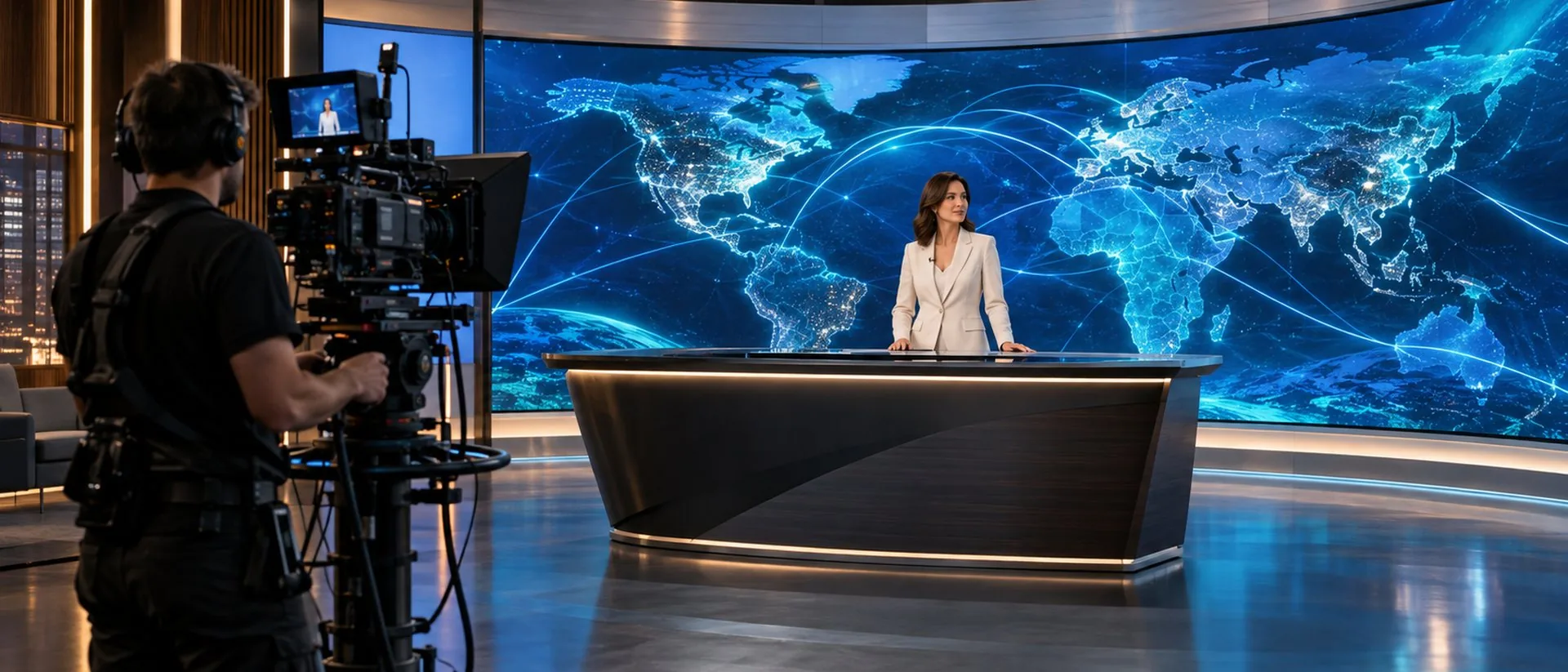
A backdrop behind the presenter with no banding on camera and no glare.
In a studio the screen is filmed, not watched — so what matters is refresh rate and colour depth, not brightness. Cards from 3,840 Hz and 16-bit processing give a flicker-free picture at any camera shutter.
Pitch P1.25–P1.95: the presenter stands a metre or two from the screen, so grain on a close-up is unacceptable. We installed the screens in the Eurasia TV channel studios in Almaty.
The scene visualisation is generated; the project photos below are real.
What matters here
- 1
3,840 Hz and above
No banding or flicker on any camera.
- 2
Pitch P1.25–P1.95
Close-ups without grain.
- 3
Front access
Module replacement between broadcasts.
Which screens fit
Models from the price list
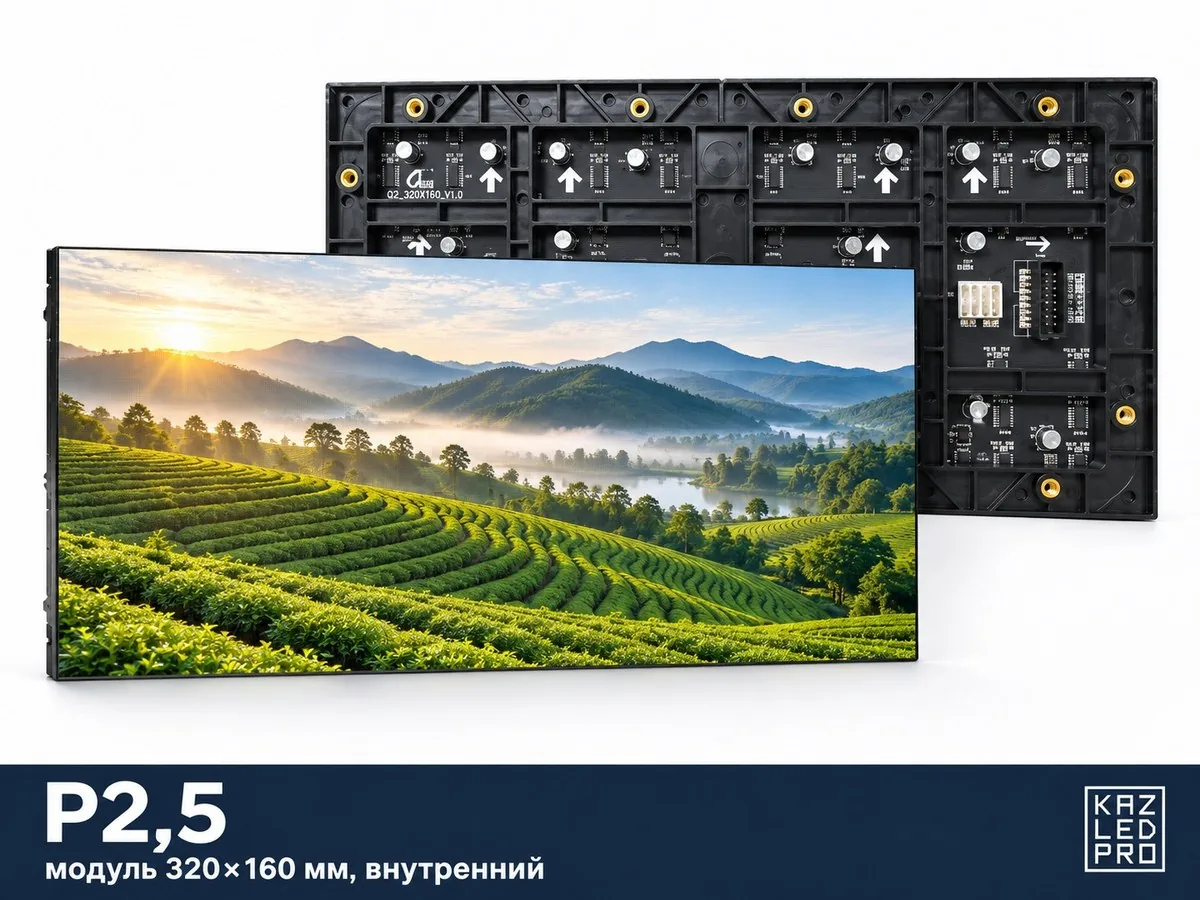 P2.5
P2.5Indoor displays
LED screen P2.5 for indoor use — 320×160 mm module
Indoor screen P2.5 (320×160 mm module), pixel density 160 000 dots/m². Comfortable viewing from 2 m.
- Brightness
- 350–550 cd/m²
- Density
- 160 000 dots/m²
- Protection
- IP 31
Details →
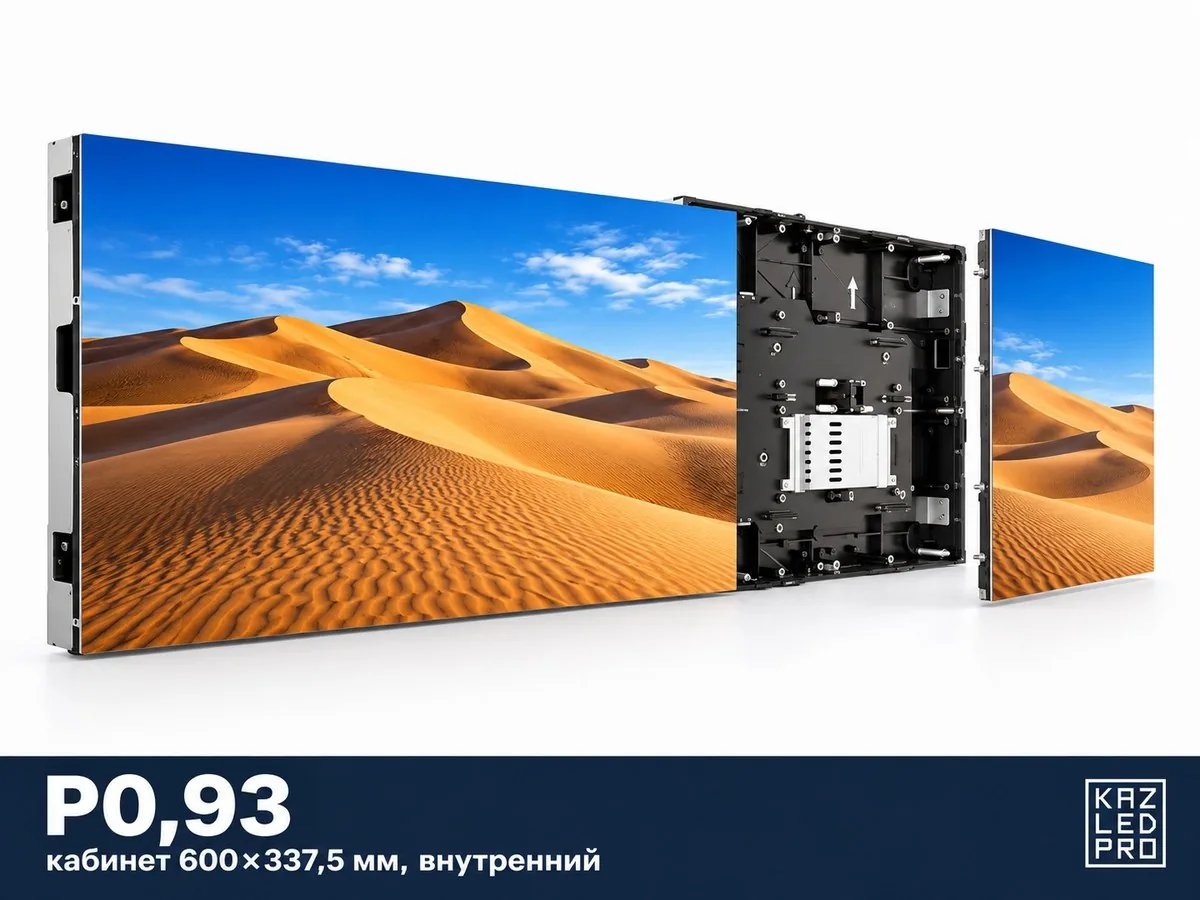 P0.93
P0.93Indoor displays
LED screen P0.93 for indoor use — 600×337.5 mm cabinet
Indoor screen P0.93 (600×337.5 mm cabinet), pixel density 1 137 778 dots/m². Comfortable viewing from 1 m.
- Brightness
- 600 cd/m²
- Density
- 1 137 778 dots/m²
- Protection
- IP40 (indoor version)
Details →
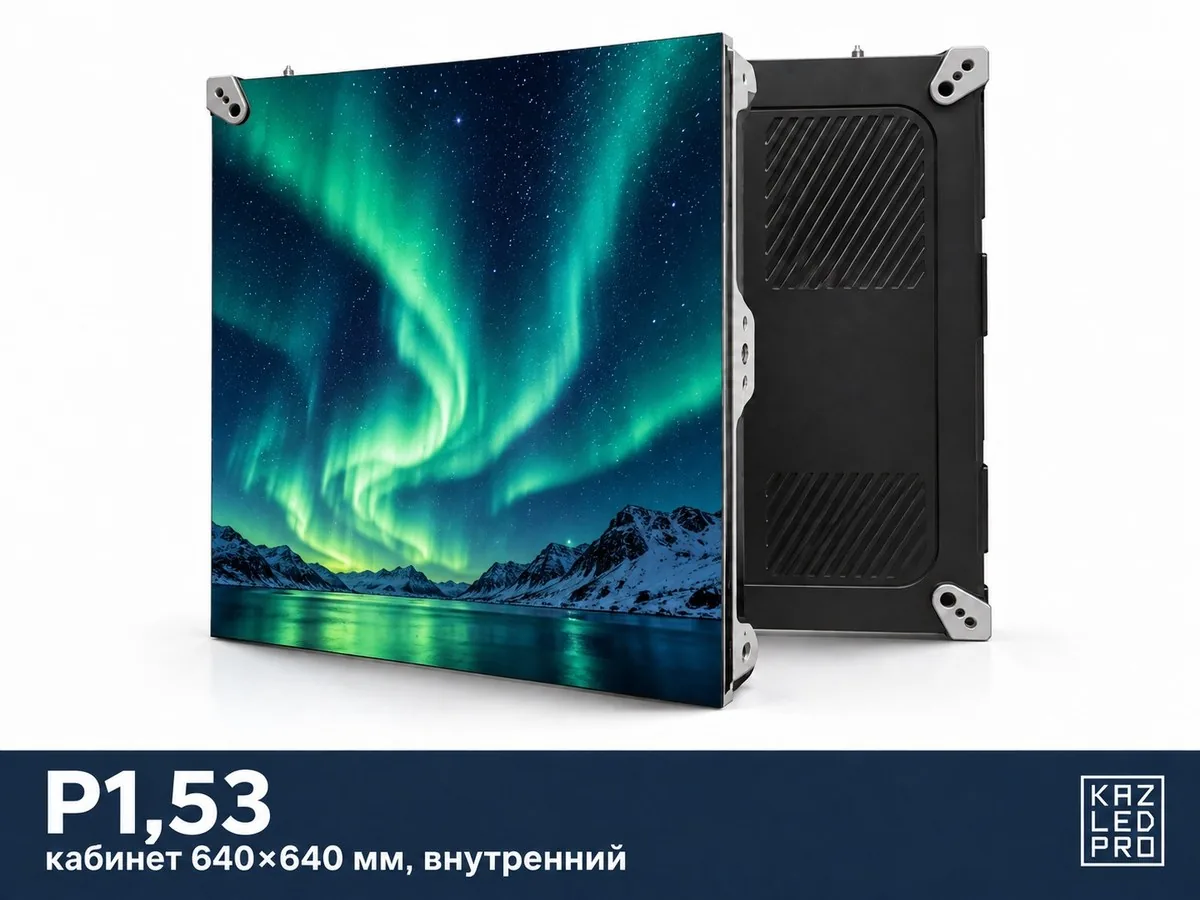 P1.53
P1.53Indoor displays
LED screen P1.53 for indoor use — 640×640 mm cabinet
Indoor screen P1.53 (640×640 mm cabinet), pixel density 422 500 dots/m². Comfortable viewing from 2 m.
- Brightness
- 350–400 cd/m²
- Density
- 422 500 dots/m²
- Protection
- IP 24
Details →
An LED screen for a TV studio is filmed by a camera, not watched by an audience, so the requirements are different: a refresh rate from 3,840 Hz so there is no banding in the frame, a fine pixel pitch with no visible grain on close-ups, and brightness matched to the studio lighting. We installed such backdrops in the studios of the Eurasia TV channel in Almaty and Astana and know how to match a screen to specific cameras.
KazLedPro has worked with LED screens since 2012: model selection, steel structure, installation by our own crew, camera calibration and service. A module stock in Almaty means a replacement in the studio does not wait for an overseas shipment. More than 1,000 projects across Kazakhstan, 62 of them published on the site with photos. Estimate the size and resolution of your screen with the calculator on the site; we send an exact quote within a day.
Which pitch and brightness work on camera
Pixel pitch is chosen by the distance from the camera to the screen and the tightness of the shot. If the presenter stands a metre from the backdrop and is filmed in close-up, you need P0.93: COB technology with a solid front surface, 1,137,778 pixels per m², comfortable viewing from 1 m. For a news studio with two to three metres to the screen, P1.53 and P1.86 fit. A P2 screen works for wide shots from four metres — that is the pitch in the Eurasia studio in Astana.
All indoor models in the catalogue have a refresh rate from 3,840 Hz by specification, so there is no banding at any shutter speed. Indoor brightness is 350–600 cd/m², and in a studio it is usually turned down: the screen should match the presenter's face in luminance, not overpower it. Outdoor brightness only hurts here.
- P0.93 COB — virtual studios and close-ups from one metre
- P1.53 and P1.86 — news studios, presenter at two to three metres
- P2 and P2.5 — wide shots, set pieces, talk shows
Connecting to the desk and working with cameras
The signal reaches the screen from the vision mixer or a player through a video processor over HDMI or DVI: it scales the picture to the canvas resolution, switches sources without a black frame and stores brightness presets for different lighting setups. The screen can be split into zones — a live-feed window, captions, a static background — all controlled from one workstation.
Moiré on camera depends on pixel pitch, distance, focal length and shutter. So before purchase we match the model to your cameras: send the camera models, studio plan and typical shots, and we calculate the pitch and offer a test shoot. The screen's colour temperature is calibrated to the studio lighting so a white background does not drift blue on air.
Installation in the studio and service between broadcasts
A studio screen is built from 640×640, 640×480 and 640×320 mm cast-aluminium cabinets 65 mm deep; a cabinet weighs 12–16 kg. A 16:9 format is assembled from cabinets of different heights, for example 5.12×2.88 m; the frame mounts to a wall or to the set truss. Modules come off the front on magnets, so a module can be replaced between broadcasts without dismantling the set. Indoor models have no fans, so studio microphones pick up no hum.
Rated power consumption is up to 800 W/m² peak and about 320 W/m² average, so the screen gets its own power line. At the Eurasia TV studio on Republic Square in Almaty a screen of 256×256 mm modules was installed in July 2021; at the Eurasia studio in Astana a P2 screen followed in August that year. Both work on air.
How the project goes
- 1
Enquiry and studio plan
Send the backdrop size, camera positions, camera models and typical shots. We visit for measurements in Almaty; in other cities we work from drawings and photos.
- 2
Pitch selection and calculation
We calculate pixel pitch, canvas resolution and brightness for the studio lighting and offer two or three options. A commercial proposal with the equipment list is ready within a day.
- 3
Contract and delivery
Cabinets and modules from our stock in Almaty or made to order at the factory. The steel structure for the set is designed and built for your specific wall or truss.
- 4
Installation and calibration
We assemble the screen, connect the video processor to the desk and calibrate brightness and colour temperature by camera. A test shoot with your operator precedes handover.
- 5
Handover and service
We train the studio engineer and hand over documents and a 2–5 year warranty depending on the model. Spare modules are stocked in Almaty; service visits on request.
What the price depends on
The cost of an LED screen for a TV studio is made up of area and pixel pitch, cabinet type, the structure for the set and signal processing. We calculate an exact estimate from your studio dimensions: the calculator on the site gives a guide, and a commercial proposal is ready within a day.
Pixel pitch
The finer the pitch, the more LEDs per square metre: P0.93 carries seven times as many pixels as P2.5 and costs noticeably more per metre.
Area and format
Backdrop size sets the number of cabinets, and canvas resolution sets the class of video processor. A non-standard format needs 640×320 cabinets and a trimmed structure.
Technology and cabinet
COB P0.93 modules in a cast 600×337.5 mm cabinet cost more than SMD 640×640 cabinets; ready cabinets assemble faster than modules on a custom frame.
Structure and installation
Mounting to a solid wall, to the set truss or hanging from the ceiling means a different steel structure and a different amount of work at height.
Signal and control
The number of inputs, multi-window mode, a backup processor for live broadcast and camera calibration are added to the estimate as separate lines.
Questions and answers
Which pixel pitch should a news studio choose?
The guide is the distance from the lens to the backdrop in the tightest shot. From one metre you need P0.93, from two to three metres P1.53 or P1.86 is enough, from four metres and beyond P2 works. If in doubt, go finer: studio screens serve for years and cameras only get sharper in that time.
Will there be banding or flicker on camera?
All indoor models in the catalogue have a refresh rate from 3,840 Hz by specification — enough for short shutter speeds and slow-motion replays. Banding appears on cheap screens running at 960–1,920 Hz. Moiré, caused by the pixel grid clashing with the sensor grid, is removed by distance, focus and pitch selection — we verify this with a test shoot.
Can an LED screen replace a green screen?
Yes — that is a virtual studio: the backdrop shows the finished scene, the presenter sees it and is lit correctly, and there is no green spill on clothes and hair. This needs a fine pitch of P0.93–P1.53 and brightness matched to the lighting. A green screen remains cheaper if the background rarely changes.
What power and ventilation does the screen need?
By specification indoor models draw up to 800 W/m² peak and about 320 W/m² average at working brightness; P0.93 COB draws 300 and 100 W/m². A 4×2.25 m backdrop gets its own power line. The cabinets have no fans, no extra studio extraction is needed, and heat leaves through the aluminium housing.
How long does a studio screen take?
Cabinets in common pitches are in stock in Almaty; a non-standard pitch or format is ordered from the factory. Installation and calibration of a 10–20 m² backdrop in a finished studio take several days. The exact lead time goes into the commercial proposal after the survey.
What about the warranty and module replacement?
The warranty is 2–5 years depending on the model. Modules come off the front on magnets, so the studio engineer swaps a module in a minute between broadcasts; we recommend keeping spares from the same batch in the studio, with the rest in our Almaty stock. Service visits are on request, to any city in Kazakhstan.
Do you work in other cities?
Yes. We equipped the Eurasia studio in Astana in 2021 with a travelling crew and work the same way in Shymkent, Karaganda and other cities. Measurements from drawings and photos, installation by our own crew, equipment shipped from the Almaty stock.
A turnkey screen: quote, installation, launch.
Send us the dimensions and location — a quote today. WhatsApp around the clock.