
Products
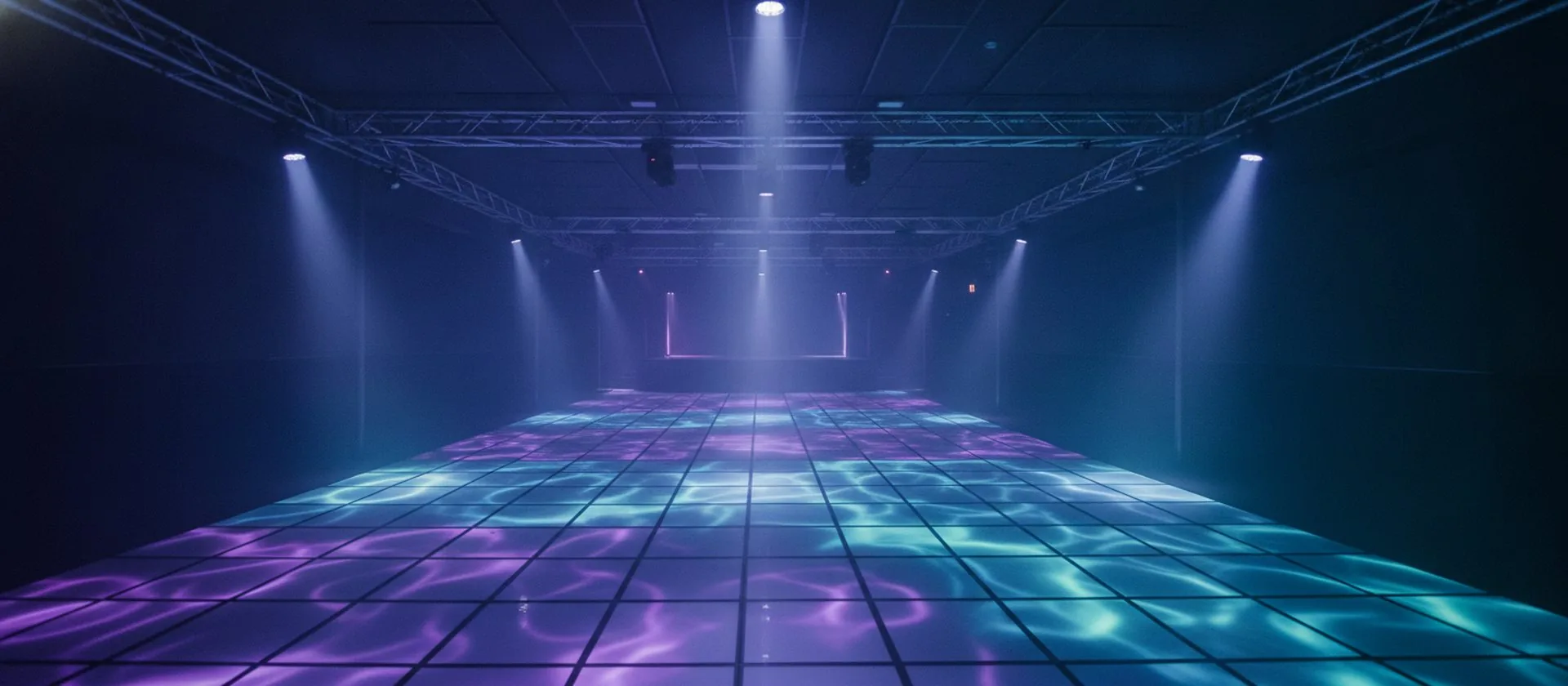
Interactive LED floor
Interactive LED floor: a screen you walk on. Stages, showrooms, exhibitions, children's centres. Not in the price list yet — matched to the task and venue on request.
Where it goes
Stage and shows
A floor screen for dance numbers and light shows.
Exhibition stands
An interactive walkway that reacts to steps.
Malls and showrooms
A zone that gathers people and gets filmed on phones.
Children's and entertainment centres
Games, footprints, waves underfoot.
Models from the price list
Not in the price list yet — we match it to the task. Send the dimensions and site, and we will return a quote with a drawing.
Leave a requestWhy this type
Load up to 2 t/m²
Tempered glass and steel frame — takes a crowd and equipment.
Step sensors
Infrared or capacitive — the floor reacts to movement.
Anti-slip surface
Matte finish, safe wet or dry.
Quick assembly
500×500 mm panels on adjustable feet — installed in a shift.
Projects with such screens
Why an LED display
Warranty of up to 5 years
On screens of our own manufacture and on the equipment we supply.
Brightness control
Different by day and by night — the screen does not dazzle or flood windows with light, and consumption drops.
Service without dismantling
Front, rear or mixed — the module comes off and the structure stays in place.
Round-the-clock operation
LED life of 50–100 thousand hours in continuous use.
Vandal-resistant build
For places where the screen is within arm's reach.
Any shape and size
The screen is assembled from modules, so the dimensions fit the opening and the shape fits the task.
Wide temperature range
Outdoor models operate from −30 to +50 °C.
Installation on any surface
Brick, concrete, glass, an aluminium facade, a free-standing pylon or a roof.
An interactive LED floor is an LED screen you walk on. Panels with tempered glass and a steel frame are laid on the floor of a stage, a stand or a retail zone, and sensors under the surface pick up footsteps: waves spread underfoot, footprints stay, the picture changes. Such floors are used on stages and dance floors, exhibition stands, in showrooms, shopping malls and children's entertainment centres — wherever you need to gather people and make them reach for their phones.
Let us say it plainly up front: the KazLedPro price list has no LED floor items yet. We do not keep these panels in stock and do not publish specifications for them the way we do for the 42 screen models in the catalogue. We bring an LED floor in for a specific project, once the area, load, scenario and timing are agreed. There are no model cards on this page, but there is what you need to know to order a floor correctly and not overpay for extras.
What stands behind this: KazLedPro has been building LED screens in Almaty since 2012, installs them with its own crew across Kazakhstan and keeps a stock of modules and spares in Almaty. The screen on the stage, the lighting truss and the floor screen beneath it are one venue and one contractor.
How a floor screen is built
An LED floor panel is an LED module covered on top with tempered glass with a matte anti-slip finish and set into a steel frame. The typical panel format is 500×500 mm; panels sit on adjustable feet, so the floor is levelled over an uneven base and assembled in a single shift. Load capacity is up to 2 t per square metre: the floor takes a crowd on a dance floor, equipment racks and a car in a showroom. The surface is safe wet or dry.
Interactivity comes from sensors under the glass — infrared or capacitive. They tell the controller where a person is standing, and the software draws an effect around that spot: ripples, footprints, scattering particles, a lit path. Without sensors the same floor works as a regular screen for video content under a dance number or a light show. Pixel pitch and brightness are matched to the task and distance: a floor is viewed from standing height and from a balcony, so grain requirements are more relaxed than for a wall screen.
- Tempered glass with a matte anti-slip finish on top.
- Steel panel frame, load up to 2 t/m².
- 500×500 mm panels on adjustable feet — assembled in a shift.
- Infrared or capacitive step sensors, a controller and effects software.
- Video processor and power supply — the same as a regular LED screen.
Where it goes and what to expect
On a stage and dance floor the LED floor works in tandem with the backdrop: one piece of content runs across the wall and the floor, and the number is filmed as a whole. On an exhibition stand an interactive walkway stops the flow of visitors — people come back to step on it again and stay at the stand. In a mall or showroom it is the zone people film and post; in a children's centre it is a game with no rules or instructions.
It is important to understand the difference between a temporary and a permanent installation. For an event the floor is assembled for a day or two on a level base, and sensors and effects are tuned to the evening's programme. A permanent floor in a mall or children's centre runs for years: it needs a level load-bearing floor, concealed power and signal runs, access to panels for maintenance and content that changes with the seasons. We price the two differently, and it is worth deciding which is yours before ordering.
Why to order and how it works
LED floors are ordered rarely in Kazakhstan, and the panels cost more than wall modules of the same area because of the glass, frame and sensors. Keeping them in stock just in case would build idle inventory into every buyer's price. So we work differently: for your project we request panels from the manufacturer, verify the specifications, size the kit and state the lead time. It is longer than for screens from the Almaty warehouse, and we say so before the contract, not after.
There are no published LED floor projects in our portfolio yet — we will not show other people's photos as our own. What we do have is experience with the venues where such a floor belongs: a stage screen for the Eleven Hotel & Hall banquet venue in Almaty (2019), a screen in an Almaty amusement park (2022), screens with trusses and stage lighting in school assembly halls. A floor screen slots into the same chain: calculation, frame, power, installation by our crew, content setup and service with spares.
How the project goes
- 1
Enquiry and scenario
You describe the venue and the task: stage, stand, retail zone or children's centre, the size of the zone, temporary or permanent installation, whether interactivity is needed. From this we determine the panel type.
- 2
Survey and base calculation
An engineer checks the base, load, power and signal routing and the raised floor height. For a stage — the join with the backdrop and lighting truss; for a permanent floor — panel access for maintenance.
- 3
Quotation and lead time
We request panels for the project, verify the specifications and send a quotation with area, kit, lead time to order and payment stages. We promise nothing from a warehouse that does not exist.
- 4
Delivery, assembly and setup
Panels arrive in Almaty, the crew assembles the floor on its feet in a shift, connects the processor and sensor controller, loads the effects and your content and checks the response to footsteps.
- 5
Handover, training and service
Act, passport, operator training in launching effects and changing content. Warranty on the supplied equipment, spares for the project, service visits across Kazakhstan.
What the price depends on
The cost of an LED floor is calculated per project; there is no ready price list for it. The total depends on area, panel type, interactivity and whether the installation is temporary or permanent. We build the estimate from the dimensions of your zone: the calculator on the site gives a guide by area, and an exact quotation with panel prices to order follows after the calculation.
Area and shape of the zone
A floor is counted in 500×500 mm panels: a 6×4 m rectangle is 96 panels. A complex shape, cut-outs for columns and steps add infill pieces and labour.
Pixel pitch and brightness
A floor is viewed from standing height and from a balcony, so the pitch is usually coarser than for a wall screen. A fine pitch is needed only for close-up filming and raises the panel price noticeably.
Interactivity
Panels with infrared or capacitive sensors, a controller and effects software cost more than a plain floor screen. If the scenario is video under a number, the sensors can be left out.
Temporary or permanent installation
A one-off build on a level base and a permanent floor with base preparation, concealed cabling and maintenance access mean a different installation estimate and a different kit.
Power and control
Power with headroom over the calculated load, a video processor, a sensor controller and integration with the stage screen and lighting — we price them as one venue system.
Warranty, spares and lead time
Equipment to order comes with its own lead time and manufacturer warranty; a stock of panels and glass for the project, training and a service visit are part of the offer.
Questions and answers
Why is the LED floor not in the price list if you supply it?
Because demand for it in Kazakhstan is occasional, and panels with glass, frame and sensors cost more than regular modules. Stock would end up in the price of every order. We bring panels in for a specific project, verify the specifications and state the lead time before the contract. That is more honest than a price list for something not in stock.
How long is delivery of an LED floor?
Longer than a screen from the Almaty warehouse: panels are ordered per project, and the lead time depends on area, panel type and logistics. The exact date is given in the quotation after the calculation. If the event is a week away, an LED floor to order will not make it — let us discuss a stage screen and lighting instead.
What load does the floor take?
Tempered-glass panels on a steel frame are rated for loads up to 2 t per square metre. That is a crowd on a dance floor, sound and lighting racks, a car in a showroom. The base under the feet must be level and load-bearing — we check this during the survey.
Is it slippery to walk and dance on?
The glass on top is matte with an anti-slip finish, safe wet or dry. For a dance floor and a children's centre this is a must, and we do not offer panels without it. For a permanent installation we add a cleaning routine: ordinary glass cleaners, no abrasives.
How does the floor know where a person is standing?
Sensors sit under the glass — infrared or capacitive. They pass touch coordinates to the controller, and the software draws an effect around that point: ripples, footprints, particles, a lit path. A set of effects ships with the equipment; your own content and branded scenes are prepared separately for your video or logo.
Can the floor be built for one event and then removed?
Yes, 500×500 mm panels on adjustable feet are assembled in a shift and taken apart the same way. A one-off installation needs a level base, power and a day for assembly and effect setup. If you need the floor regularly, we can discuss buying a kit outright, as with rental cabinets.
Who makes the content for the floor?
Basic interactive effects are part of the controller software. Video content for a dance number, branded effects with your logo and seasonal scenes are prepared separately — by your designer to our technical brief with resolution and format, or by our partners. File requirements are issued together with the quotation.
Do you work outside Almaty?
Yes, across Kazakhstan. Survey, installation and setup are done by our travelling crew, and the panels travel together with the rest of the venue equipment. We have installed stage and hall screens from Aktau to Kokshetau; an LED floor follows the same scheme, allowing for the lead time to order.
A turnkey screen: quote, installation, launch.
Send us the dimensions and location — a quote today. WhatsApp around the clock.