
Products
Transparent mesh LED screens for shop windows
Transparent screens for glazing: a full screen from outside, daylight and the view remain from inside. Transparency 30–70%.
Where it goes
Shop windows
Advertising on the glass with the goods visible behind it.
Atriums and glass facades
A screen across all the glazing without losing light inside.
Car showrooms
The huge window becomes a screen; the cars stay visible.
Event rental
Light cabinets are hung within an hour.
Models from the price list
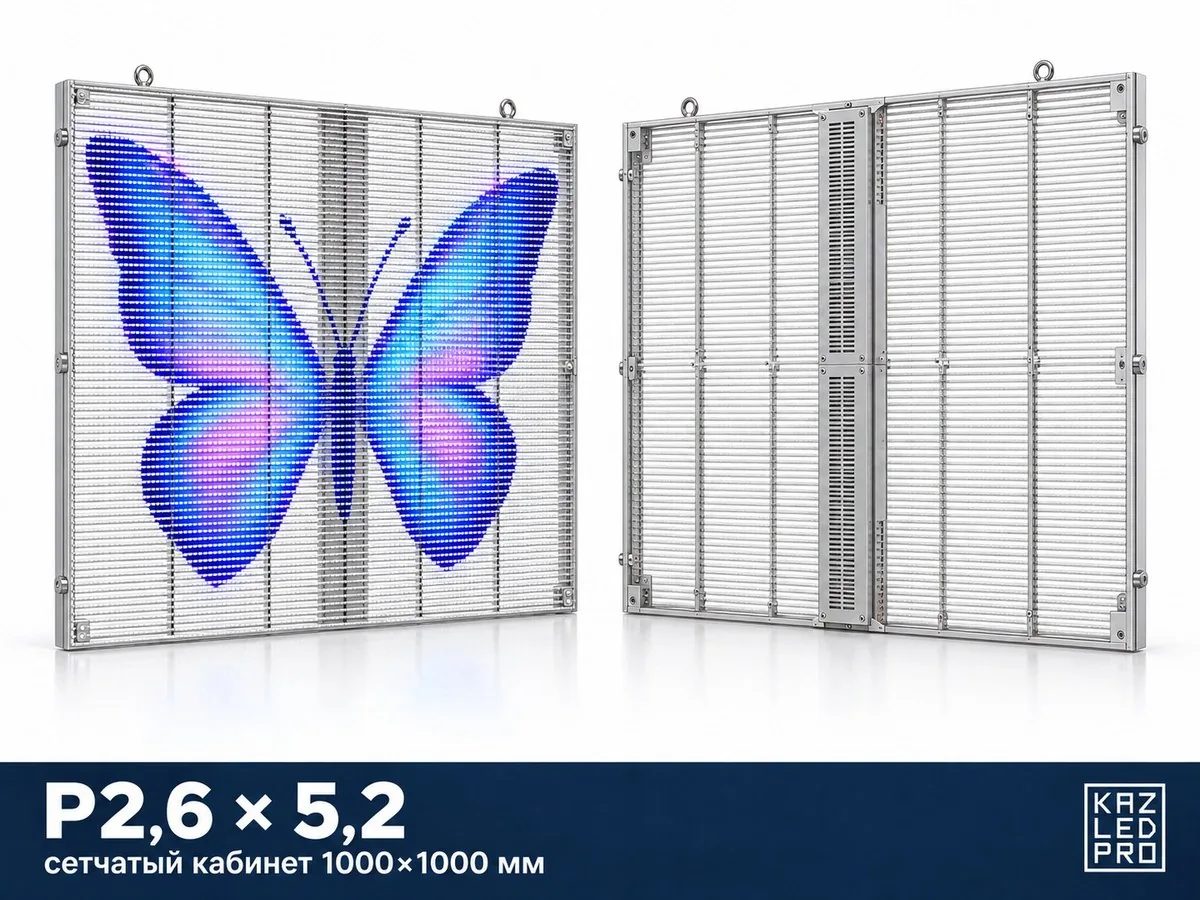 P2.6 × 5,2
Mesh displays
Mesh screen P2.6 × 5.2 — 70 % transparency
Transparent mesh screen P2.6 × 5.2 for glazing and façades: 70 % of the light passes through, weight 7.5 kg (cabinet 1000×1000 mm).
- Transparency
- 70 %
- Brightness
- 2000–4500 cd/m2
- Protection
- IP33
Details →
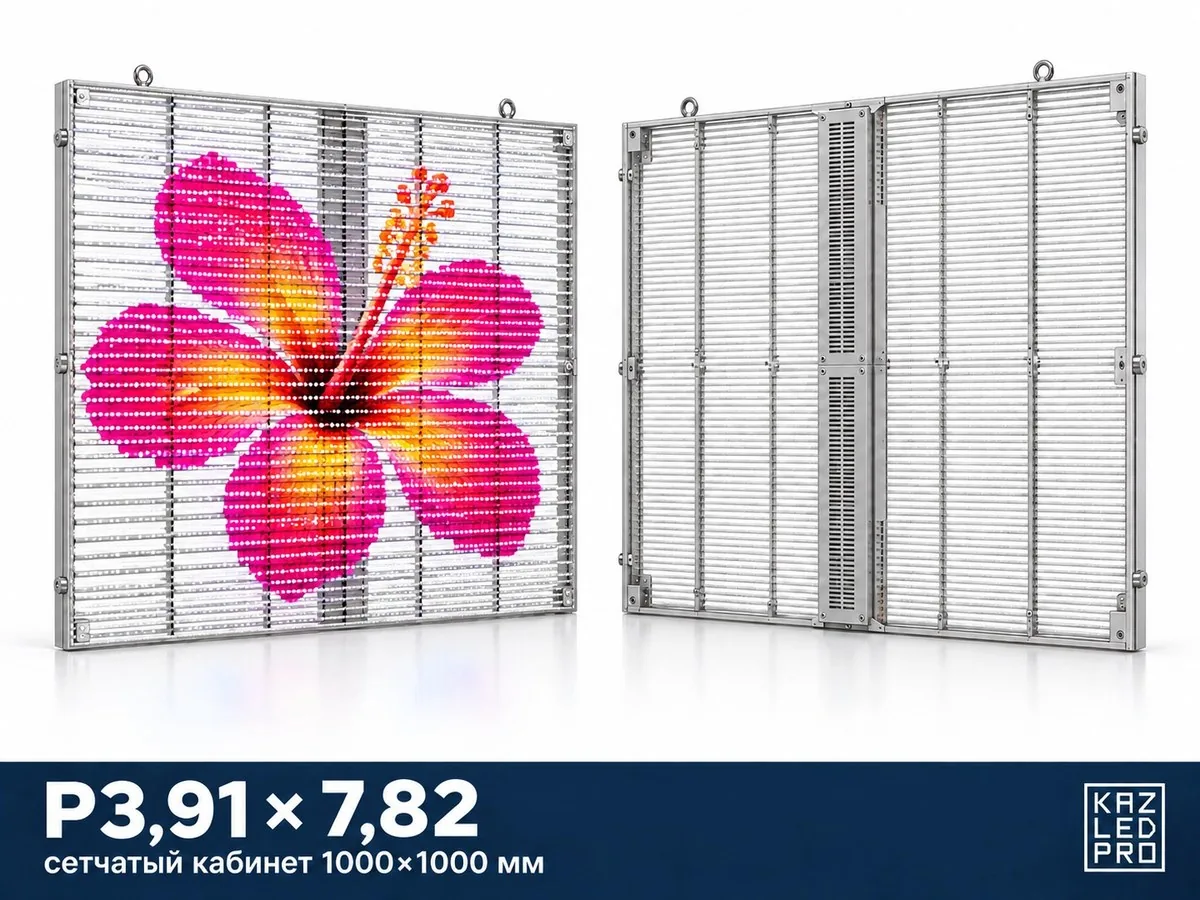 P3.91 × 7,82
Mesh displays
Mesh screen P3.91 × 7.82 — 65 % transparency
Transparent mesh screen P3.91 × 7.82 for glazing and façades: 65 % of the light passes through, weight 7.5 kg (cabinet 1000×1000 mm).
- Transparency
- 65 %
- Brightness
- 2000–4500 cd/m2
- Protection
- IP33
Details →
Why this type
Up to 70% transparent
Special modules: air and light between the LED strips.
2,000–4,500 cd/m²
Enough for shop windows and glazing: the screen is viewed from the street.
Light
Aluminium cabinets 1000×1000 and 1000×500 mm — no heavy frame.
Service from both sides
Front or rear — whichever suits the site.
Why an LED display
Warranty of up to 5 years
On screens of our own manufacture and on the equipment we supply.
Brightness control
Different by day and by night — the screen does not dazzle or flood windows with light, and consumption drops.
Service without dismantling
Front, rear or mixed — the module comes off and the structure stays in place.
Round-the-clock operation
LED life of 50–100 thousand hours in continuous use.
Vandal-resistant build
For places where the screen is within arm's reach.
Any shape and size
The screen is assembled from modules, so the dimensions fit the opening and the shape fits the task.
Wide temperature range
Outdoor models operate from −30 to +50 °C.
Installation on any surface
Brick, concrete, glass, an aluminium facade, a free-standing pylon or a roof.
A transparent mesh LED screen is mounted on glazing: from outside it is a full screen with video and advertising, while from inside daylight passes through and the view from the window remains. The LEDs sit in thin strips with air between them, which is why our models are 65–70% transparent. This is a screen for shop windows, glass facades, atriums and car showrooms in Almaty and across Kazakhstan.
KazLedPro has built LED screens since 2012: more than 1,000 sites, 62 of them published in the portfolio, including screens in the retail floors and shopfronts of Mega Almaty and Dostyk Plaza. Installation is done by our own crew, and our module warehouse is in Almaty. The catalogue has two mesh screen models with datasheet specifications — P2.6 × 5.2 and P3.91 × 7.82, both on 1000×1000 and 1000×500 mm cabinets.
A transparent screen for a shop window is bought to the exact size of the glazing: cabinets are stacked to the width and height of the opening, and we price the job by area and model. There is a calculator on the site, and a commercial proposal with a cabinet layout is ready within a day.
How a mesh screen is built
A mesh screen module is 500×125 mm. Its LEDs sit in horizontal strips with a gap between the strips. Hence the two numbers in the pixel pitch: 2.6 mm between LEDs along a strip and 5.2 mm between strips on the first model, 3.91 and 7.82 mm on the second. Light passes through those gaps: transparency is 70% for P2.6 × 5.2 and 65% for P3.91 × 7.82.
A 1000×1000 mm cabinet weighs 7.5 kg and the panel is 40 mm thick. A 10 m² screen weighs under 80 kg, so no heavy frame is needed: the mesh hangs on an aluminium profile or a suspension behind the window frame. Brightness of 2,000–4,500 cd/m² gives a margin for a shop window in direct sun. Refresh rate 1,920–3,840 Hz, lifespan 100,000 hours.
One important detail: both models are rated IP33. This is a screen for installation indoors, behind glass. It cannot go on the outside of a building in rain and snow — for the open street there are outdoor screens and media facades rated IP65–IP67.
Two models: P2.6 × 5.2 and P3.91 × 7.82
P2.6 × 5.2 has 73,728 pixels per square metre and 70% transparency. It suits shop windows that people walk past at two or three metres: boutiques in a mall, entrance lobbies, glass partitions inside a building. The picture is dense enough for video clips and large text.
P3.91 × 7.82 has 32,768 pixels per square metre and 65% transparency. This is the option for large glass surfaces viewed from four metres and beyond: two- or three-storey facade glazing, atriums, car showrooms with a big window. Half the pixels, so the square metre is noticeably cheaper.
Both models share the same 1000×1000 and 1000×500 mm cabinets, the same power draw of 800 W/m² maximum and 240 W/m² average, and a 140° viewing angle. The choice between them comes down to viewing distance and content: text and logos read on both, detailed video and faces on P2.6 × 5.2.
Shop windows, glass facades, car showrooms
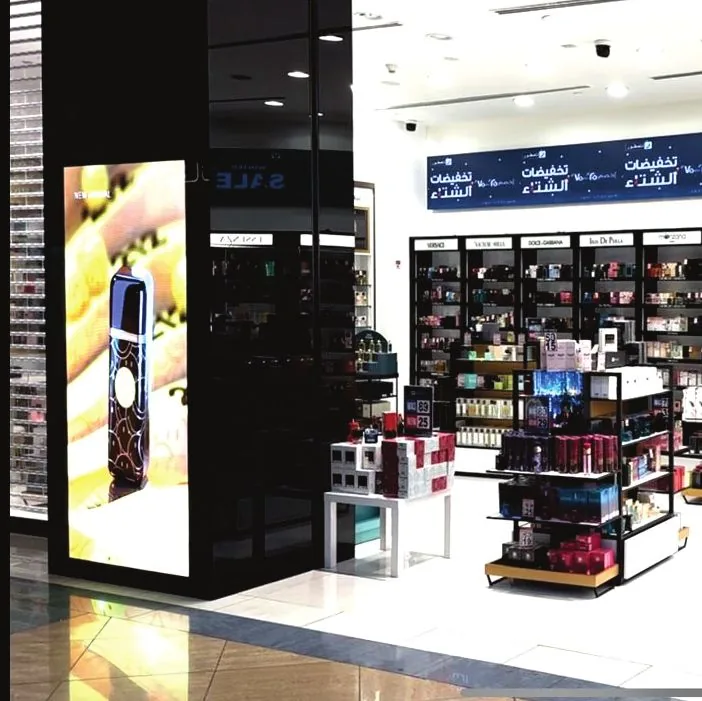
A shop window is the main use. A shopfront screen covers the glass with advertising while the goods and interior behind it stay visible from the street. The shop does not have to choose between a window and a screen. We built screens for the Lacoste and SuperStep stores in Mega Almaty (2025), the Sulpak Vivo brand zone in Dostyk Plaza (2023) and the Adidas chain in Almaty (2025) — wherever the shop glass works as an advertising surface, mesh removes the problem of a darkened floor.
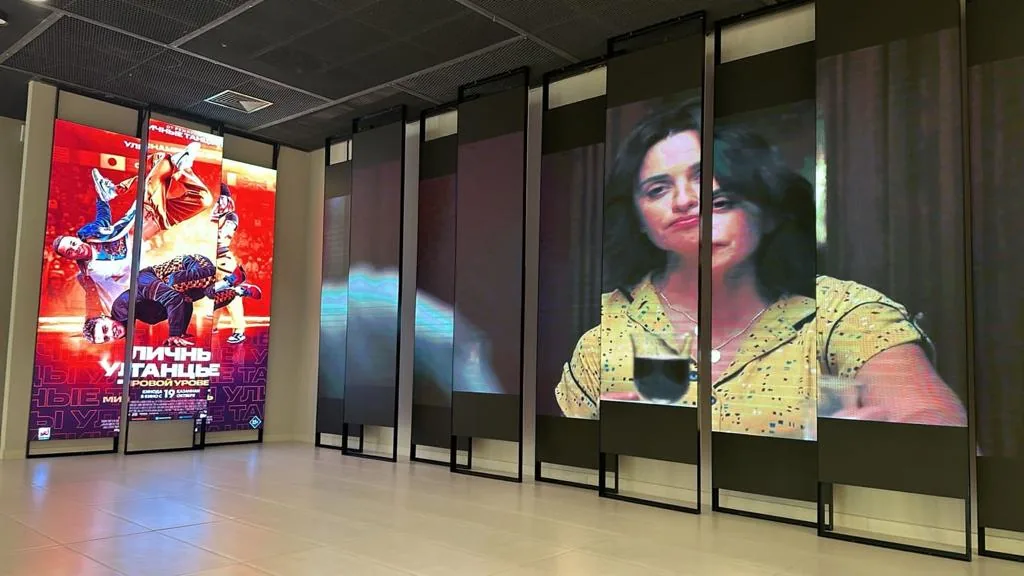
The glass facade of a business centre or a mall atrium is the second use: a screen across all the glazing without the building going dark. A screen in a car showroom is the third: the huge window becomes a screen and the cars behind it stay in view. In every case installation is from inside, behind the glass, with front or rear service — whichever suits the site.
Mesh cabinets stack to any size in 500 mm steps in height and 1,000 mm steps in width. Cabinet orientation is fixed by the design: the LED strips are always horizontal, and rotation is not provided for. We draw the layout for the specific opening in the commercial proposal.
Mesh or a regular screen in a shop window
A regular indoor P2.5 screen gives 160,000 pixels per square metre and a photorealistic picture, but it is solid: the window becomes a wall and no daylight reaches the floor. A mesh screen trades some density for transparency and light weight. If you need the window as a window with advertising on top, choose mesh. If the only task is to show video in maximum detail and the glass does not matter, choose a regular screen.
There is a third option we use in shopping malls: mesh on the window plus a dense screen inside the floor. The outside advertising stays transparent, and detailed content is shown where the shopper is already standing two metres away.
What the supply includes and how we deliver across Kazakhstan
A mesh screen supply includes aluminium 1000×1000 and 1000×500 mm cabinets with modules, power supplies and receiving cards installed — cards, power and the fixing system are already in the price per square metre — a video processor, cabling, installation on glazing or a facade without a heavy frame, brightness tuning for the shop window and documents: passport, wiring diagram, acts and warranty card. The electrical specification is issued before installation.
We ship from our Almaty warehouse and across Kazakhstan by freight company with the crew travelling to site. The mesh is light and needs no massive substructure, so installation on shop-window glazing is faster than a facade screen. Cabinet layout for your glass panes, timing and delivery cost are fixed in the contract after a survey or from photos and dimensions of the window.
How the project goes
- 1
Enquiry and measurement
You send the glazing dimensions and photos of the window or facade. In Almaty we visit the site: we measure the opening, frames, suspension and power points, and check the distance the screen is viewed from.
- 2
Model selection and layout
We choose P2.6 × 5.2 or P3.91 × 7.82 by distance and content and draw the layout of 1000×1000 and 1000×500 mm cabinets for the opening. We calculate resolution, power and weight.
- 3
Commercial proposal and contract
Within a day we send a proposal with specification, layout drawing and schedule. Once agreed, we sign the contract and, if needed, prepare documents for the landlord or management company.
- 4
Delivery and site preparation
We supply cabinets, controller and power supplies from our Almaty warehouse or to order. In parallel we fit the profile or suspension behind the glass and bring power to the connection point.
- 5
Installation and set-up
Our own crew assembles the screen behind the glass, connects the control system and calibrates brightness to the window lighting. We load the first content, train a shop employee and hand over documents and warranty.
What the price depends on
At KazLedPro indoor screens start from 260,000 ₸ per m² and outdoor screens from 300,000 ₸ per m². On the Kazakhstan market a square metre of LED screen costs roughly between 180,000 and 1,500,000 ₸: the lower end is a coarse pitch for outdoor use, the upper end a fine-pitch screen for a studio or meeting room. This is a market reference, not our price list: the exact figure is calculated from your dimensions and scope of work. The price of a mesh screen depends above all on the model and area: P2.6 × 5.2 has twice as many pixels per metre as P3.91 × 7.82. We calculate an exact estimate from the glazing dimensions — the calculator on the site gives a guide, and a commercial proposal with a layout is ready within a day.
Model and pixel pitch
P2.6 × 5.2 with 73,728 pixels per metre costs more than P3.91 × 7.82 with 32,768. For distant viewing there is no point paying for density; for a window viewed up close there is.
Area and layout
1000×1000 and 1000×500 mm cabinets are stacked to the opening; the larger the area, the smaller the share of controller and installation in the cost per square metre.
Mounting method
A profile on the frame, a suspension from the ceiling or a separate frame behind the glass. A light screen needs no structural frame, but the fixing detail depends on the window construction.
Power and control
Average power 240 W/m², maximum 800 W/m². A controller, a video processor when working with several sources, cable routes to the power point.
Service and warranty
Equipment warranty is 2–5 years depending on the model. A stock of spare modules and a service contract with scheduled inspections are priced separately.
Questions and answers
How transparent is this screen really?
By datasheet, 70% for P2.6 × 5.2 and 65% for P3.91 × 7.82: that is how much light passes through the mesh. From inside the shop you see the street; from outside you see the goods behind the screen when it is off or showing light content. With bright video the eye from the street focuses on the picture and the window behind it reads as background.
Can a mesh screen be hung on the outside of a building?
No. Both models are rated IP33 and are designed for installation indoors, behind glass, away from rain and snow. Brightness of 2,000–4,500 cd/m² is enough to work through glass on the sunny side. For open-air installation, look at outdoor screens rated IP68 or the transparent P31.25 and P50 media facades rated IP67.
What screen size can be assembled?
Any size in 500 mm steps in height and 1,000 mm steps in width: 1000×1000 and 1000×500 mm cabinets are set in rows. Cabinets cannot be rotated — the LED strips must stay horizontal. If the opening is not a multiple, the screen is made slightly smaller than the glass and the remainder is covered with a trim or left open.
How much does the screen weigh, and will the window take it?
A 1000×1000 mm cabinet weighs 7.5 kg, so a 3×2 m screen is about 45 kg including the profile. The load on the frame is small, but we usually fix to the ceiling or to a separate frame rather than to the glass. During the survey we look at the window construction and propose the fixing detail.
How much electricity does mesh use?
Average power is 240 W/m², maximum 800 W/m² on a white field at full brightness. A 6 m² screen in normal operation runs from a single circuit; the exact calculation and power diagram come with the commercial proposal. Brightness drops automatically at night and consumption falls with it.
How long is the wait, and how long does installation take?
A commercial proposal within a day. Cabinets in stock at our Almaty warehouse ship immediately; made-to-order items follow the delivery time written into the contract. Installing a screen on one shop window takes one or two days including connection and set-up; the work can be done at night so the shop does not close.
What about warranty and repairs?
Equipment warranty is 2–5 years depending on the model, and LED lifespan is 100,000 hours. A 500×125 mm module is replaced individually, from the front or the rear, without taking the screen apart. We keep spare modules at our warehouse in Almaty; a service engineer visits within the city the same or the next day.
Do you work in other cities?
Yes, we have installed screens in Astana, Karaganda, Aktobe, Turkistan and other cities of Kazakhstan. For a mesh screen the dimensions and photos of the window are enough — we prepare the layout and proposal remotely, then the crew travels for installation. Delivery and travel are added to the estimate as a separate line.
A turnkey screen: quote, installation, launch.
Send us the dimensions and location — a quote today. WhatsApp around the clock.