
Products
Flexible LED screens
A soft-backed module from 10 mm thick bends any way: columns, curves, waves, cylinders and whole compositions of them.
Where it goes
Columns in malls and airports
The screen wraps the whole column — advertising is visible from every side.
Waves and canopies
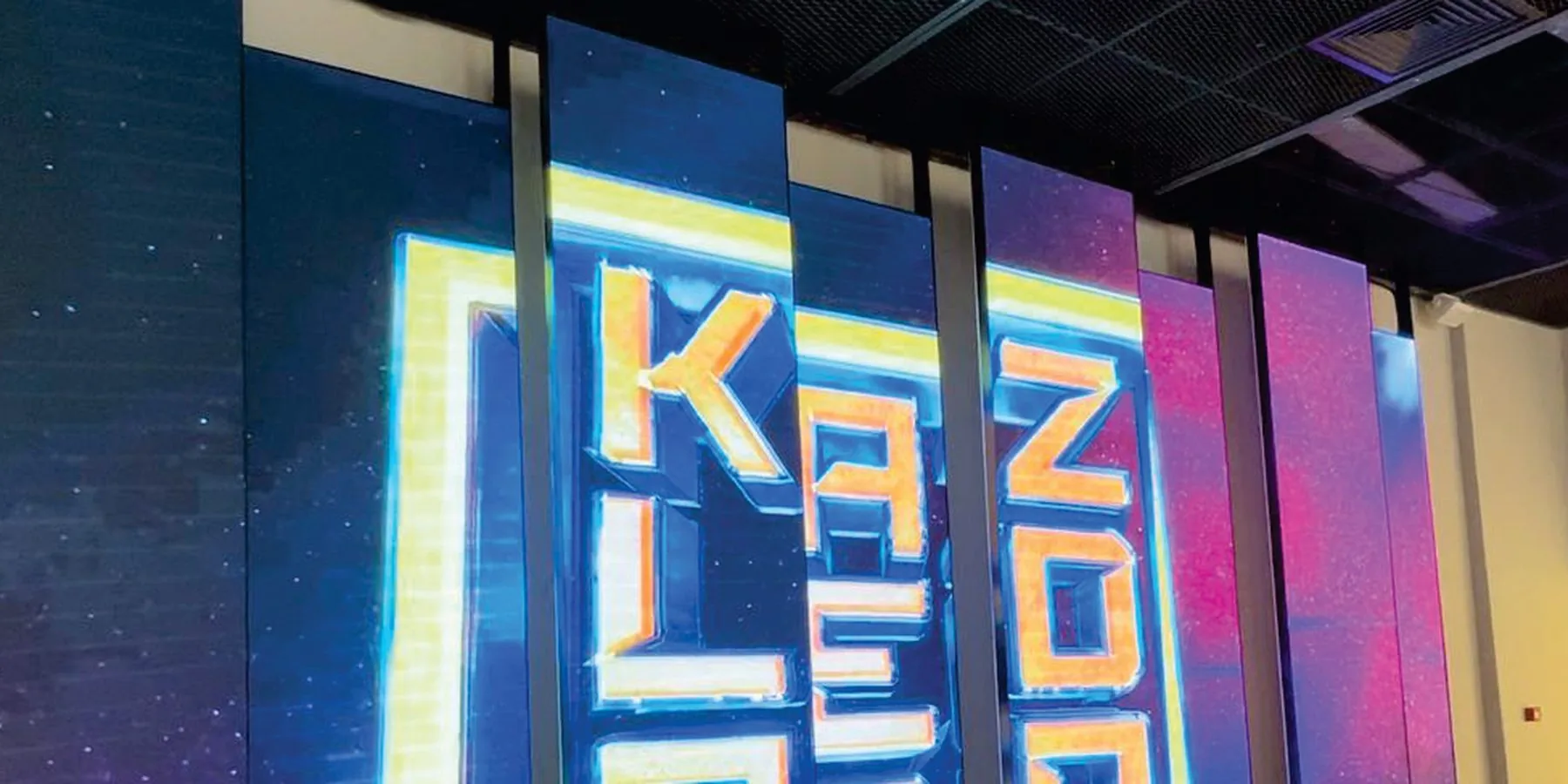
Ceiling installations impossible with rigid cabinets.
Shopfronts and stands
A curved screen along a window or around a stand.
Stage and shows
Cylinders and cubes for concerts and presentations.
Models from the price list
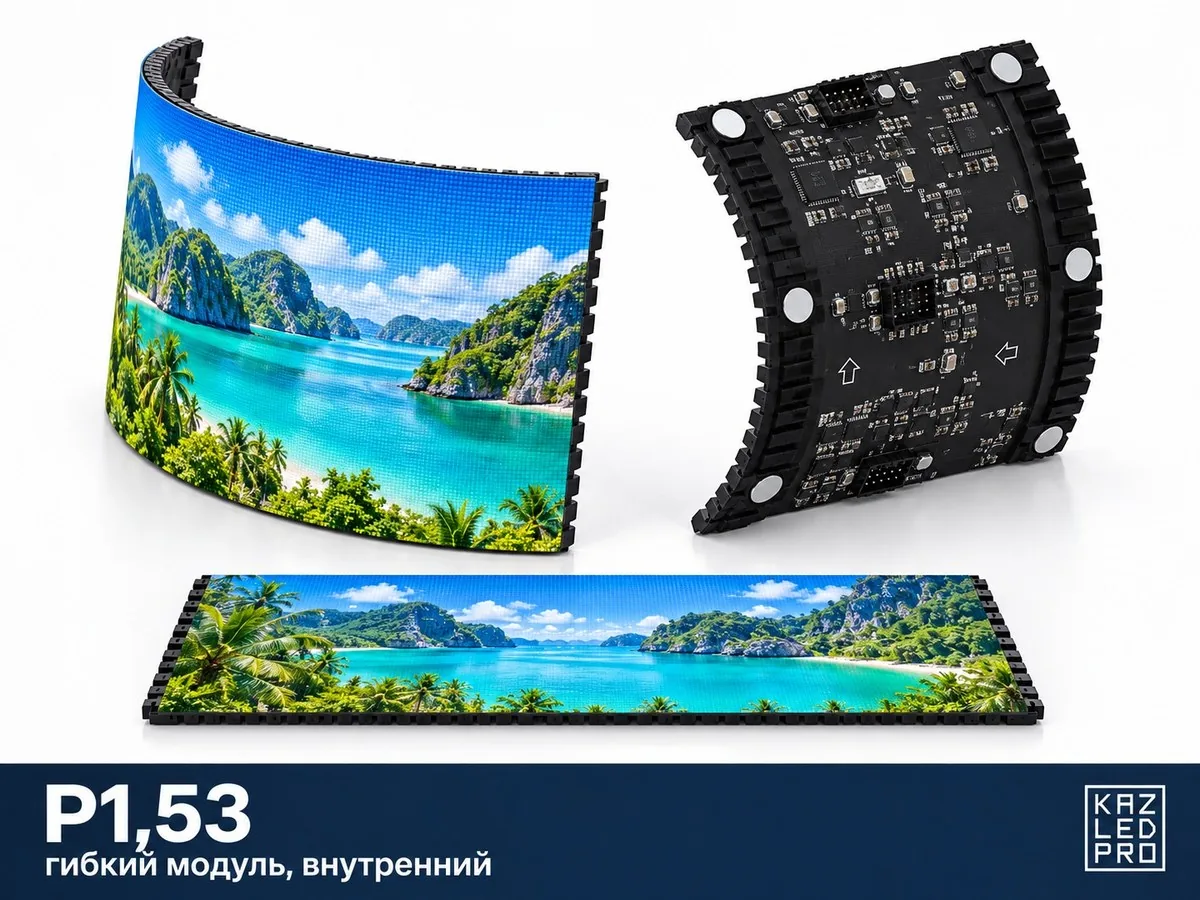 P1.53
P1.53Flexible displays
Flexible LED screen P1.53 for indoor use
Flexible module P1.53 for indoor use: bends to a radius, holds on magnets. Columns, waves and rounded façades.
- Brightness
- 350–400 cd/m²
- Density
- 422 500 dots/m²
- Protection
- IP 24
Details →
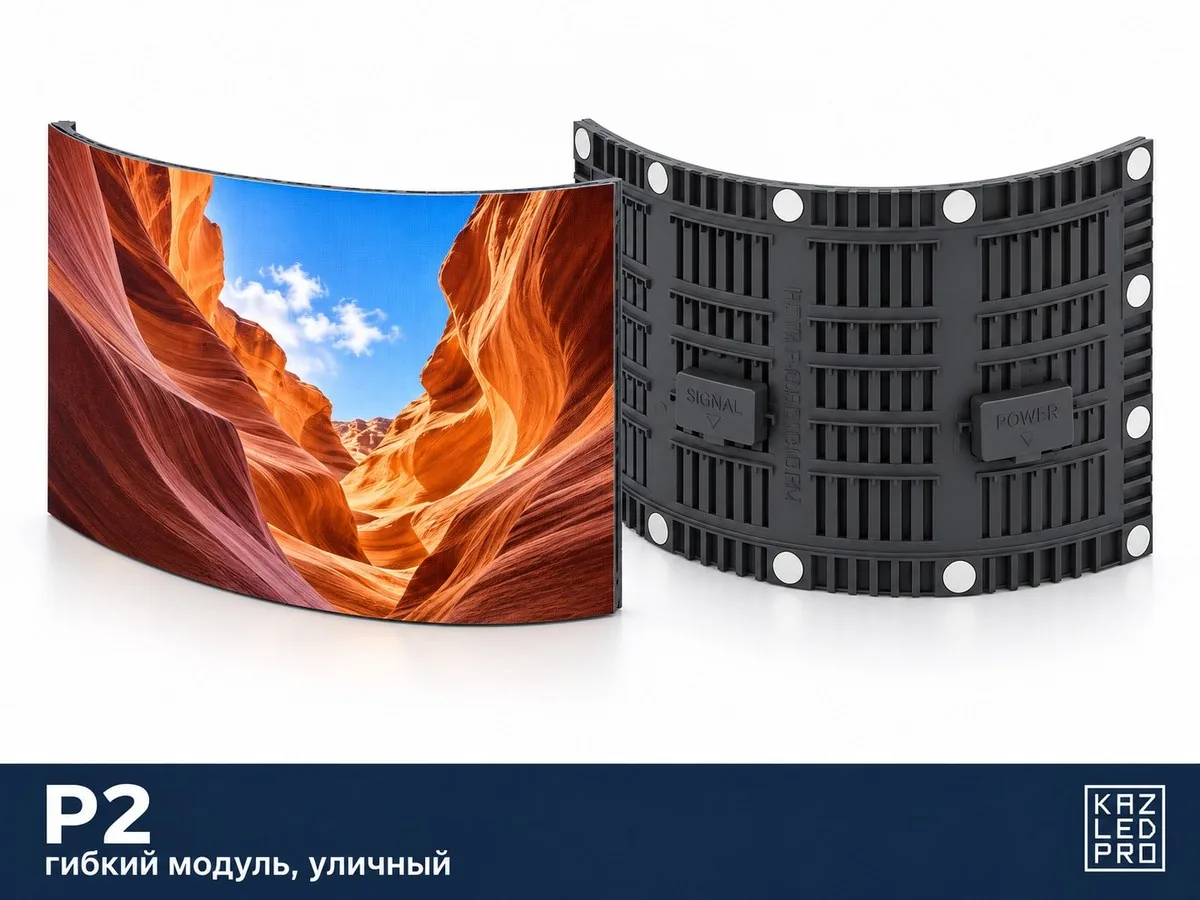 P2
P2Flexible displays
Flexible LED screen P2 for outdoor use
Flexible module P2 for outdoor use: bends to a radius, holds on magnets. Columns, waves and rounded façades.
- Brightness
- 5500–7800 cd/m²
- Density
- 250 000 dots/m²
- Protection
- IP 68
Details →
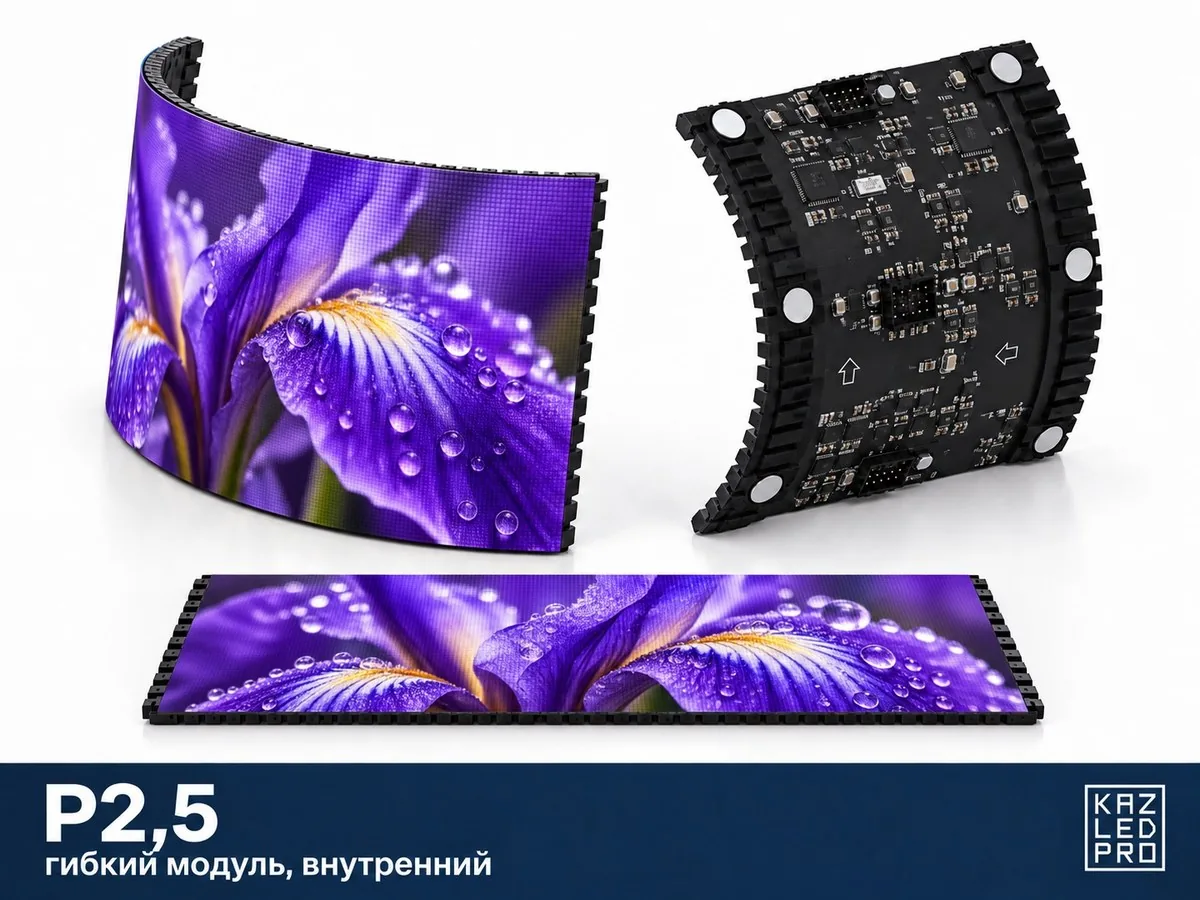 P2.5
P2.5Flexible displays
Flexible LED screen P2.5 for indoor use
Flexible module P2.5 for indoor use: bends to a radius, holds on magnets. Columns, waves and rounded façades.
- Brightness
- 350–550 cd/m²
- Density
- 160 000 dots/m²
- Protection
- IP 31
Details →
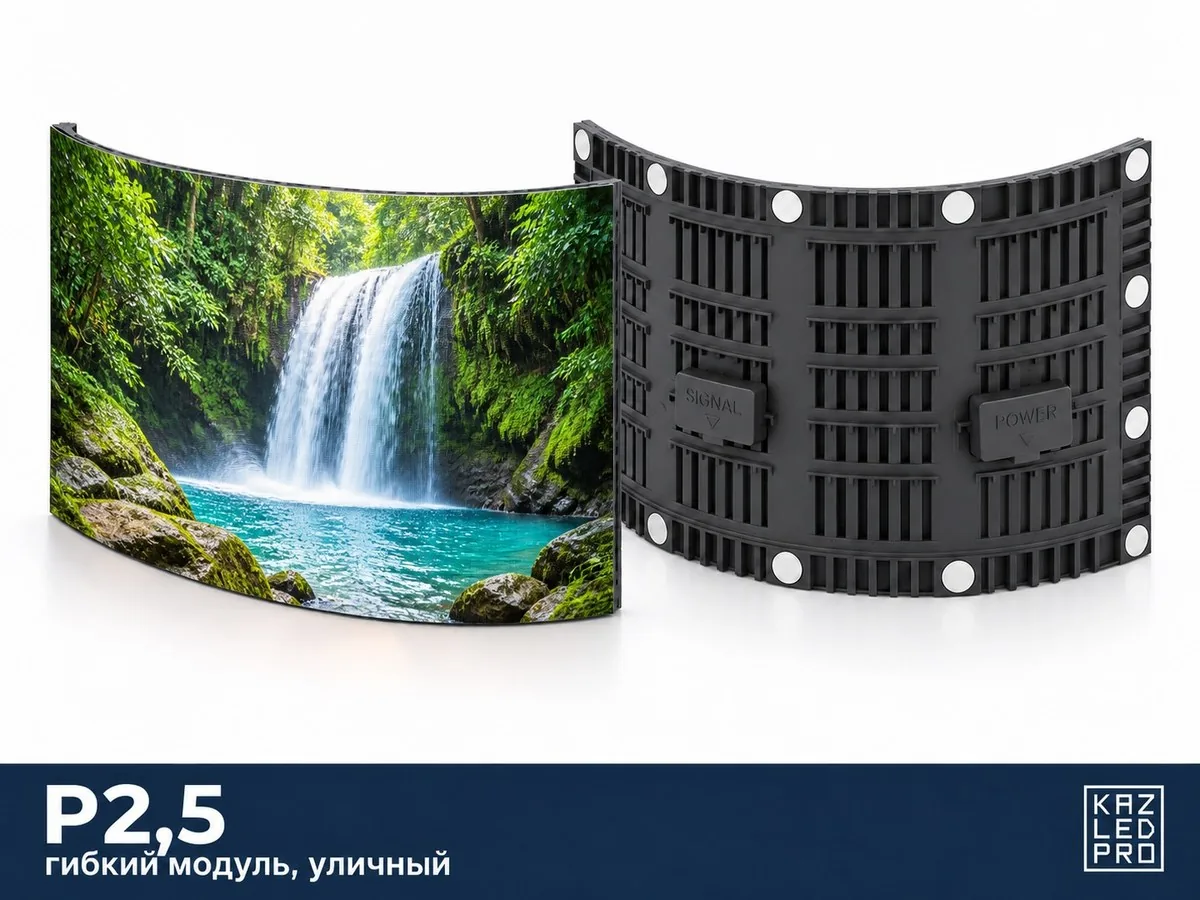 P2.5
P2.5Flexible displays
Flexible LED screen P2.5 for outdoor use
Flexible module P2.5 for outdoor use: bends to a radius, holds on magnets. Columns, waves and rounded façades.
- Brightness
- 5500–7800 cd/m²
- Density
- 160 000 dots/m²
- Protection
- IP 68
Details →
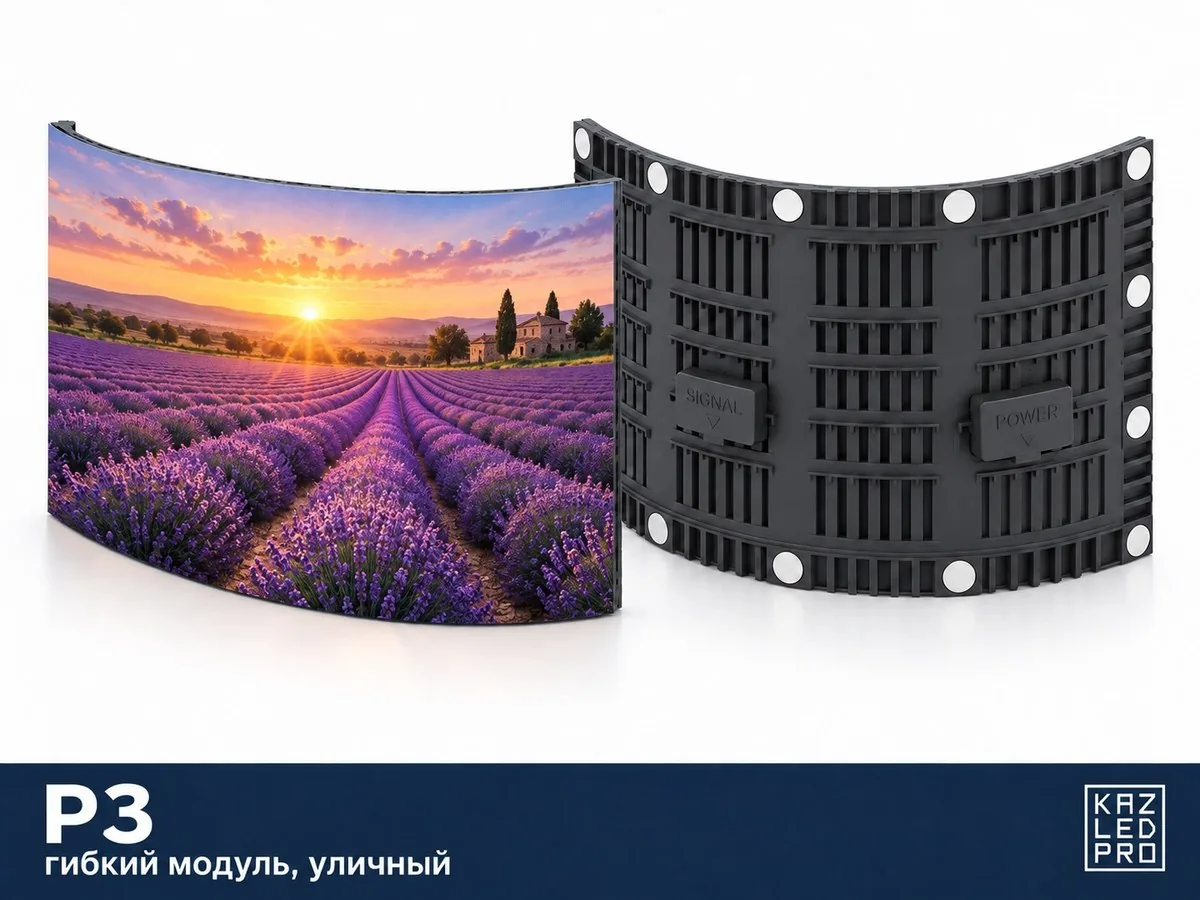 P3
P3Flexible displays
Flexible LED screen P3 for outdoor use
Flexible module P3 for outdoor use: bends to a radius, holds on magnets. Columns, waves and rounded façades.
- Brightness
- 5500–7800 cd/m²
- Density
- 105 625 dots/m²
- Protection
- IP 68
Details →
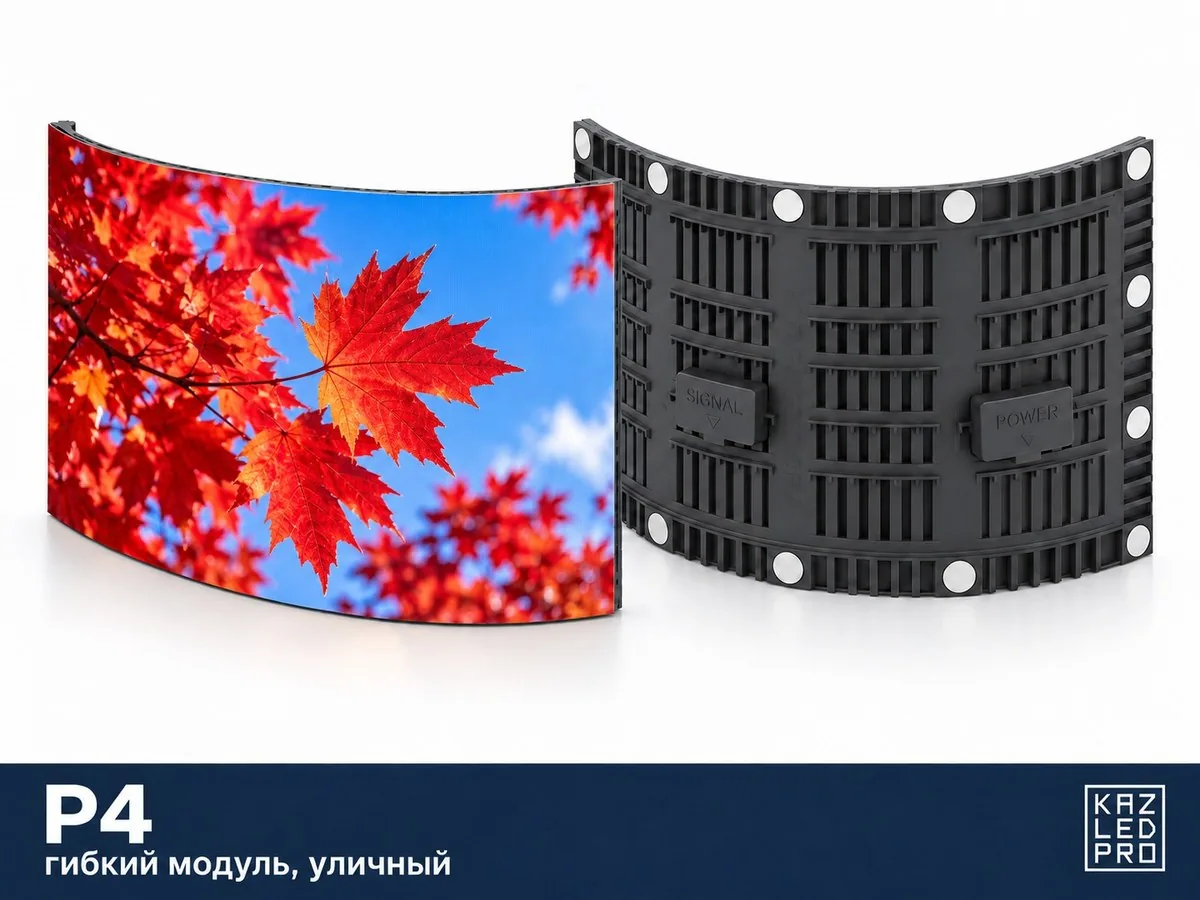 P4
P4Flexible displays
Flexible LED screen P4 for outdoor use
Flexible module P4 for outdoor use: bends to a radius, holds on magnets. Columns, waves and rounded façades.
- Brightness
- 5500–7800 cd/m²
- Density
- 62 500 dots/m²
- Protection
- IP 68
Details →
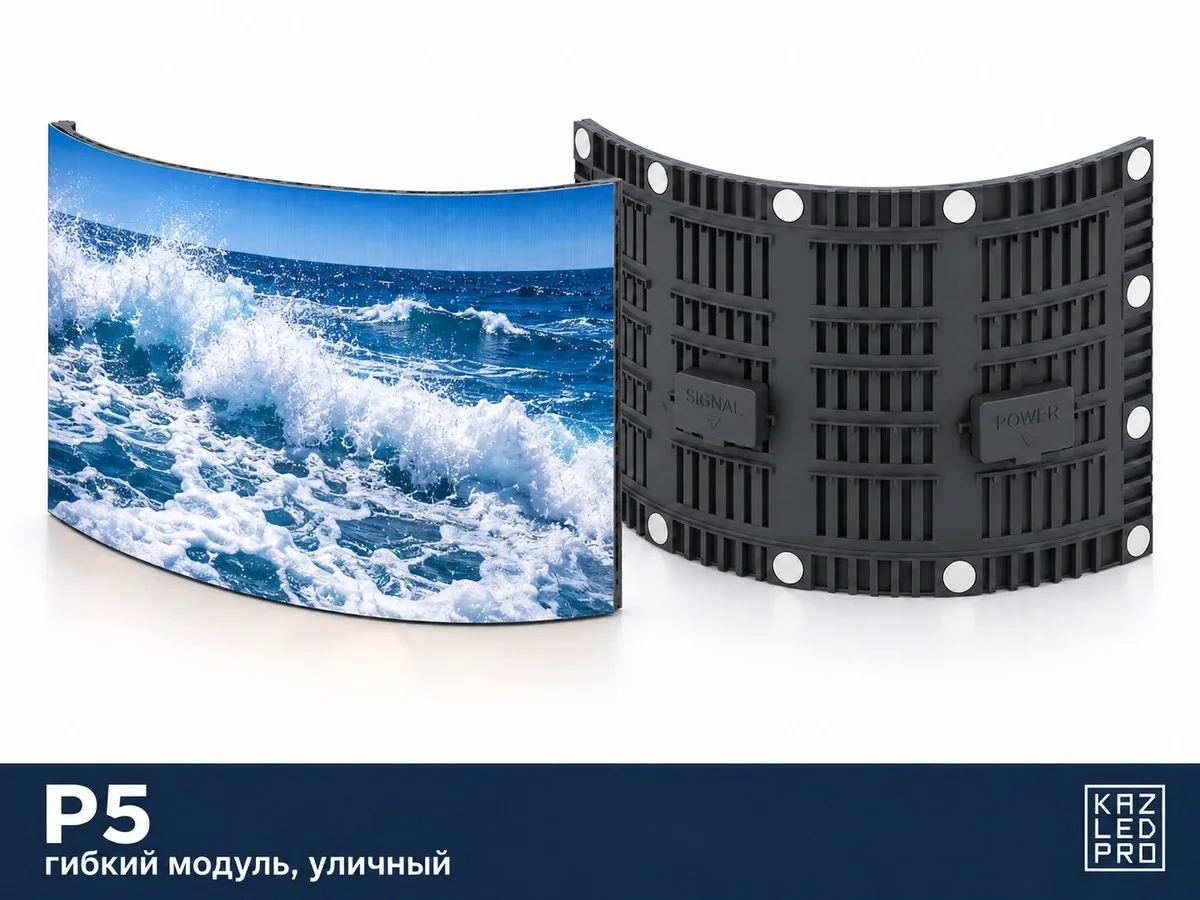 P5
P5Flexible displays
Flexible LED screen P5 for outdoor use
Flexible module P5 for outdoor use: bends to a radius, holds on magnets. Columns, waves and rounded façades.
- Brightness
- 5500–7800 cd/m²
- Density
- 40 000 dots/m²
- Protection
- IP 68
Details →
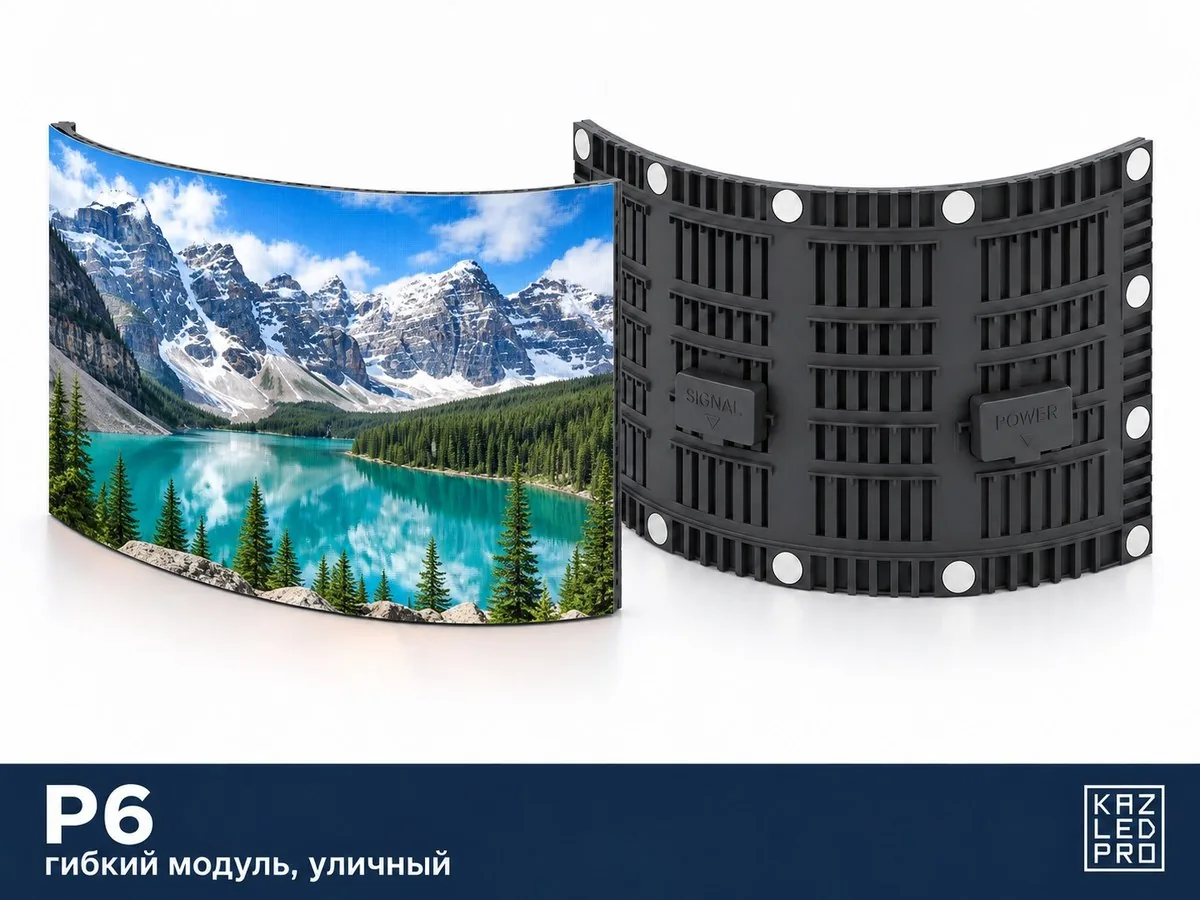 P6
P6Flexible displays
Flexible LED screen P6 for outdoor use
Flexible module P6 for outdoor use: bends to a radius, holds on magnets. Columns, waves and rounded façades.
- Brightness
- 5500–7800 cd/m²
- Density
- 22 500 dots/m²
- Protection
- IP 68
Details →
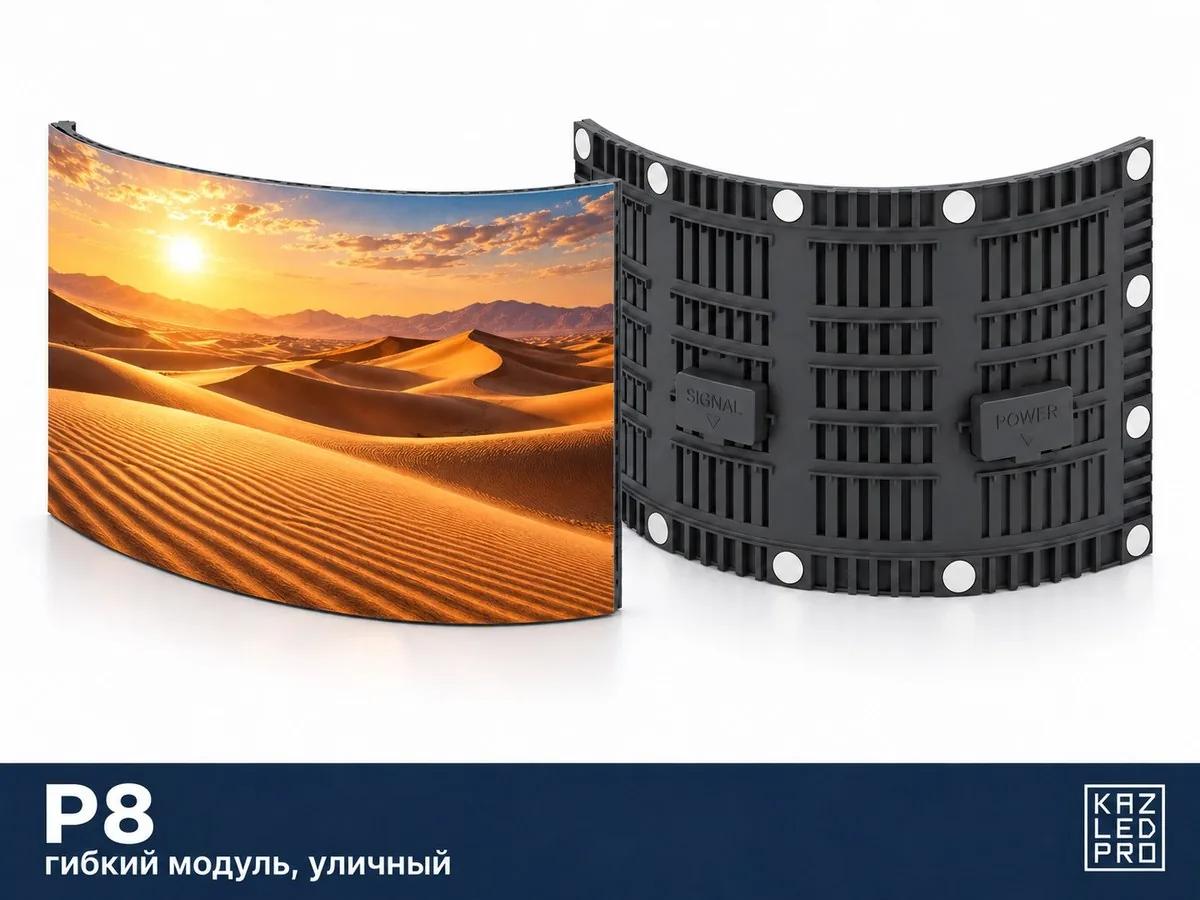 P8
P8Flexible displays
Flexible LED screen P8 for outdoor use
Flexible module P8 for outdoor use: bends to a radius, holds on magnets. Columns, waves and rounded façades.
- Brightness
- 5500–7800 cd/m²
- Density
- 15 625 dots/m²
- Protection
- IP 68
Details →
Why this type
Any radius
Convex and concave shapes, minimum radius from 15 cm.
From 10 mm thick
Takes no volume and barely protrudes from the surface.
Magnetic mounting
Modules are held by magnets and come off the front without dismantling.
Three module series
240×120, 320×160 and 256×128 mm — for the radius and pitch you need.
Why an LED display
Warranty of up to 5 years
On screens of our own manufacture and on the equipment we supply.
Brightness control
Different by day and by night — the screen does not dazzle or flood windows with light, and consumption drops.
Service without dismantling
Front, rear or mixed — the module comes off and the structure stays in place.
Round-the-clock operation
LED life of 50–100 thousand hours in continuous use.
Vandal-resistant build
For places where the screen is within arm's reach.
Any shape and size
The screen is assembled from modules, so the dimensions fit the opening and the shape fits the task.
Wide temperature range
Outdoor models operate from −30 to +50 °C.
Installation on any surface
Brick, concrete, glass, an aluminium facade, a free-standing pylon or a roof.
Why flexible rather than rigid
A flexible module is built on a soft rubber base with a flexible board. That is where the design features a rigid screen does not have come from.
Thickness from 10 mm
The panel barely stands off the wall and does not eat into the room.
Bends either way
Convex and concave screens, cylinders, spheres, pyramids, obelisks, cubes — and whole compositions built from them.
Light mounting
The low weight removes the need for heavy fixings: the screen is strapped to the wall or hung on a metal frame.
Magnetic service
Strong magnets hold the module — it never works loose or falls, and it comes off the front without dismantling the structure.
Extends and adapts
Modular assembly lets the screen grow into a video wall or shrink to the size of the surface.
Three module series
Flexible modules of 240×120, 320×160 and 256×128 mm — for the radius and the pitch you need.
A flexible LED screen is a canvas of soft-backed modules from 10 mm thick that bends to a radius from 15 cm and is held by magnets. A rigid cabinet cannot follow a column, a wave or a rounded corner, while a flexible module lies along the shape of its base and the image stays continuous, with no frames or seams. The KazLedPro catalogue has nine flexible models: P1.53 and P2.5 for interiors and P2, P2.5, P3, P4, P5, P6.67 and P8 for outdoor use.
These screens go where the surface is not flat: columns in shopping centres and airports, ceiling waves and canopies, curved shopfronts, cylinders and cubes on stage, rounded facades. We have worked since 2012, assemble screens in Almaty and install them with our own crew across Kazakhstan; the frame for the required radius is designed and welded by us. Below: how a flexible canvas is put together, which pitches are available, where we have already done it, and what we need from you for a calculation.
How a flexible module is built
An ordinary module sits on a rigid board inside an aluminium cabinet. A flexible one has a soft backing and recessed LED packages, so the canvas bends both outwards and inwards: the minimum radius is 15 centimetres, enough to wrap a column about a third of a metre across. A thickness from 10 mm takes almost no space — the screen lies on the surface instead of protruding as a box. Mounting is magnetic: a module sits on a prepared base and comes off the front, without removing its neighbours and without access from behind. For a column or a ceiling wave that is the only practical way to service it.
The shape is set by the base, not by the module, so a flexible screen project always starts with the frame: an arc, cylinder, wave or cone is built from profile to the calculated radius, and the canvas follows it. Modules come in three series — 240×120, 320×160 and 256×128 mm: the smaller the module, the more smoothly it describes a tight arc and the fewer faceted sections show on the bend.
- Radius from 15 cm, convex and concave bending.
- Canvas from 10 mm thick, magnetic mounting and front servicing.
- Three module series: 240×120, 320×160 and 256×128 mm — for the radius and pitch required.
- Module weight 380–487 g, roughly 7.5–9.5 kg per square metre of canvas without the frame.
Nine models: two pitches indoors, seven outdoors
Indoors we use P1.53 and P2.5. The first packs 422,500 pixels per m² at 350–400 cd/m² with IP24 protection — the pitch for a column in a lobby or atrium that people walk right past. The second has 160,000 pixels per m², 350–550 cd/m² and IP31; it is used for stage arcs and large interior installations, with a comfortable viewing distance from about 2.5 metres. Both run at 3,840 Hz and above, so they show no banding on camera or on a phone, and are rated for −20…+40 °C.
Outdoors there are seven pitches, from P2 to P8. All outdoor flexible models deliver 5,500–7,800 cd/m², are sealed to IP68 and work from −40 to +50 °C, drawing 650 W/m² at peak and 220 W/m² on average. The pitch follows the distance: a rounded building corner by the pavement takes P2–P3, a round canopy column or a facade wave seen from the road takes P5–P8. Density ranges from 250,000 pixels per m² at P2 down to 15,625 at P8, and the price per metre moves with it.
Malls, airports, stages: where this works
Our largest flexible job is the Shokan Ualikhanov private school in Almaty, June 2023: a 120 m² canvas at P2.5 for the stage of the assembly hall. The point was the shape — the screen had to follow the architecture of the hall and curve along the wall rather than stand as a flat rectangle in the middle. P2.5 was chosen because of the front rows: children sit close to the stage and would see individual pixels at a coarser pitch. The screen runs assemblies, concerts, presentations and a camera feed.
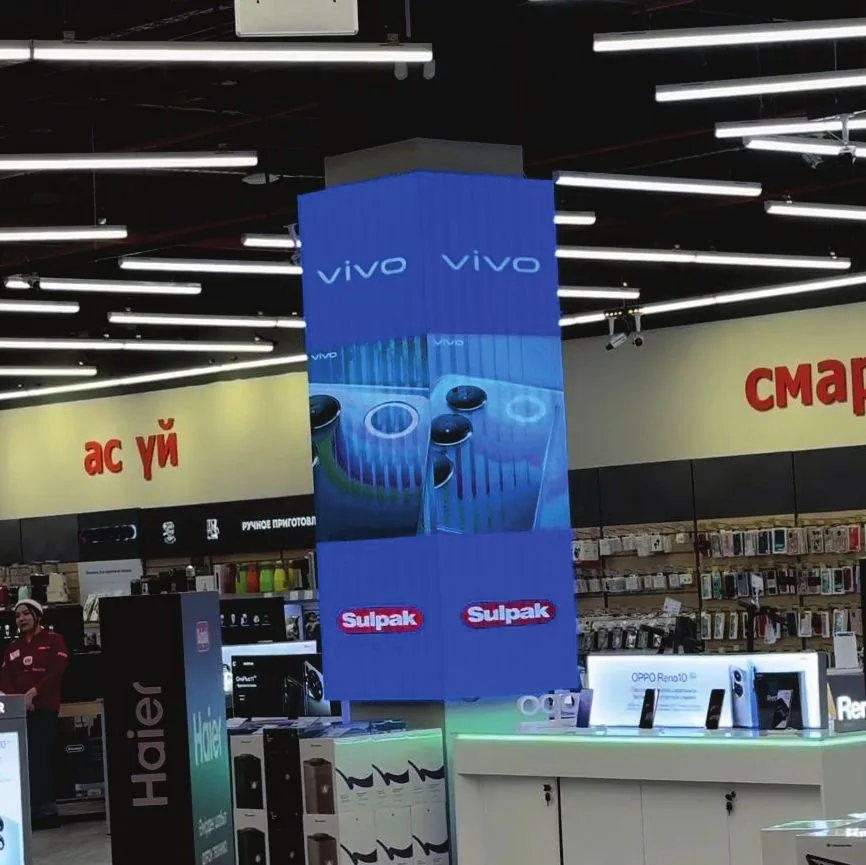
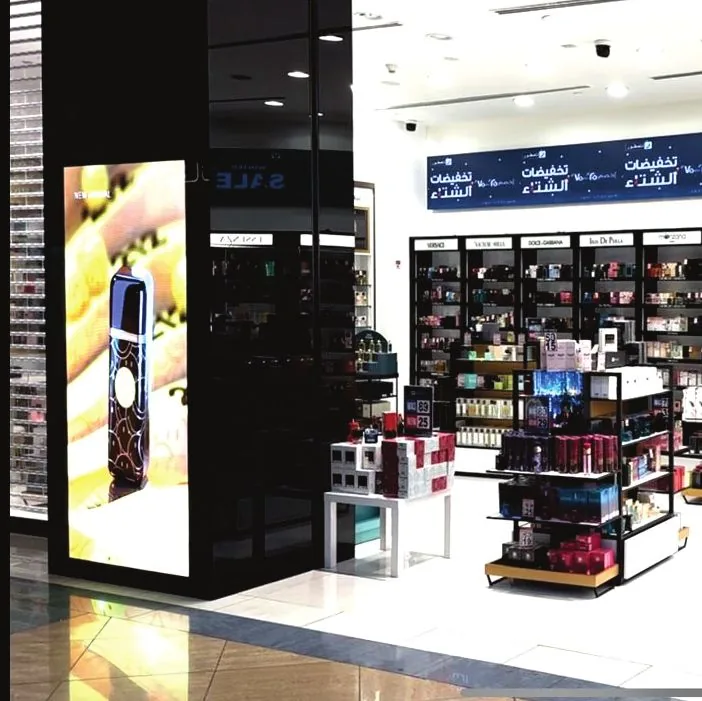
The other frequent customer is retail and transport hubs. A column in a mall gallery or a departure hall works as an advertising pillar with a 360-degree view: the screen wraps it completely and the clip is visible from any side. We have long worked in such places: the Vivo brand zone at Sulpak in Dostyk Plaza (P2.5, 14 m², 2023), the Lacoste, Adidas and SuperStep stores in Mega Almaty, Aport Mall (P3, 64 m², 2023), FORUM mall (48 m², 2023), the V PERFUMES boutique in Al Wahda Mall in Abu Dhabi (2023) and the arrivals hall of Karaganda airport (2020).
- Columns and pillars in mall galleries, airports and railway stations.
- Ceiling waves, canopies and arches above an entrance.
- Curved shopfronts, reception desks, rounded counters and stands.
- Stage arcs, cylinders and cubes for concerts and presentations.
What we need to price a curved screen
A flat screen needs two dimensions; a curved one needs a shape. For a column that is the diameter and the height of the wrap, for an arc the radius and the length along it, for a wave the pitch and amplitude — ideally with photos of the site and an unrolled elevation from the designer if an interior project already exists. From that we lay the canvas out in modules, calculate the resolution along the developed surface, the power and the number of receiving cards, and then design the base: profile bent to the radius, fixing points, trunking and the power feed.
Honestly about the limits. A flexible module costs more than a rigid one at the same pitch and area — you pay for the freedom of shape, so in a large project the flat sections are usually built from ordinary modules and only the bends from flexible ones. A very tight radius makes no sense at a coarse pitch: at P8 the pixels are sparse and the image falls apart on a small arc before the structure even bends. And the base must be rigid — a soft module reproduces every irregularity of the frame, which is why we calculate and weld the frame ourselves.
How the project goes
- 1
Enquiry and shape
Send photos of the site and the dimensions: column diameter, arc radius or wave profile, canvas height. If an interior project exists, the designer's unrolled elevation makes the layout more precise.
- 2
Layout and quote
We lay the canvas out in modules, calculate resolution along the developed surface, power, cards and processor, and match the pitch to the distance. A proposal with specification is sent within a day.
- 3
Base and frame
We design and weld the frame in Almaty to the calculated radius with fixing points and cable trunking, and issue the electrical specification. The customer brings power to the points.
- 4
Installation and setup
We erect the frame, build the canvas from magnet-mounted modules with shape and seam control, run power and signal, configure the processor and calibrate brightness and colour.
- 5
Handover and service
Acceptance act, passport with serial numbers, video report, operator training. Warranty of 2–5 years depending on the model; spare modules for your screen are kept in Almaty.
What the price depends on
At KazLedPro indoor screens start from 260,000 ₸ per m² and outdoor screens from 300,000 ₸ per m². On the Kazakhstan market a square metre of LED screen costs roughly between 180,000 and 1,500,000 ₸: the lower end is a coarse pitch for outdoor use, the upper end a fine-pitch screen for a studio or meeting room. This is a market reference, not our price list: the exact figure is calculated from your dimensions and scope of work. The price of a flexible screen depends on pitch, canvas area, complexity of the shape and the base beneath it: a column in a lobby and a wave under the ceiling cost differently at the same area. We calculate an exact quote for your dimensions and shape: the calculator on the site shows resolution and layout, and the proposal is ready within a day.
Pixel pitch
Between P1.53 and P8 the number of LEDs differs many times over. The pitch is set by the nearest viewer: a fine pitch for a gallery column, a coarse one for a facade arc by the road.
Area and developed surface
What counts is not the projection but the length of the canvas along the curve: wrapping a column or unrolling a wave almost always gives more area than the floor plan suggests.
Complexity of the shape
A simple arc costs less than a cylinder, and a cylinder less than a wave with a varying radius. The shape drives both the module layout and the amount of steelwork.
Base and installation
Profile bent to radius, fixing points, ceiling suspension or a wrap around a column mean different steel and different hours. Height adds lifting equipment.
Outdoor or indoor version
Outdoor flexible models at 5,500–7,800 cd/m² with IP68 cost more than the indoor P1.53 and P2.5, but they hold −40…+50 °C and the weather all year round.
Electrics, control and service
The video processor, receiving cards, power lines, operator training and warranty service are separate lines so that the quote is clear before signing.
Questions and answers
What is the tightest radius a module can take?
From 15 centimetres, which is enough to wrap a column about a third of a metre across or to build a tight cylinder on stage. It bends both ways, convex and concave. The smaller the module series, the more smoothly a tight arc is described: 240×120 mm shows fewer faceted sections on a bend than 320×160 mm.
How does a flexible screen differ from an ordinary one, and does it cost more?
The LED technology and the picture are the same; the difference is the base — a soft backing instead of a rigid board in a cabinet, magnets instead of a frame. At equal pitch and area a flexible canvas costs more, so in a large project the bends are flexible and the flat sections ordinary. We show the difference as two lines in the proposal.
Can a flexible screen be installed outdoors?
Yes, there are seven outdoor pitches from P2 to P8: 5,500–7,800 cd/m², IP68 protection and an operating range of −40…+50 °C. Such canvases go on rounded building corners, round canopy supports and facade waves. The base for an outdoor screen is calculated for wind and snow load just like a normal facade frame.
How much does a flexible screen weigh and will a column take it?
A 320×160 mm module weighs 380–487 grams, roughly 7.5–9.5 kg per square metre of canvas before the frame and power supplies. For comparison, a finished cabinet screen weighs 30–60 kg per metre. The load on the column or ceiling is calculated when we design the base and agreed with the building operator where needed.
Which pitch should we choose for a column in a mall?
Look at the distance people view the column from in the gallery. If they pass a metre or two away, take P1.53: 422,500 pixels per m² and no visible grain. If the column stands in an atrium and is seen from three to five metres, P2.5 is enough and noticeably more economical for the same perceived quality.
How is a curved screen maintained?
Modules are held by magnets and come off the front, so nobody has to climb behind the column or into the ceiling: a faulty module is replaced on site in minutes. Spare modules for your screen are kept in the Almaty warehouse. The warranty is 2–5 years depending on the model, and screen status is visible in the control software.
How long does such a project take?
Longer than a flat one. The canvas itself goes up quickly; the time goes into the shape — surveying, layout and fabricating the frame to the radius. For a typical column or arc that is usually two to three weeks from contract, and longer for a complex wave with a varying radius. The exact term is fixed after the survey.
Do you work in other cities of Kazakhstan?
Yes. Our travelling crew has installed screens in Astana, Karaganda, Aktobe, Taraz, Taldykorgan, Turkestan and Kokshetau, and among projects abroad there are shopping centres in Dubai and Abu Dhabi. For curved shapes we normally survey on site: unrolling a column or a wave from photographs is harder than measuring a flat wall.
A turnkey screen: quote, installation, launch.
Send us the dimensions and location — a quote today. WhatsApp around the clock.