
Solutions
LED screens for stages and concert halls
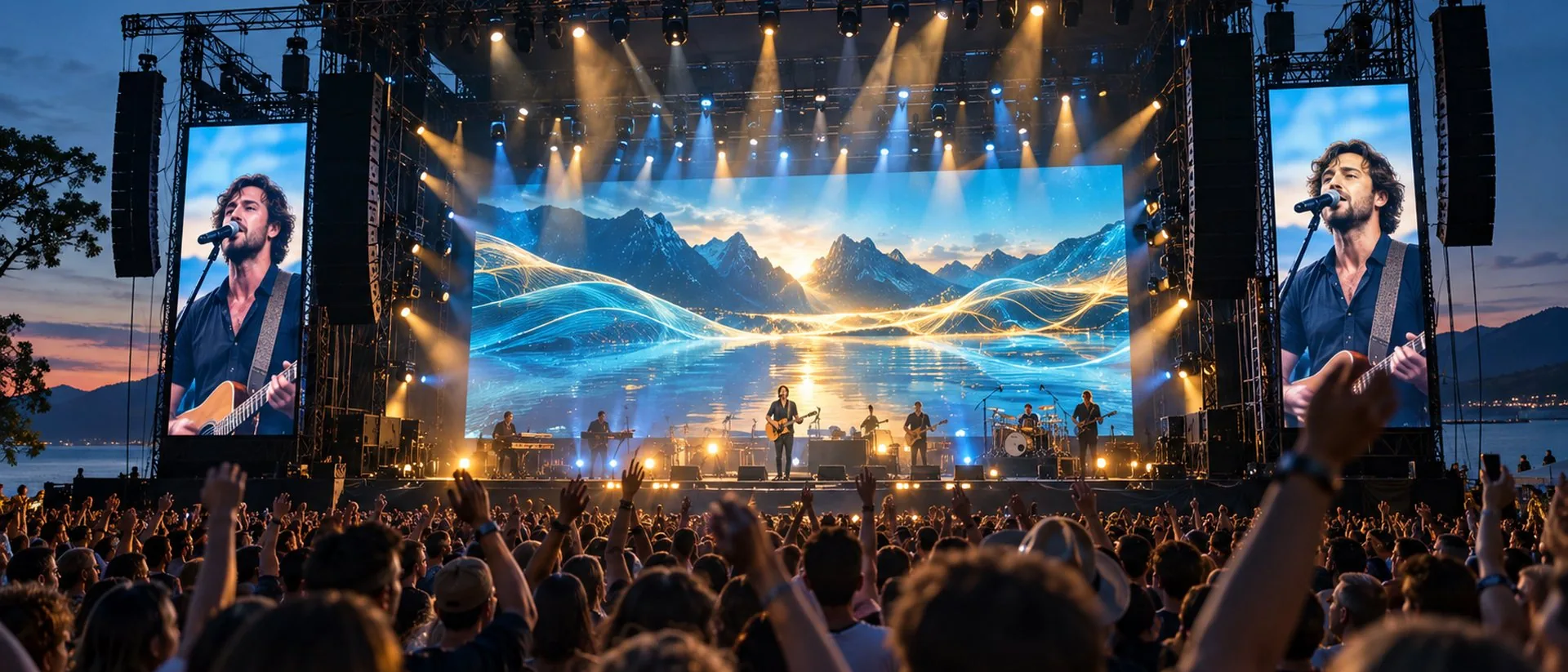
A screen for the stage of an assembly hall, house of culture or concert venue — to own, installed on truss or in the portal; for a single event the same screen can be rented.
A stage screen is built from 500×1000 mm lock cabinets: any size in half-metre steps, even seams, tool-free assembly. Indoor P1.95–P3.91, outdoor P3.91 at 5,500–7,800 cd/m². Halls, houses of culture and schools buy such cabinets into their own inventory.
The package includes a video processor, cabling, truss or a portal frame and installation by our crew; light and sound go under the same contract. This is how the Zhansugurov Palace of Culture in Taldykorgan, the Aksay House of Culture and school assembly halls in Almaty are equipped.
If the screen is needed for one evening — rental with a technician in Almaty.
The scene visualisation is generated; the project photos below are real.
What matters here
- 1
500×1000 lock cabinets
Any size in half-metre steps, tool-free assembly.
- 2
Everything for the stage included
Processor, cabling, truss or frame, installation, light and sound.
- 3
Rental — for a single event
The same screen with a technician in Almaty if you do not need to buy.
Which screens fit
Projects with such screens
Models from the price list
 P2.9
P2.9Indoor displays
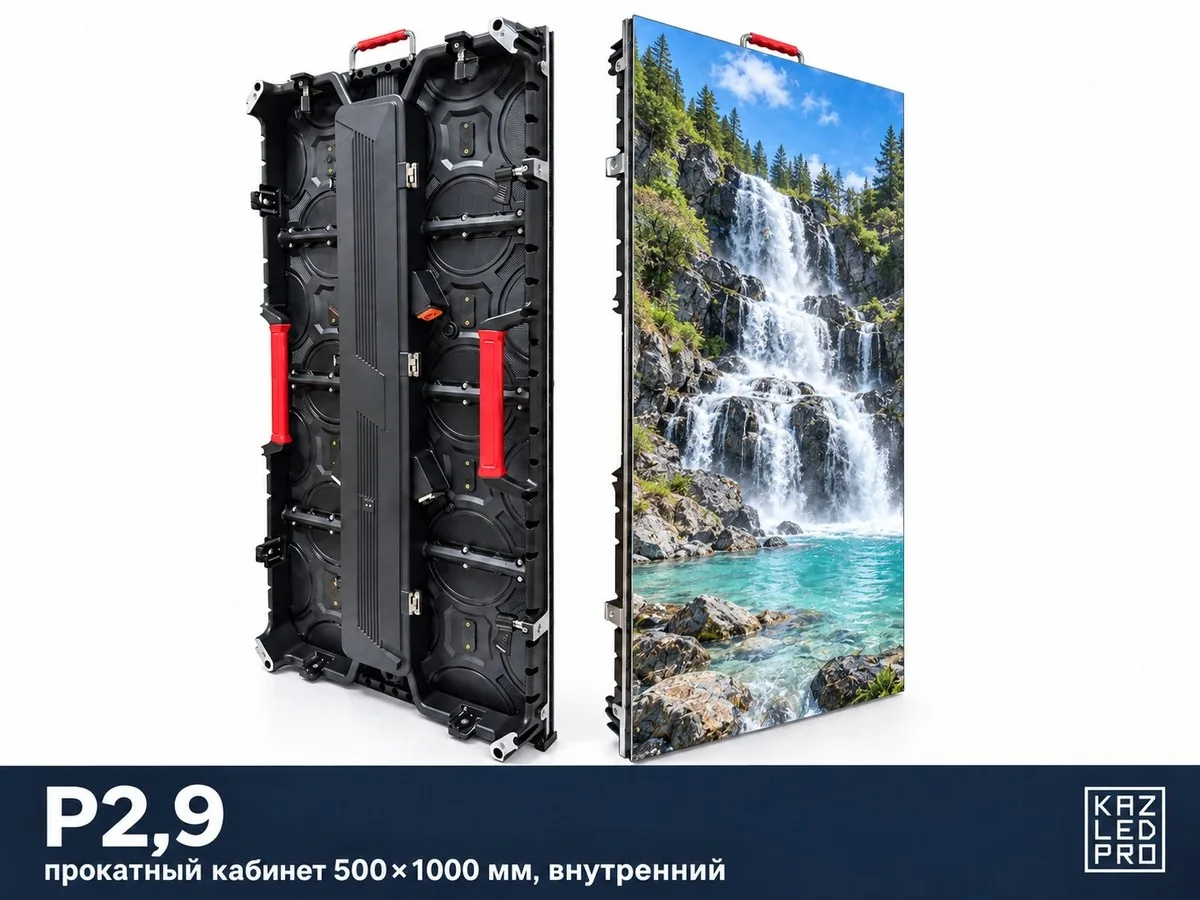
LED screen P2.9 for indoor use — 500×1000 mm cabinet
Indoor screen P2.9 (500×1000 mm cabinet), pixel density 118 336 dots/m². Comfortable viewing from 3 m.
- Brightness
- 1000 cd/m2
- Density
- 118 336 dots/m²
- Protection
- IP40
Details →
 P1.95
P1.95Indoor displays
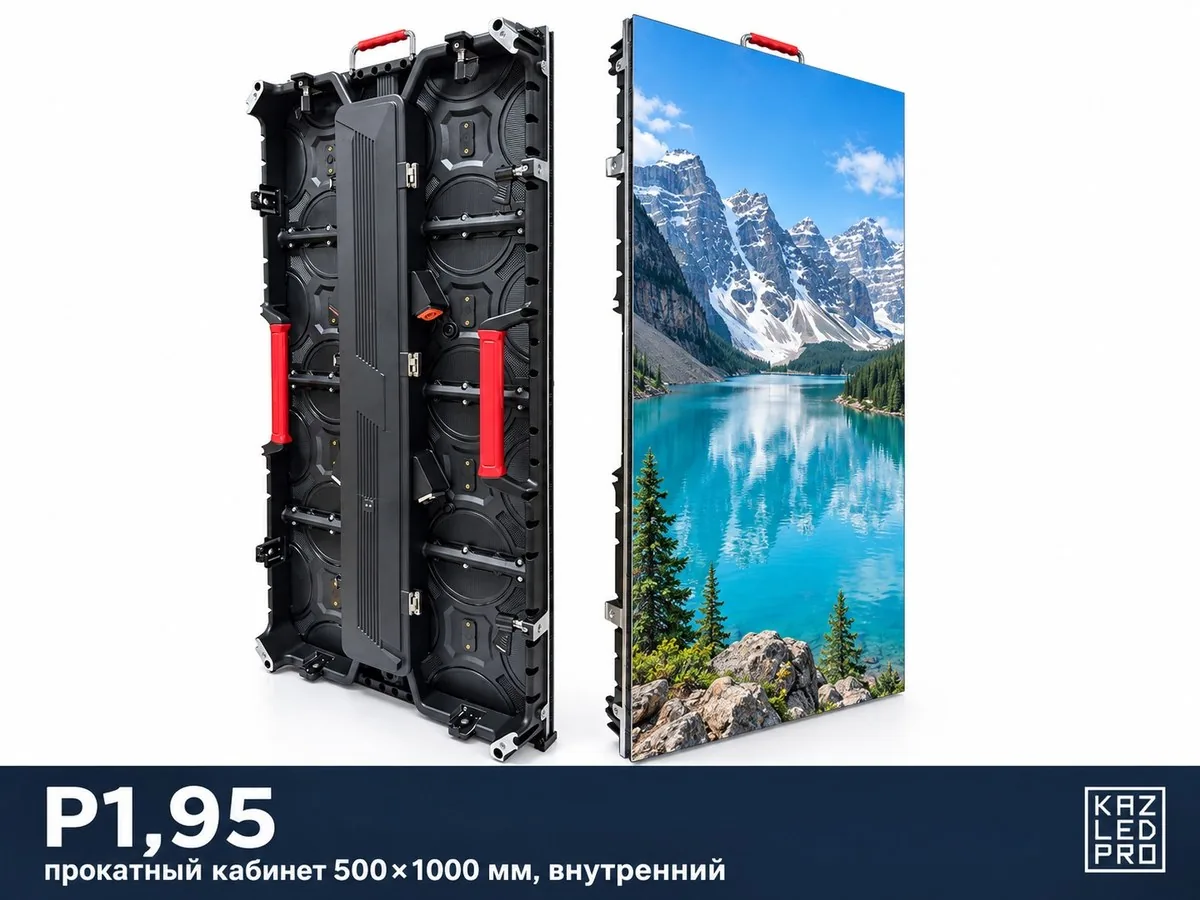
LED screen P1.95 for indoor use — 500×1000 mm cabinet
Indoor screen P1.95 (500×1000 mm cabinet), pixel density 262 144 dots/m². Comfortable viewing from 2 m.
- Brightness
- ≥900 cd/m²
- Density
- 262 144 dots/m²
- Protection
- IP31 / IP54
Details →
 P2.6
P2.6Indoor displays
LED screen P2.6 for indoor use — 500×1000 mm cabinet
Indoor screen P2.6 (500×1000 mm cabinet), pixel density 147 456 dots/m². Comfortable viewing from 3 m.
- Brightness
- 1000 cd/m2
- Density
- 147 456 dots/m²
- Protection
- IP40
Details →
An LED screen on stage replaces both the painted backdrop and the projector: the picture holds up under full stage lighting, the set changes in a second, and the back rows still see a close-up. Since 2012 KazLedPro has been building stage screens in Almaty and across Kazakhstan, from assembly-hall and House of Culture backdrops to outdoor fan-zone screens at city events.
A stage canvas is assembled from 500×1000 mm rental cabinets with locks: any size in half-metre steps, even seams, tool-free assembly. Venues buy these cabinets into their own inventory; if the screen is needed for a single evening, it is rented together with light, sound and a technician. Installation is done by our own crew, and the module warehouse is in Almaty.
This page covers the pixel pitch and brightness a stage needs, how a camera-ready screen differs from a screen built just for the audience, how weight and truss rigging are calculated, and how long assembly takes. If you are looking for an LED screen for a stage or a concert, the main answers are here, and the site calculator estimates the cost from your stage dimensions.
Pixel pitch and brightness for a stage
In a hall the audience sits four to fifteen metres from the backdrop, so a fine pitch is not needed: rental cabinets P2.6 and P2.9 at 1,000 cd/m² and P3.91 at 500 cd/m² do the job. For a small stage where the front row is two metres away, P1.95 is the choice: brightness from 900 cd/m² and a density of 262,144 dots per square metre. All of these cabinets are 500×1000 mm, so the canvas builds up in half-metre steps and fits the proscenium exactly.
An outdoor stage or fan zone calls for the outdoor P3.91 cabinet: 5,500–7,800 cd/m², IP68 protection and an operating range from minus 40 to plus 50 °C. Refresh rate on the rental models is at least 3,840 Hz, and up to 7,680 Hz on the outdoor cabinet. That matters when the stage is filmed: no banding and no flicker on camera. And unlike a projector, the screen does not require the house lights to be dimmed.
- Hall backdrop and culture-house stage: P2.6–P3.91, 500×1000 mm cabinets
- Small stage, front row at 2 m: P1.95, brightness from 900 cd/m²
- Outdoor stage and fan zone: P3.91, IP68, 5,500–7,800 cd/m²
- Filming on camera: refresh rate from 3,840 Hz
- Light, sound, truss and an on-site technician under one contract
Stages, halls and venues we have equipped
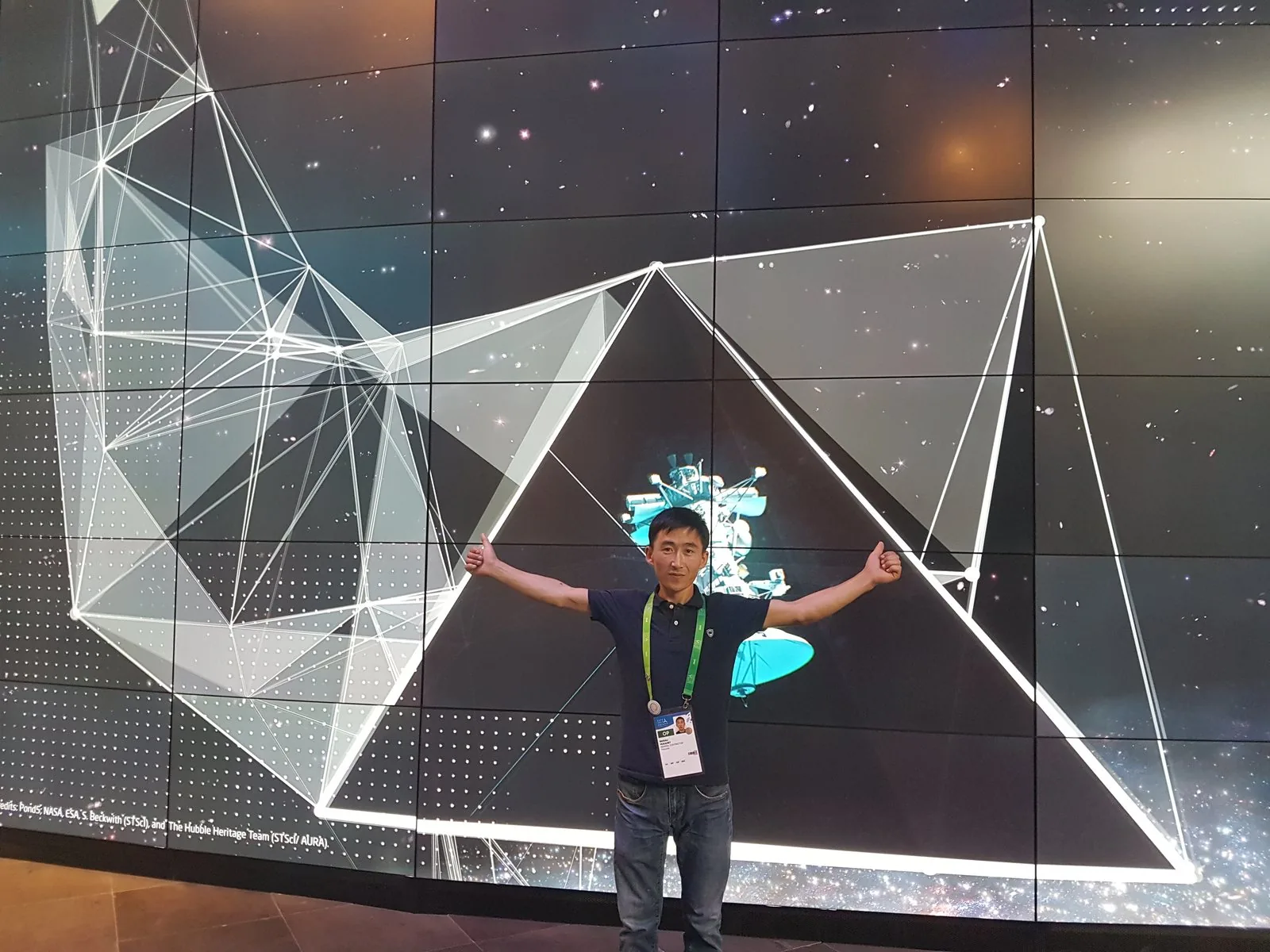
The Zhansugurov Palace of Culture in Taldykorgan runs a 100 m² screen at pitch P3 (December 2023). The House of Culture in Aksai has a 62 m² canvas built from 500×1000 mm cabinets, with a viewing distance from four metres (January 2021). At the EXPO-2017 exhibition ground we installed a 9 m² screen made of 320×160 mm modules in February 2017.
School and university stages are a large part of the work: the assembly hall of the KIS private school in Almaty, gymnasiums 132 and 133, where the screen came with stage lighting on truss, and the sports hall of the NGS school with a P4 screen. At the Children and Youth Centre in Karaganda a P4 screen was delivered with a full lighting set (January 2021). Every project is documented with photos and video in the portfolio.
Assembly, rigging and connection
A 500×1000 mm cabinet weighs 13–15 kg indoors and 11–13 kg outdoors, so a square metre of canvas is roughly 26–30 kg plus truss and rigging. We calculate the load before installation and agree the rigging drawing with the venue. Cabinets lock together without tools: a 6×3 m screen is assembled, cabled and set up by the crew in two to four hours, and comes down faster.
Power is sized from the peak: rental cabinets are rated at 600–800 W/m² maximum and 240–320 W/m² average. Content is fed from the director's laptop through a video processor, so camera switches, captions and sponsor clips run without a black frame. Light, sound, truss and console arrive with the screen, and the technician stays on site until the end of the event.
How the project goes
- 1
Enquiry and venue
Send the stage or proscenium dimensions, photos of the venue and the running order. In Almaty an engineer visits the site; in other cities we work from drawings, photos and the hall plan.
- 2
Selection and estimate
We match pitch to the front-row distance, calculate resolution, weight and power, and check the rigging options. A quotation with the model, area and scope of work follows within a day.
- 3
Drawings and approvals
We prepare the rigging drawing and cabinet layout and agree power points, rigging and the load-in schedule with the venue. For an event we also fix the build window and rehearsal time.
- 4
Installation and setup
We lock the canvas together, hang it on truss or set it on ground support, run the cabling and connect the video processor. Brightness and colour are calibrated for stage light and for camera.
- 5
Event and handover
For a permanent screen we train the operator and hand over the site with a warranty. At an event the technician is on duty to the finale, then comes the strike, loading and a clean venue.
What the price depends on
The cost of a stage LED screen depends on pixel pitch, canvas area, the indoor or outdoor version, and on whether you buy the screen for your own inventory or take it for a single event. We calculate the exact figure from your stage dimensions: the site calculator gives an estimate at once and a quotation is ready within a day.
Pixel pitch
The finer the pitch, the more LEDs per square metre and the more expensive the canvas. A large hall backdrop is fine at P2.9–P3.91; a stage with the front row two metres away needs P1.95–P2.6.
Area and resolution
Price grows with area, while resolution sets the number of receiving cards and the class of video processor. A wide 12×4 m backdrop is priced differently from a compact 4×3 m screen on the same stage.
Rental cabinet or fixed canvas
Locking 500×1000 mm cabinets assemble and strike without tools and survive dozens of transports. A fixed modular screen, installed in the hall once, comes out cheaper.
Indoor or outdoor version
An outdoor stage needs a cabinet rated 5,500–7,800 cd/m², IP68 and an operating range from minus 40 to plus 50 °C. Indoor models are lighter and use less power.
Truss, rigging and height
Truss suspension, ground support or a frame in the proscenium are each priced separately. Canvas weight, rigging hardware, work at height and a night build window all affect the estimate.
Light, sound and control
A video processor, cabling and power lines are always required. A full package adds lighting fixtures, speakers, a console and a technician on duty during the event.
Questions and answers
Which pixel pitch should I choose for a stage screen?
A simple guide: viewing distance in metres roughly equals pitch in millimetres. If the front row is four metres away, P3.91 is enough. For a hall where the audience sits two to three metres from the backdrop, take P1.95–P2.6. For an outdoor fan zone watched from ten metres and beyond, a coarser pitch simply saves budget.
Is the screen visible with the stage lights on?
Yes. Indoor rental cabinets deliver 900–1,000 cd/m², which holds up with the stage washed in light and the house lights on, so there is no need to darken the room as you would for a projector. Outdoors we use cabinets at 5,500–7,800 cd/m², readable against the sun and dimmed in the evening.
Will there be banding or flicker when we film the stage?
Rental cabinets run at a refresh rate of at least 3,840 Hz and the outdoor P3.91 goes up to 7,680 Hz. At those rates the camera records the screen cleanly, with no banding and no flicker. Before a shoot we also tune screen brightness with the camera operator so the backdrop does not blow out the exposure.
How long do assembly and strike take?
A 6×3 m screen of 500×1000 mm cabinets is assembled, cabled and set up by the crew in two to four hours, and the strike is quicker. The exact time depends on the rigging: truss and hardware take longer than ground support. The build window is agreed with the venue in advance, along with rehearsal times.
Can we rent the screen for one event instead of buying it?
Yes, that is what the rental section is for: the screen arrives with a crew, installation, strike and a technician on duty until the end of the event. Light, sound, truss and a console come with it. If the stage works year-round, the same rental cabinets are bought into your own inventory.
How much does the screen weigh and will the truss hold it?
A 500×1000 mm cabinet weighs 13–15 kg indoors and 11–13 kg outdoors, so a square metre of canvas is around 26–30 kg. We calculate the load on the rigging, the hardware and the fixing points before installation and agree the drawing with the venue management.
What power supply is needed at the venue?
Rental cabinets are rated at 600–800 W/m² peak and 240–320 W/m² average. An 18 m² screen draws about 5 kW on average and up to 14 kW at peak. We size the power lines from the peak with a margin and state this in the electrical specification for the venue.
Do you work outside Almaty?
Yes, the crew travels anywhere in Kazakhstan. We have built stage screens in Taldykorgan, Aksai, Karaganda and Almaty, and assembled a screen at the EXPO-2017 ground. Equipment ships from the Almaty warehouse on our own transport, with installation and setup by a travelling crew.

A turnkey screen: quote, installation, launch.
Send us the dimensions and location — a quote today. WhatsApp around the clock.