
Products
Indoor LED screens
Fine-pitch P0.93–P4 screens for places viewed from one to four metres: meeting rooms, council halls, TV studios, receptions, retail floors.
Where it goes
Meeting and council rooms
Instead of a projector: visible with the lights on, no seams between panels.
TV studios and situation centres
Refresh rate from 3,840 Hz — no banding on camera.
Retail floors and receptions
Advertising and wayfinding that never fades and needs no printing.
School and university halls
Stage, broadcasts, presentations — one screen for every task.
Price
from 260,000 ₸ per m²
The exact price depends on pixel pitch, area and structure. We send a quote within one working day.
Models from the price list
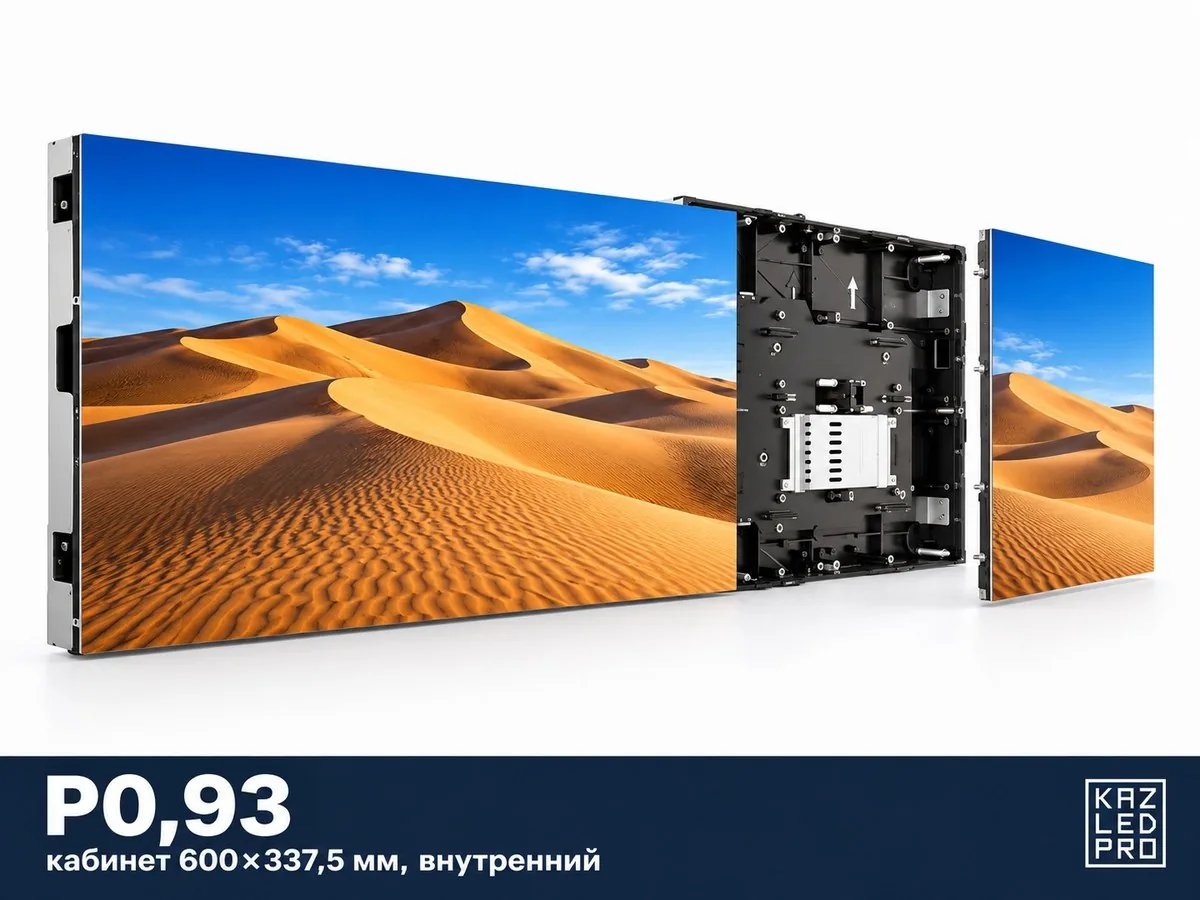 P0.93
P0.93Indoor displays
LED screen P0.93 for indoor use — 600×337.5 mm cabinet
Indoor screen P0.93 (600×337.5 mm cabinet), pixel density 1 137 778 dots/m². Comfortable viewing from 1 m.
- Brightness
- 600 cd/m²
- Density
- 1 137 778 dots/m²
- Protection
- IP40 (indoor version)
Details →
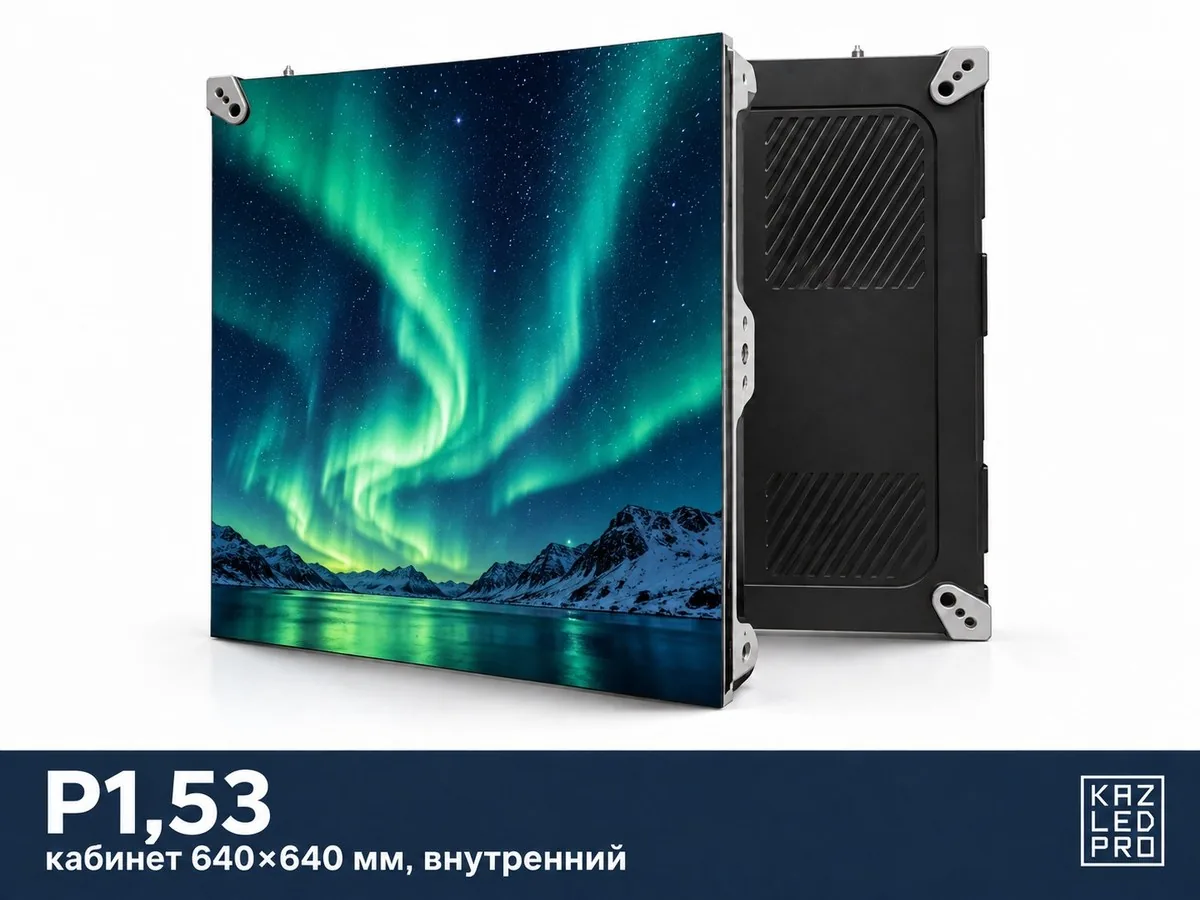 P1.53
P1.53Indoor displays
LED screen P1.53 for indoor use — 640×640 mm cabinet
Indoor screen P1.53 (640×640 mm cabinet), pixel density 422 500 dots/m². Comfortable viewing from 2 m.
- Brightness
- 350–400 cd/m²
- Density
- 422 500 dots/m²
- Protection
- IP 24
Details →
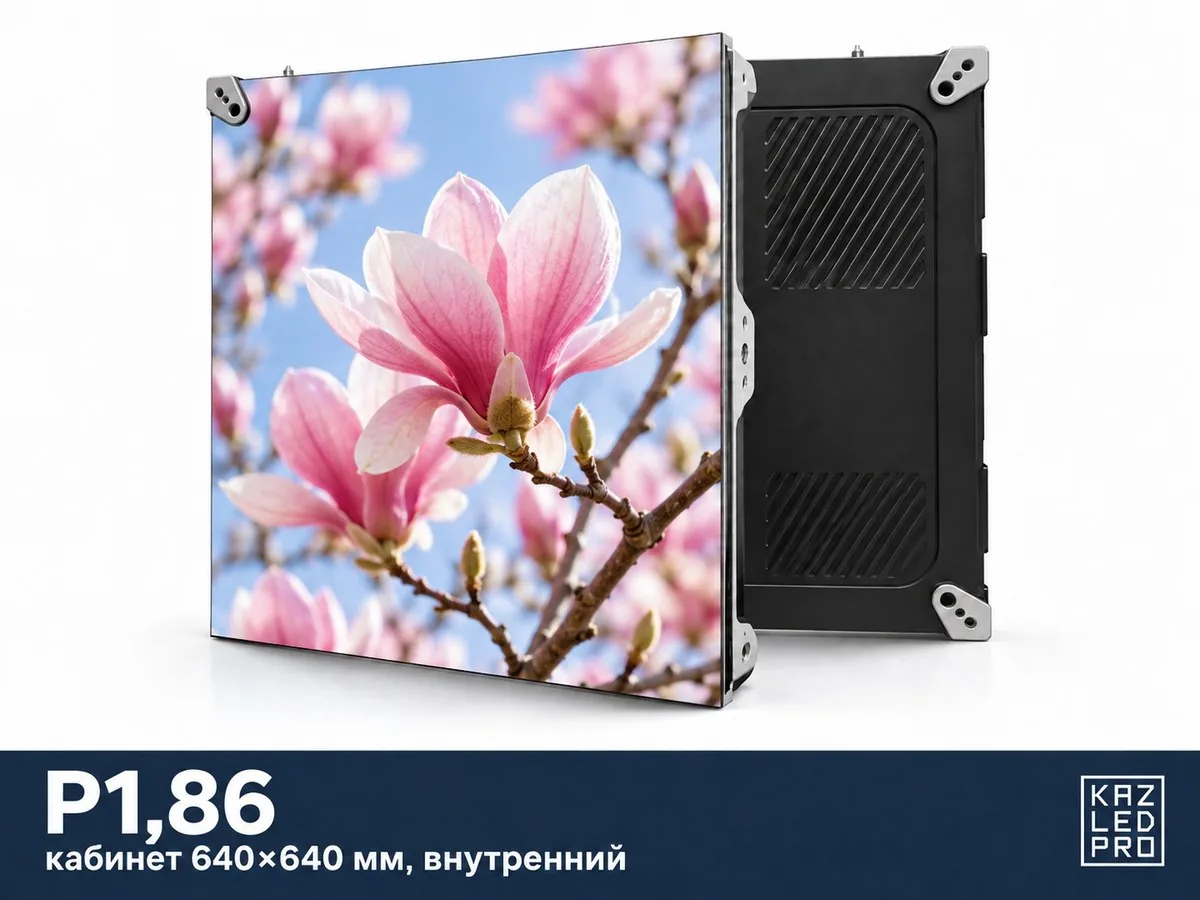 P1.86
P1.86Indoor displays
LED screen P1.86 for indoor use — 640×640 mm cabinet
Indoor screen P1.86 (640×640 mm cabinet), pixel density 288 906 dots/m². Comfortable viewing from 2 m.
- Brightness
- 400–450 cd/m²
- Density
- 288 906 dots/m²
- Protection
- IP 24
Details →
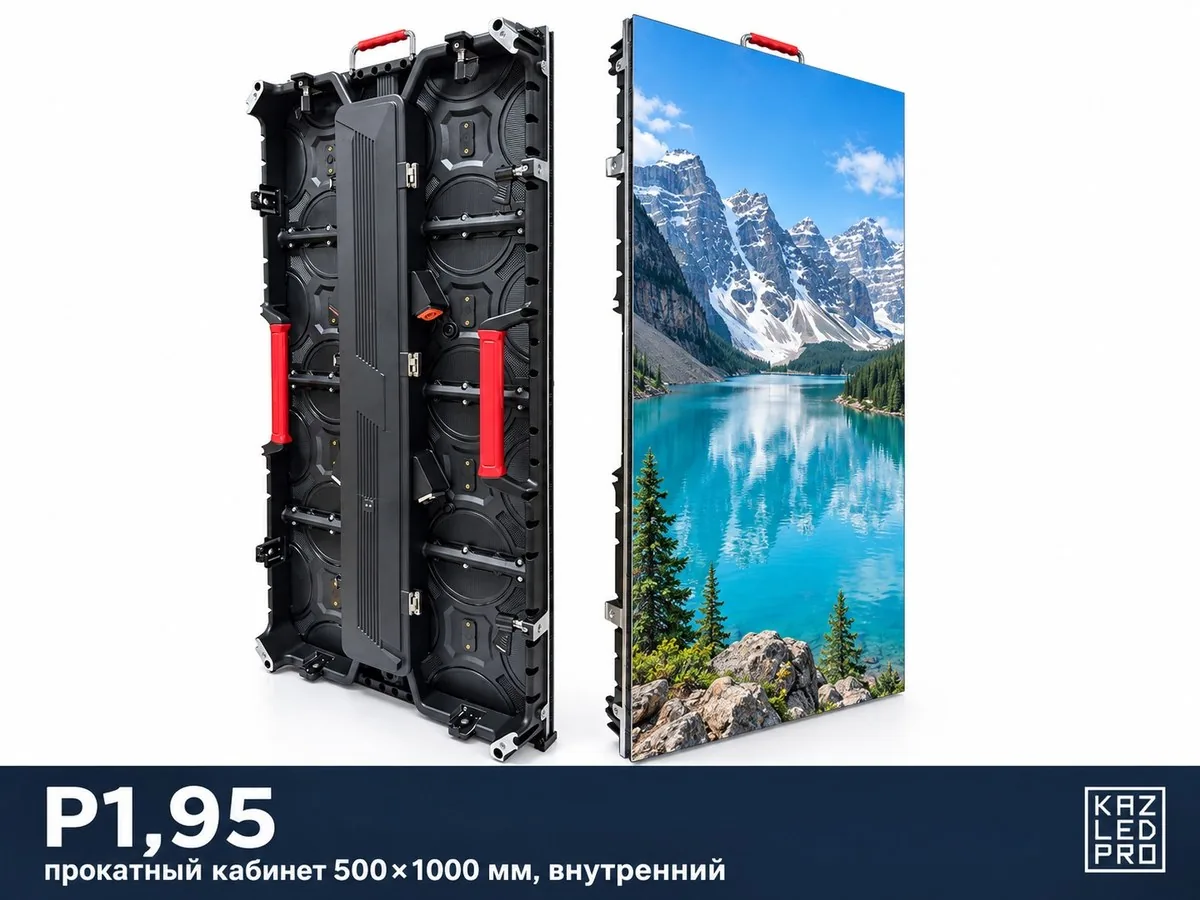 P1.95
P1.95Indoor displays
LED screen P1.95 for indoor use — 500×1000 mm cabinet
Indoor screen P1.95 (500×1000 mm cabinet), pixel density 262 144 dots/m². Comfortable viewing from 2 m.
- Brightness
- ≥900 cd/m²
- Density
- 262 144 dots/m²
- Protection
- IP31 / IP54
Details →
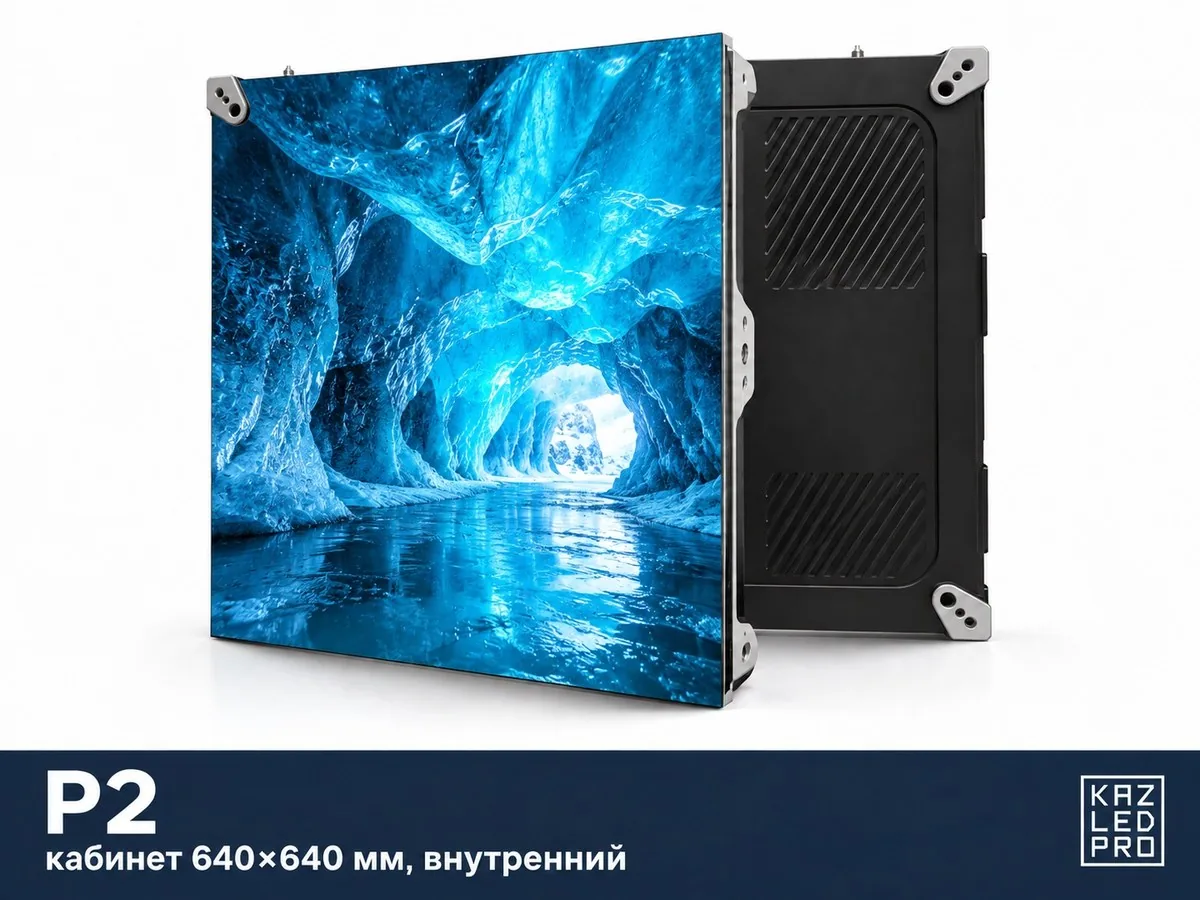 P2
P2Indoor displays
LED screen P2 for indoor use — 640×640 mm cabinet
Indoor screen P2 (640×640 mm cabinet), pixel density 250 000 dots/m². Comfortable viewing from 2 m.
- Brightness
- 450–500 cd/m²
- Density
- 250 000 dots/m²
- Protection
- IP 24
Details →
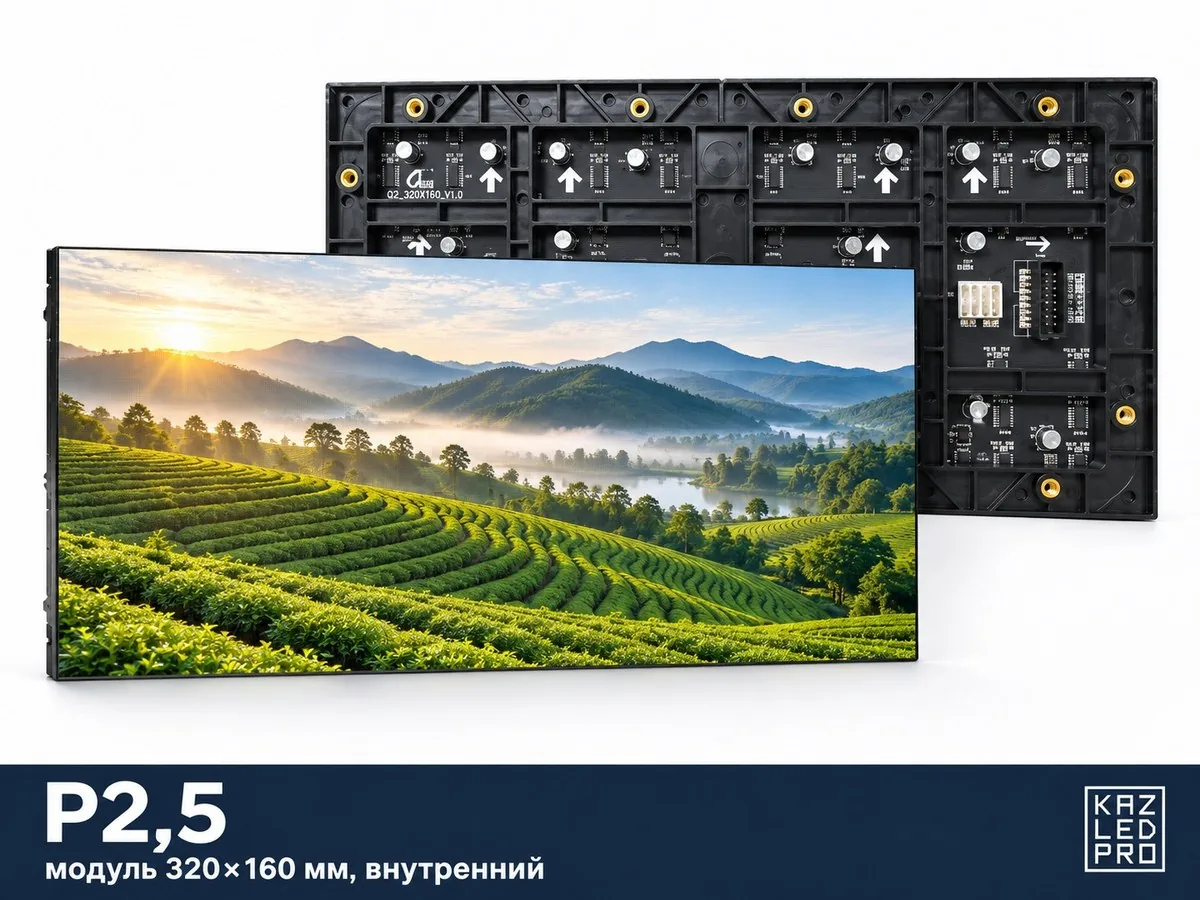 P2.5
P2.5Indoor displays
LED screen P2.5 for indoor use — 320×160 mm module
Indoor screen P2.5 (320×160 mm module), pixel density 160 000 dots/m². Comfortable viewing from 2 m.
- Brightness
- 350–550 cd/m²
- Density
- 160 000 dots/m²
- Protection
- IP 31
Details →
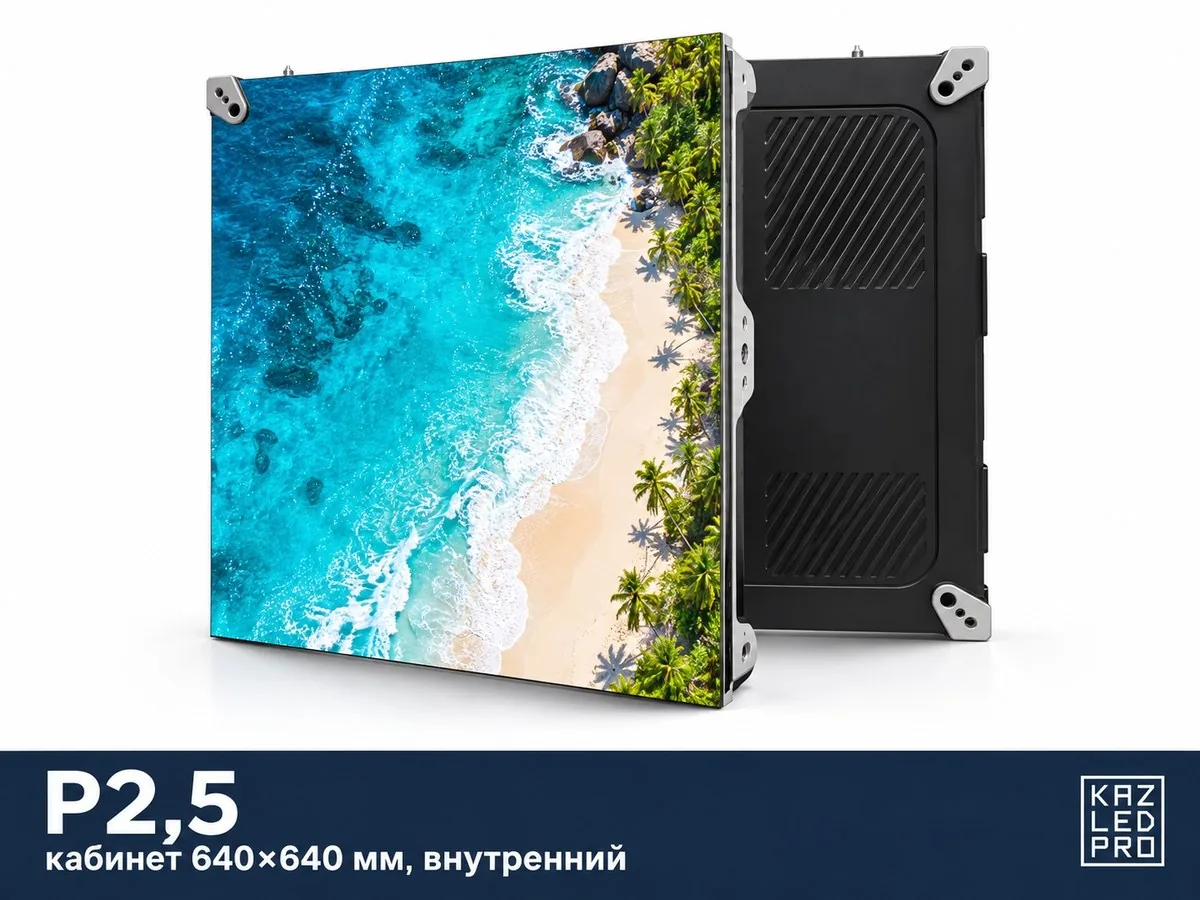 P2.5
P2.5Indoor displays
LED screen P2.5 for indoor use — 640×640 mm cabinet
Indoor screen P2.5 (640×640 mm cabinet), pixel density 160 000 dots/m². Comfortable viewing from 2 m.
- Brightness
- 350–550 cd/m²
- Density
- 160 000 dots/m²
- Protection
- IP 31
Details →
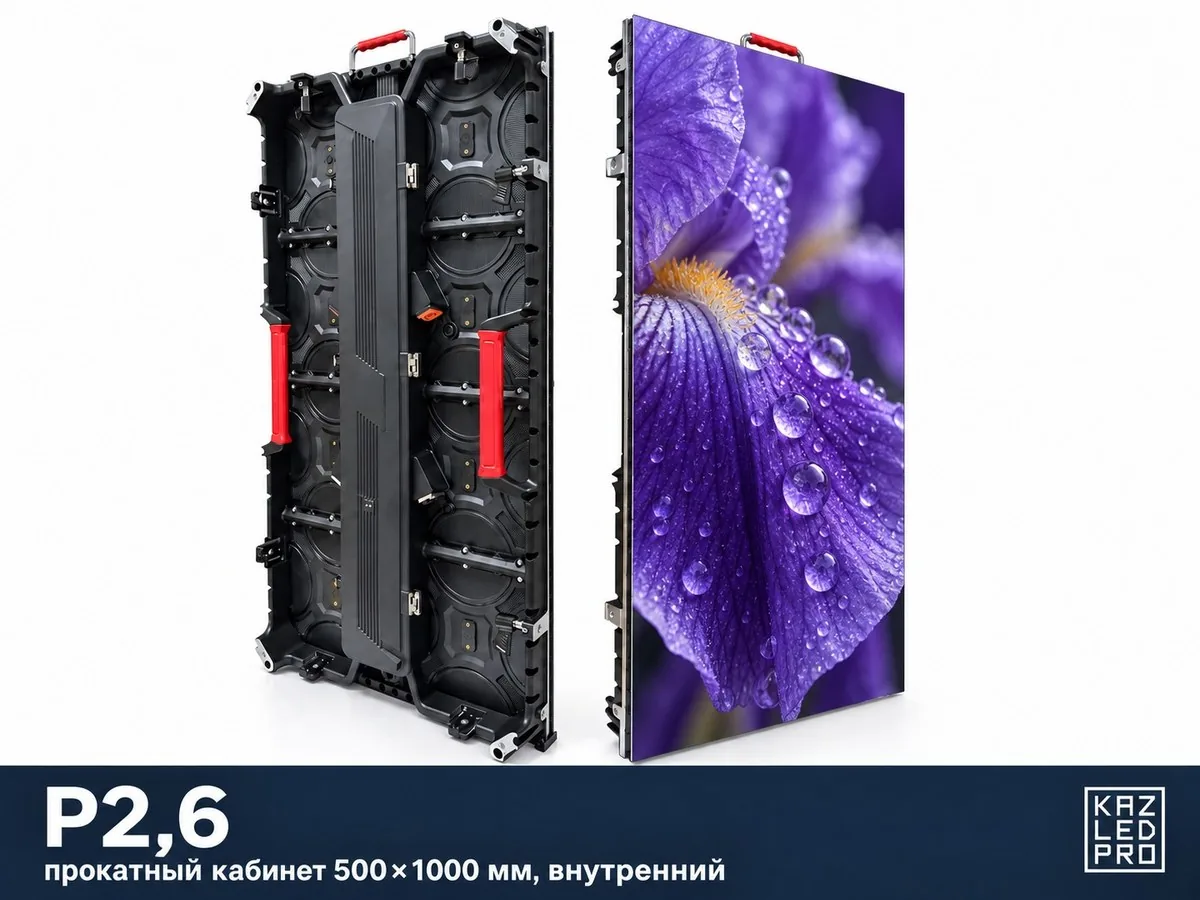 P2.6
P2.6Indoor displays
LED screen P2.6 for indoor use — 500×1000 mm cabinet
Indoor screen P2.6 (500×1000 mm cabinet), pixel density 147 456 dots/m². Comfortable viewing from 3 m.
- Brightness
- 1000 cd/m2
- Density
- 147 456 dots/m²
- Protection
- IP40
Details →
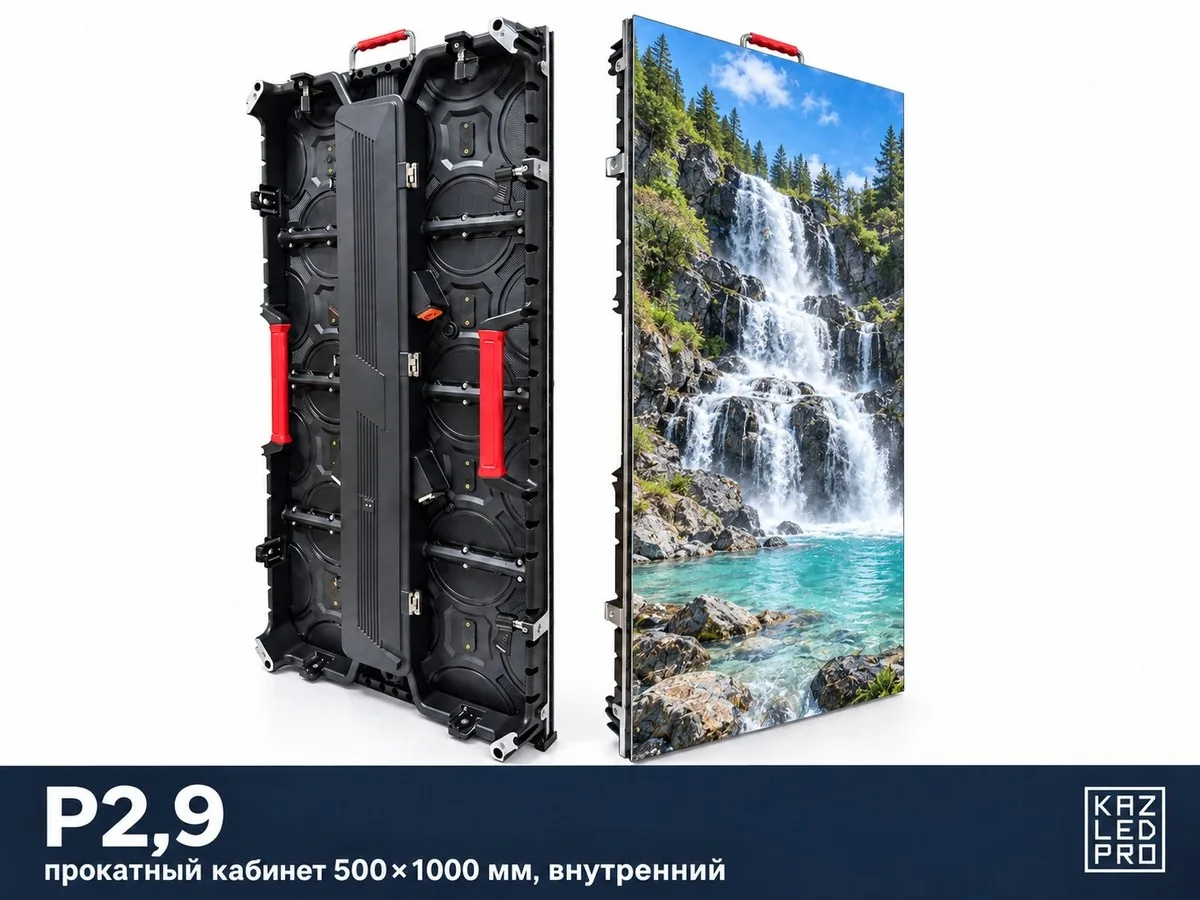 P2.9
P2.9Indoor displays
LED screen P2.9 for indoor use — 500×1000 mm cabinet
Indoor screen P2.9 (500×1000 mm cabinet), pixel density 118 336 dots/m². Comfortable viewing from 3 m.
- Brightness
- 1000 cd/m2
- Density
- 118 336 dots/m²
- Protection
- IP40
Details →
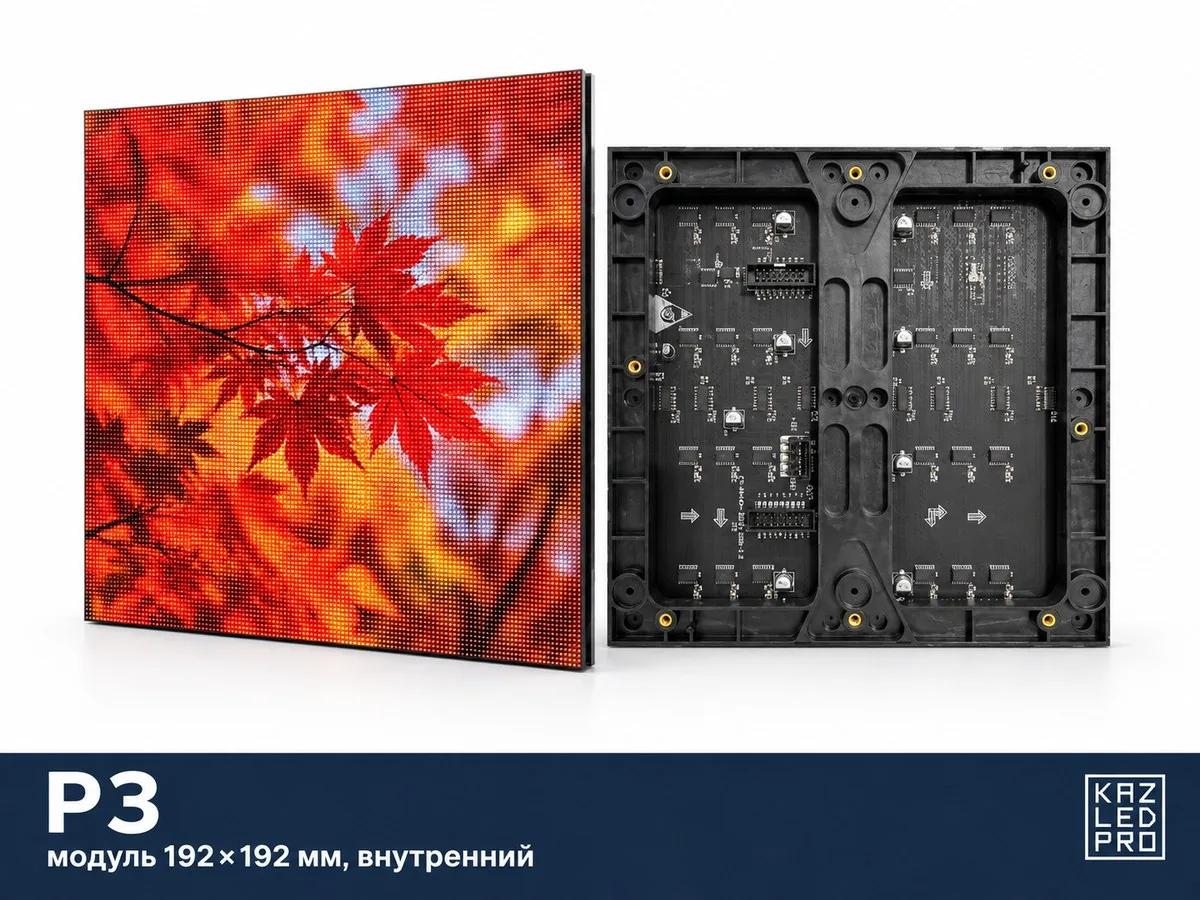 P3
P3Indoor displays
LED screen P3 for indoor use — 192×192 mm module
Indoor screen P3 (192×192 mm module), pixel density 111 111 dots/m². Comfortable viewing from 3 m.
- Brightness
- 500–550 cd/m²
- Density
- 111 111 dots/m²
- Protection
- IP 24
Details →
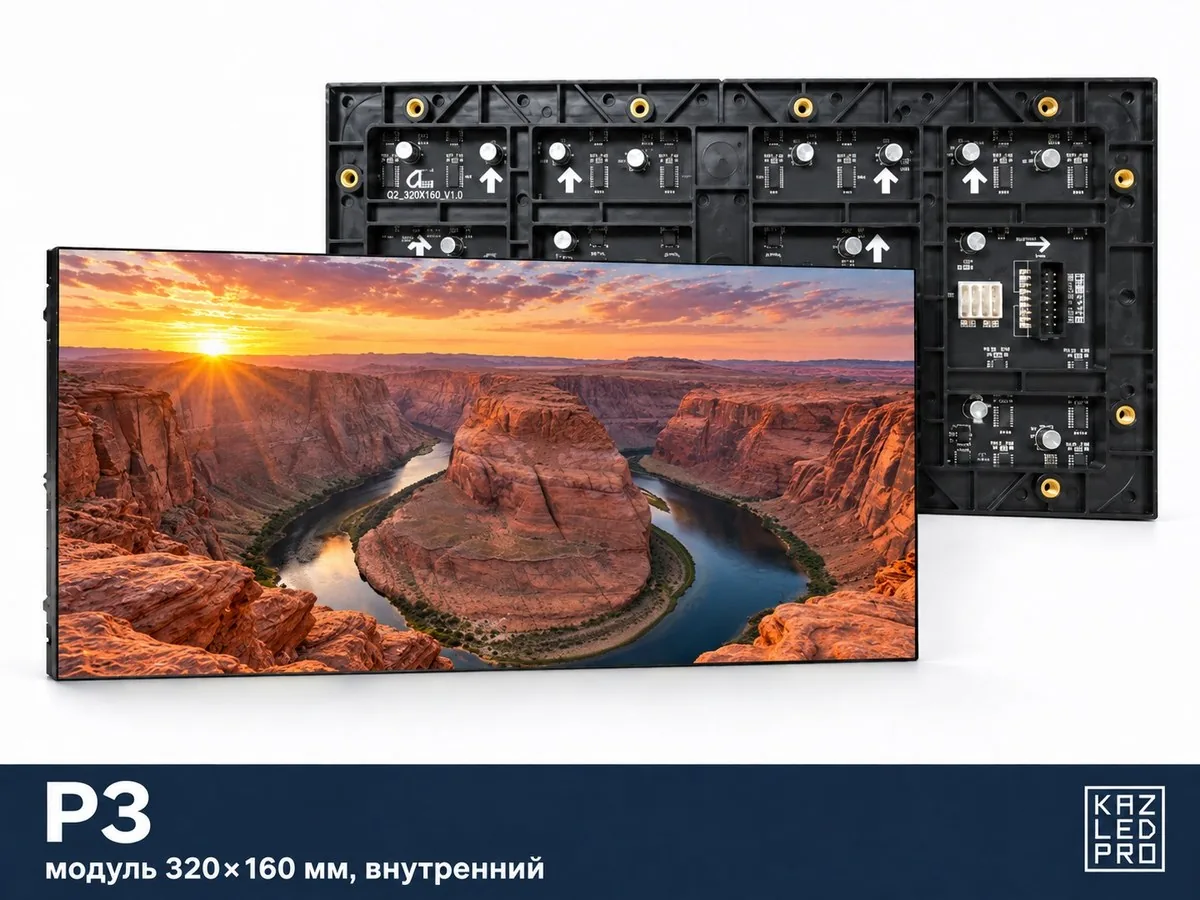 P3
P3Indoor displays
LED screen P3 for indoor use — 320×160 mm module
Indoor screen P3 (320×160 mm module), pixel density 105 625 dots/m². Comfortable viewing from 3 m.
- Brightness
- 350–550 cd/m²
- Density
- 105 625 dots/m²
- Protection
- IP 24
Details →
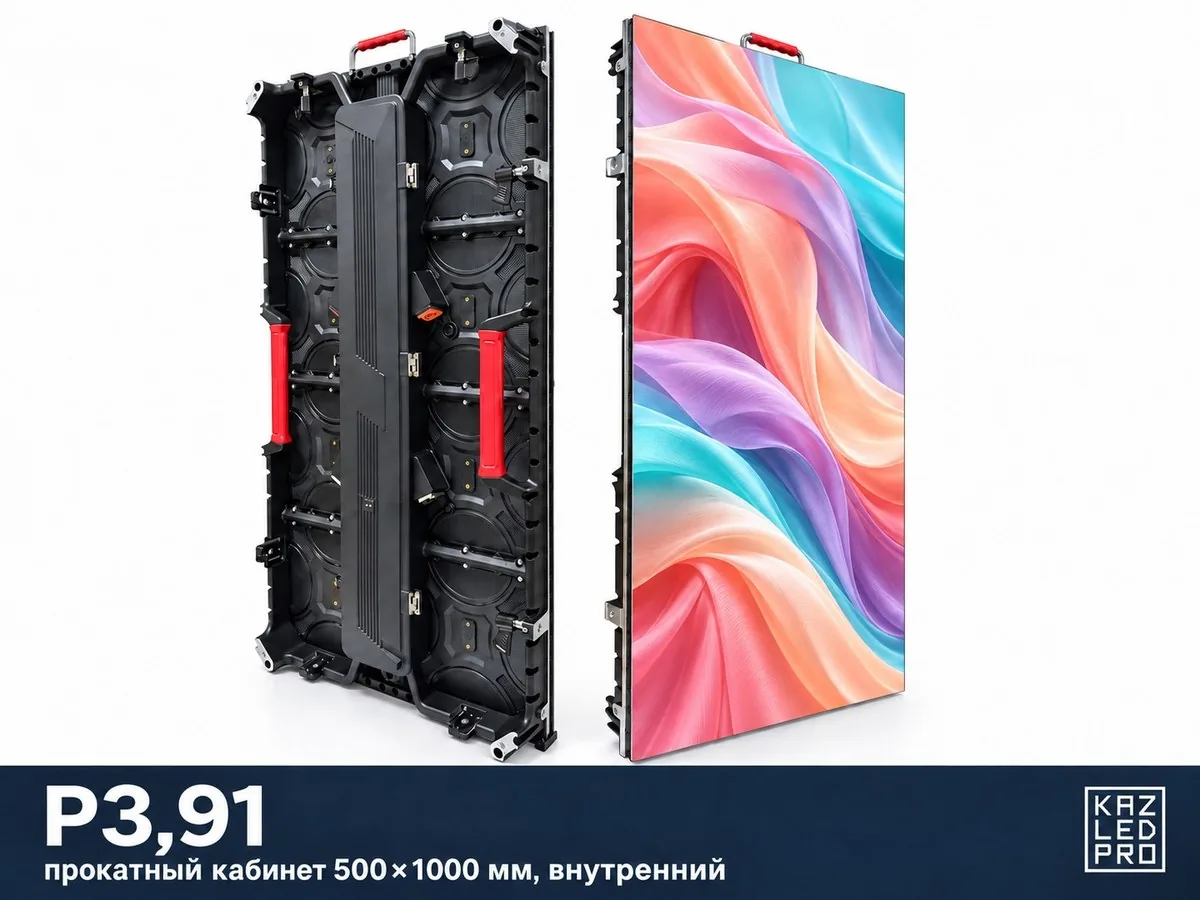 P3.91
P3.91Indoor displays
LED screen P3.91 for indoor use — 500×1000 mm cabinet
Indoor screen P3.91 (500×1000 mm cabinet), pixel density 65 536 dots/m². Comfortable viewing from 4 m.
- Brightness
- 500 cd/m²
- Density
- 65 536 dots/m²
- Protection
- IP40
Details →
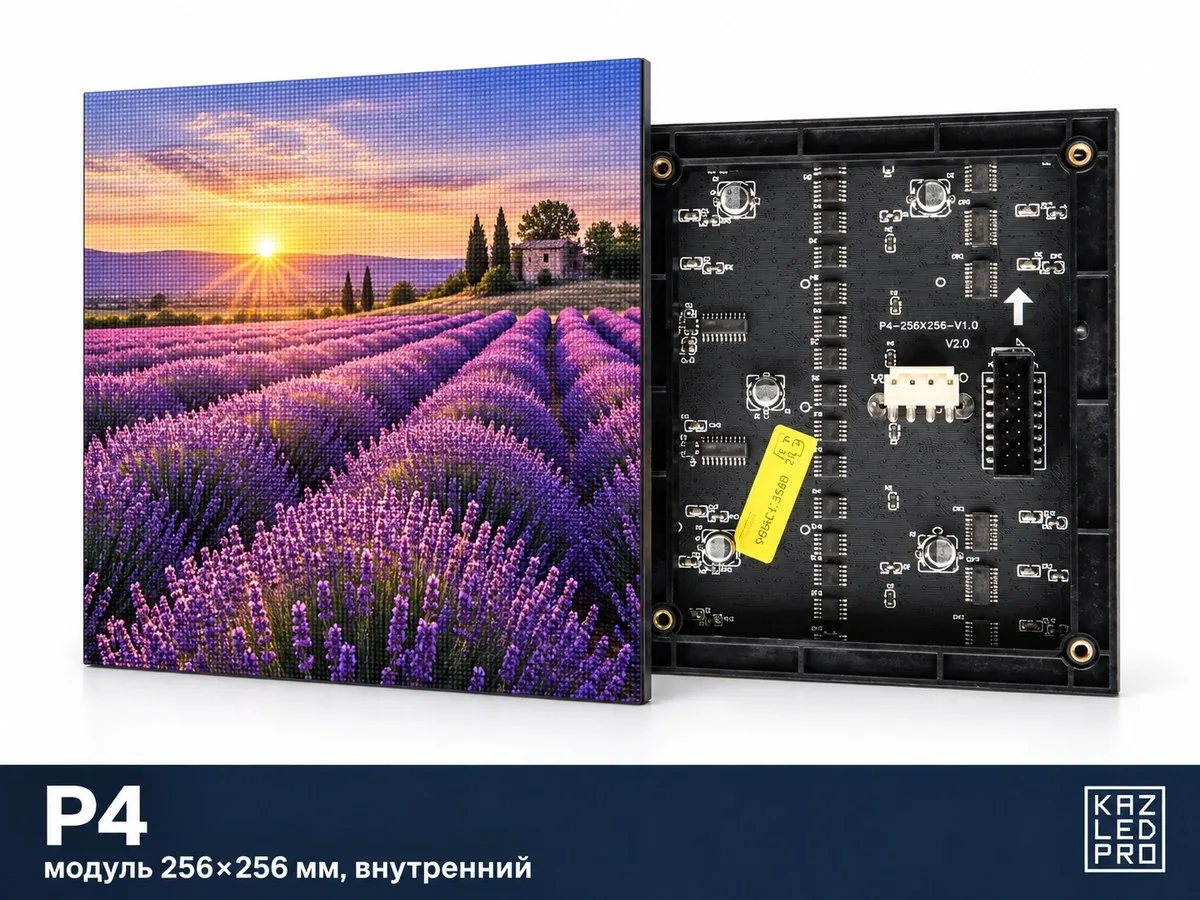 P4
P4Indoor displays
LED screen P4 for indoor use — 256×256 mm module
Indoor screen P4 (256×256 mm module), pixel density 62 500 dots/m². Comfortable viewing from 4 m.
- Brightness
- 350–400 cd/m²
- Density
- 62 500 dots/m²
- Protection
- IP40 / IP31
Details →
Why this type
Pitch from 0.93 mm
No visible grain even from a metre — for studios and meeting rooms.
Front service
Modules come off the front on magnets, so the screen can sit flush to the wall.
Cabinet or module
640×640 and 500×1000 cabinets for fast assembly; modules for an exact fit.
Quiet and cool
Indoor models have no fans — fine for rooms with sound recording.

Why an LED display
Warranty of up to 5 years
On screens of our own manufacture and on the equipment we supply.
Brightness control
Different by day and by night — the screen does not dazzle or flood windows with light, and consumption drops.
Service without dismantling
Front, rear or mixed — the module comes off and the structure stays in place.
Round-the-clock operation
LED life of 50–100 thousand hours in continuous use.
Vandal-resistant build
For places where the screen is within arm's reach.
Any shape and size
The screen is assembled from modules, so the dimensions fit the opening and the shape fits the task.
Wide temperature range
Outdoor models operate from −30 to +50 °C.
Installation on any surface
Brick, concrete, glass, an aluminium facade, a free-standing pylon or a roof.
What a screen is made of
A screen consists of modules, and modules are combined into cabinets. Because of that construction a screen can be built at almost any size and fitted to the opening.
Pixel pitch
The distance from the centre of one pixel to the centre of the next. The smaller the pitch, the denser the image and the closer you can stand to the screen. It is written with a P: P3 means a 3 mm pitch. The viewing distance in metres is roughly equal to the pitch in millimetres.
Module and cabinet
A module is a board with LEDs; a cabinet is the frame that holds the modules, the power supplies and the receiving card. A cabinet screen goes up faster on site, a module screen fits the given dimensions more precisely.
Service access
Front, rear or mixed. Front service is needed wherever the back cannot be reached: a screen flush to a wall or set into a niche.
Indoor LED screens are models with pixel pitch P0.93–P4 and brightness of 350–1,000 cd/m²: they are viewed from one to four metres with the lights on. The KazLedPro catalogue has 15 indoor models: 640×640 and 500×1000 mm cabinets, 320×160, 256×256 and 192×192 mm modules, and a P0.93 COB cabinet for studios and situation centres. We assemble the screens in Almaty and install them with our own crew across Kazakhstan.
This kind of LED screen is bought for meeting and conference rooms, school and university assembly halls, TV studios, receptions and retail floors. Since 2012 we have delivered indoor screens to dozens of schools, hotels, banquet halls and government institutions; case studies with photos are in the portfolio. Below: how to choose the pitch for your room, how COB differs from SMD, and why a screen replaces a projector and a panel video wall.
Which pixel pitch your room needs
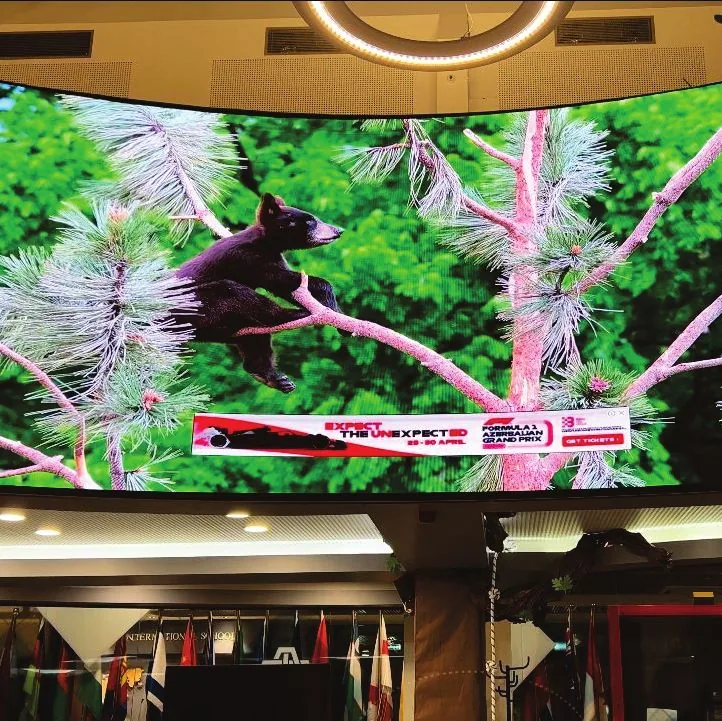
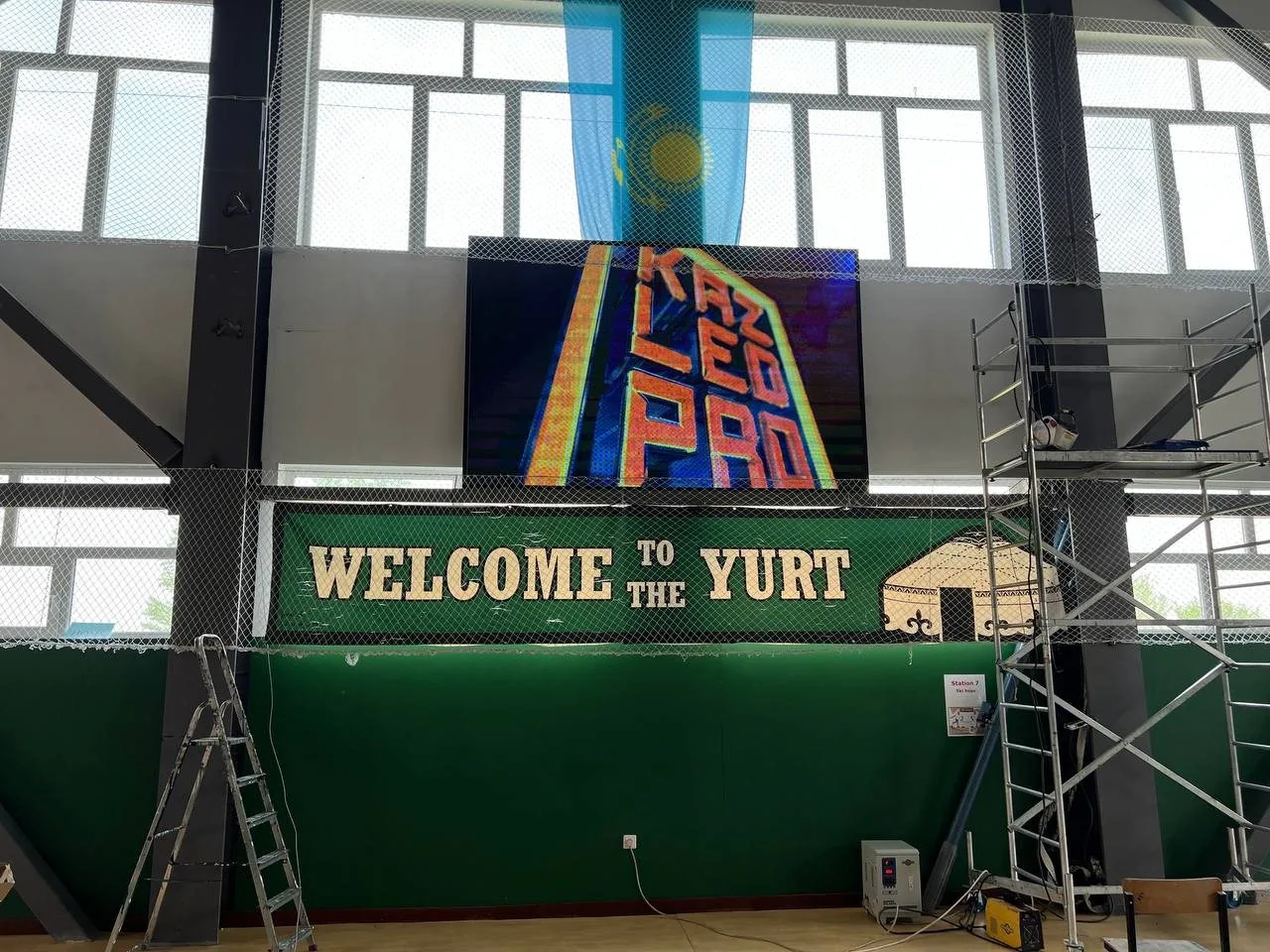
Distance in metres roughly equals pitch in millimetres, so start from the nearest viewer. A meeting room where people sit two to three metres from the wall — P1.53–P2: the 640×640 cabinets pack 422,500 and 250,000 pixels per m², with no visible grain. A conference room or school assembly hall at 6–10 m — P2.5–P3, the most common choice in our projects: P3 screens totalling 100 m² at the I. Zhansugurov Palace of Culture in Taldykorgan (2023), P2.5 at Almaty International School (2022). A gym or lobby viewed from four metres and beyond — P3.91 or P4: that is how the screen in the assembly hall of Gymnasium No. 130 in Almaty was built (2021).
TV studios and situation centres take a fine pitch with a refresh rate from 3,840 Hz so there is no banding on camera: P0.93 at the Dubai Police command centre (48 m², 2023), P1.53 at the ENOC situation centre (20 m², 2022), P2 at the Eurasia TV studio in Astana (2021).
COB and SMD, cabinet and module
Most indoor models use SMD LEDs: each pixel is a separate package with three chips soldered to the board. It is a proven technology for P1.53 and coarser. The P0.93 cabinet is built differently — COB: the chips are encapsulated in compound and the front surface is solid, with no protruding packages. Such a screen tolerates touch and cleaning, gives an even black and works from one metre away while drawing 300 W/m² at peak and 100 W/m² on average.
The 640×640 mm cabinets, 65 mm deep, assemble into 16:9 and 21:9 formats, weigh 12–16 kg and are serviced from the front: a module comes off on magnets, so the screen sits flush against the wall with no recess. The 500×1000 mm cabinets are brighter (900–1,000 cd/m² for P1.95–P2.9) and suit halls with large windows; the 62 m² screen at the Aksai House of Culture (2021) is built from them. The 320×160 and 256×256 mm modules go where a precise fit to the opening matters or the budget is tight.
- P0.93 COB, 600×337.5 mm cabinet: studios, control rooms, home cinema.
- P1.53–P2.5, 640×640 mm cabinets: meeting rooms, receptions, showrooms.
- P1.95–P3.91, 500×1000 mm cabinets: brightly lit halls, stages, rental.
- P2.5–P4, 320×160, 192×192, 256×256 mm modules: assembly halls, gyms, lobbies.
Instead of a projector or an LCD video wall
A projector in a meeting room needs blackout and a lamp that dims over time; an LED screen with 350–550 cd/m² reads in daylight from the windows and has no consumables. That is how the screen in the conference hall of the Holiday Inn Almaty hotel (2025) is set up: presentations and meetings run without curtains and without warm-up. A panel video wall is divided by seams and limited by the panel size; an LED screen is a continuous canvas of any format, and a failed module is swapped on site in minutes.
The screen connects like an ordinary monitor: a laptop over HDMI through a video processor, wireless presentation, video conferencing. Indoor models run without fans, so nothing hums in the meeting room or on a recording. Operating temperature is −20…+40 °C (up to +50 °C for the 500×1000 series), ingress protection IP24–IP40 — enough for dry rooms.
What the supply includes and how we deliver across Kazakhstan
An indoor screen supply includes modules or cabinets with power supplies and receiving cards, a video processor sized to the resolution with spare ports, cabling, a wall frame or structure for your opening, installation by our own crew, commissioning with brightness calibration, operator training and documents: a screen passport with serial numbers, a wiring diagram, acts and a 2–5 year warranty card. Before installation the customer receives our electrical specification.
We ship from our Almaty warehouse; across Kazakhstan the equipment travels by freight company or in our own vehicle with the crew — that is how screens reached schools in Karaganda and Taldykorgan and a university in Turkestan. The exact set, timing and delivery cost are fixed in the contract after a survey or from your photos and dimensions.
How the project goes
- 1
Enquiry and survey
You send the dimensions of the wall or opening, the depth of the room and the tasks for the screen. In Almaty we come to measure ourselves; in other cities a photo and a floor plan are enough.
- 2
Pitch selection and quote
We propose a pitch for the viewing distance and calculate resolution, power and cabinet layout. A commercial proposal with specification and lead time is sent within a day.
- 3
Contract and kitting
We fix the specification and warranty. Cabinets and modules come from the Almaty warehouse, the frame is made for your wall, the processor and receiving cards are configured before we leave.
- 4
Installation and commissioning
The crew mounts the frame, cabinets, power and signal, calibrates brightness and colour to the room lighting, connects the laptop, cameras and mixer, and trains the staff.
- 5
Handover and warranty
Acceptance act, screen passport with serial numbers, video report. Warranty of 2–5 years depending on the model; spare modules for your screen are kept in stock.
What the price depends on
At KazLedPro indoor screens start from 260,000 ₸ per m² and outdoor screens from 300,000 ₸ per m². On the Kazakhstan market a square metre of LED screen costs roughly between 180,000 and 1,500,000 ₸: the lower end is a coarse pitch for outdoor use, the upper end a fine-pitch screen for a studio or meeting room. This is a market reference, not our price list: the exact figure is calculated from your dimensions and scope of work. The price of an indoor LED screen depends on pitch, area and type of construction, not on a single figure per metre. We calculate an exact quote for your dimensions: the calculator on the site shows resolution and layout straight away, and the commercial proposal is ready within a day.
Pixel pitch
P0.93 and P1.53 cost several times more than P2.5–P4 because of the number of LEDs. Choose the pitch by the distance to the first row, not «with a margin» — overpaying will not improve the picture.
Area and resolution
Area multiplies modules, frame, installation and power. Resolution decides whether a simple processor is enough or a multi-window one with several outputs is needed.
Cabinet or module
The 640×640 and 500×1000 cabinets cost more per metre but assemble faster and are serviced from the front. A modular screen is more economical and fits the opening more precisely.
Brightness and refresh rate
Halls with large windows call for 900–1,000 cd/m², studios for 3,840 Hz and a fine pitch. Such models cost more than the standard 350–550 cd/m² ones.
Structure and mounting height
A wall frame, flush mounting in a recess or hanging on a truss above the stage mean different steel and different working hours. Heights above three metres add a lift.
Control and service
The video processor, scheduling software, staff training and warranty service appear as separate lines in the proposal so that the quote is clear before signing.
Questions and answers
Which pitch for a meeting room for eight people?
For a room three to four metres deep take P1.53–P2 in 640×640 cabinets: from two metres no grain is visible, and a 2.56×1.28 m screen gives 1664×832 resolution at P1.53. If the table is longer and people watch from five or six metres, P2.5 is enough — it is noticeably more economical in the same format.
Do we need a projector alongside the LED screen?
No. The screen connects to a laptop over HDMI through a video processor and works as a large monitor: presentations, video conferencing, camera feeds. Brightness of 350–550 cd/m² is enough in daylight, so the room does not need blackout. The screen has no lamp or filters, so it needs none of a projector's consumables or regular maintenance.
How long does an indoor screen take after ordering?
Common 640×640 cabinets and 320×160 modules are in stock in Almaty, so a screen for a meeting room or assembly hall is usually assembled and commissioned in one to two weeks. Ultra-fine P0.93 screens and non-standard formats take longer. The exact lead time is fixed in the contract after the survey.
What about warranty and maintenance?
The warranty is 2–5 years depending on the model. Indoor cabinets are serviced from the front: a module comes off on magnets in a minute, the wall is not opened. We keep a reserve of modules and power supplies for every delivery in the Almaty warehouse. Once every six months it is enough to wipe the surface with a dry cloth and check the screen status in the control software.
What is the power draw and what wiring should we prepare?
Indoor models draw a maximum of 600–800 W/m² and an average of 240–320 W/m²; the P0.93 COB cabinet draws 300 and 100 W/m². A 10 m² screen uses up to 8 kW at peak and about 3 kW in normal operation. Before installation we issue an electrical specification with the number of lines and breakers, and your electrician brings power to the point.
Can a school buy a screen through public procurement?
Yes. KazLedPro is listed in the registry of domestic manufacturers (KTP certificate), which gives price preferences in procurement. We prepare the technical assignment and specification for the tender. This is how screens were delivered to the assembly halls of Gymnasiums No. 130, 132, 133 and 153 in Almaty, the KIS and Almaty International School, and Nur-Mubarak University.
Do you work in other cities of Kazakhstan?
Yes. Our travelling crew has installed indoor screens in Astana, Karaganda, Taraz, Taldykorgan, Turkestan, Kokshetau and Semey. We survey from photos and drawings, carry out installation and setup on site, and ship spare modules from the Almaty warehouse. We have also taken a screen from Almaty to Dubai — for the Dubai Police command centre.
A turnkey screen: quote, installation, launch.
Send us the dimensions and location — a quote today. WhatsApp around the clock.