
Products
LED perimeter and screen models for stadiums
The outdoor catalogue models that perimeter, arena screen and scoreboard are built from: 320×160 mm P5–P6.67 modules for the perimeter ribbon, 960×960 mm P6.67–P8 cabinets for the main screen. There is no separate stadium series in the price list — and we do not invent one. The arena project as a whole is on the solution page.
Where it goes
Pitch perimeter
320×160 mm P5–P6.67 modules on their own frame: a 0.9–1.2 m ribbon, masks and a reinforced front row.
Arena screen
960×960 mm P6.67–P8 cabinets: area and resolution for 16:9 broadcast.
Scoreboard and fan zone
P8 and coarser for score and time; a regular outdoor screen with auto-brightness on the square.
School and university gyms
Indoor P2.5–P4 models — see the indoor screens section.
Models from the price list
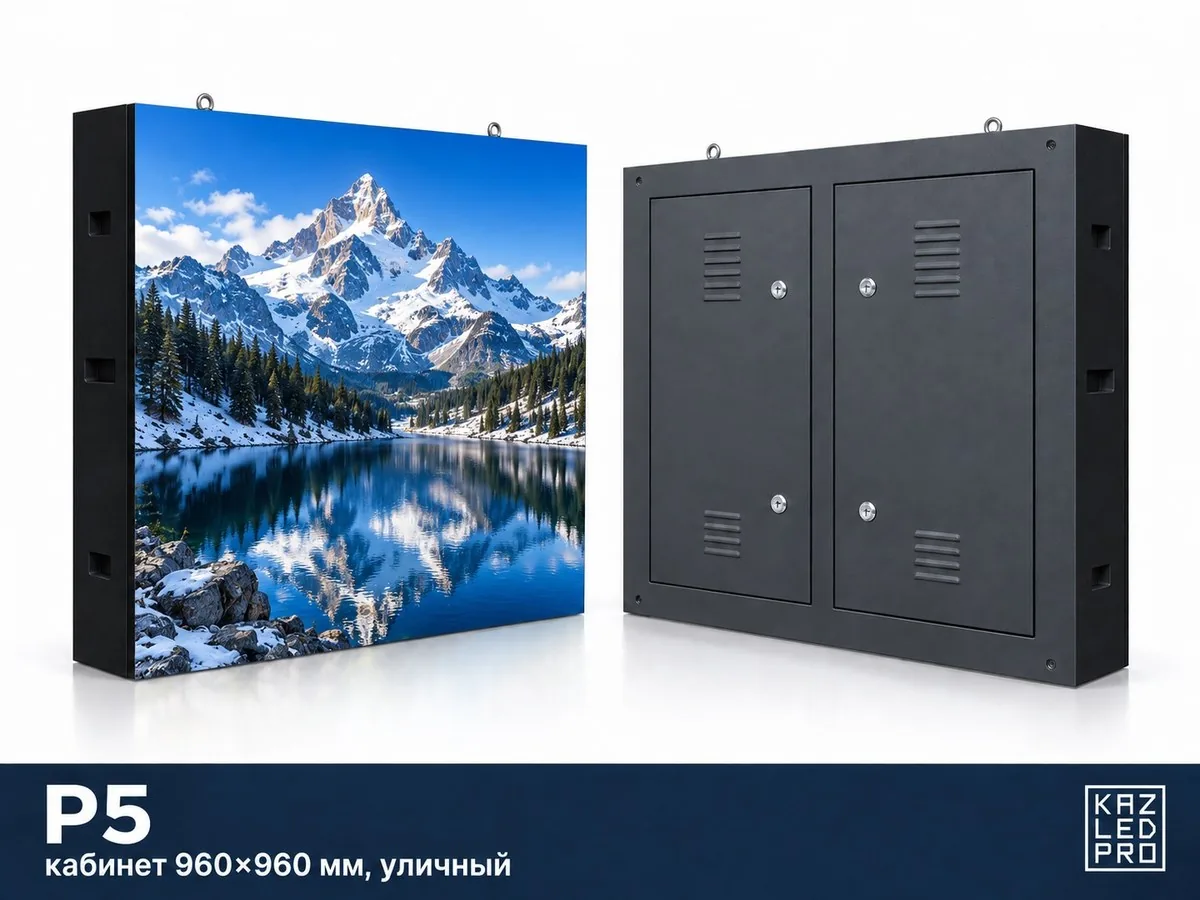 P5
P5Outdoor displays
LED screen P5 for outdoor use — 960×960 mm cabinet
Outdoor screen P5 (960×960 mm cabinet), brightness 5500–7800 cd/m², IP 68. Comfortable viewing from 5 m.
- Brightness
- 5500–7800 cd/m²
- Density
- 40 000 dots/m²
- Protection
- IP 68
Details →
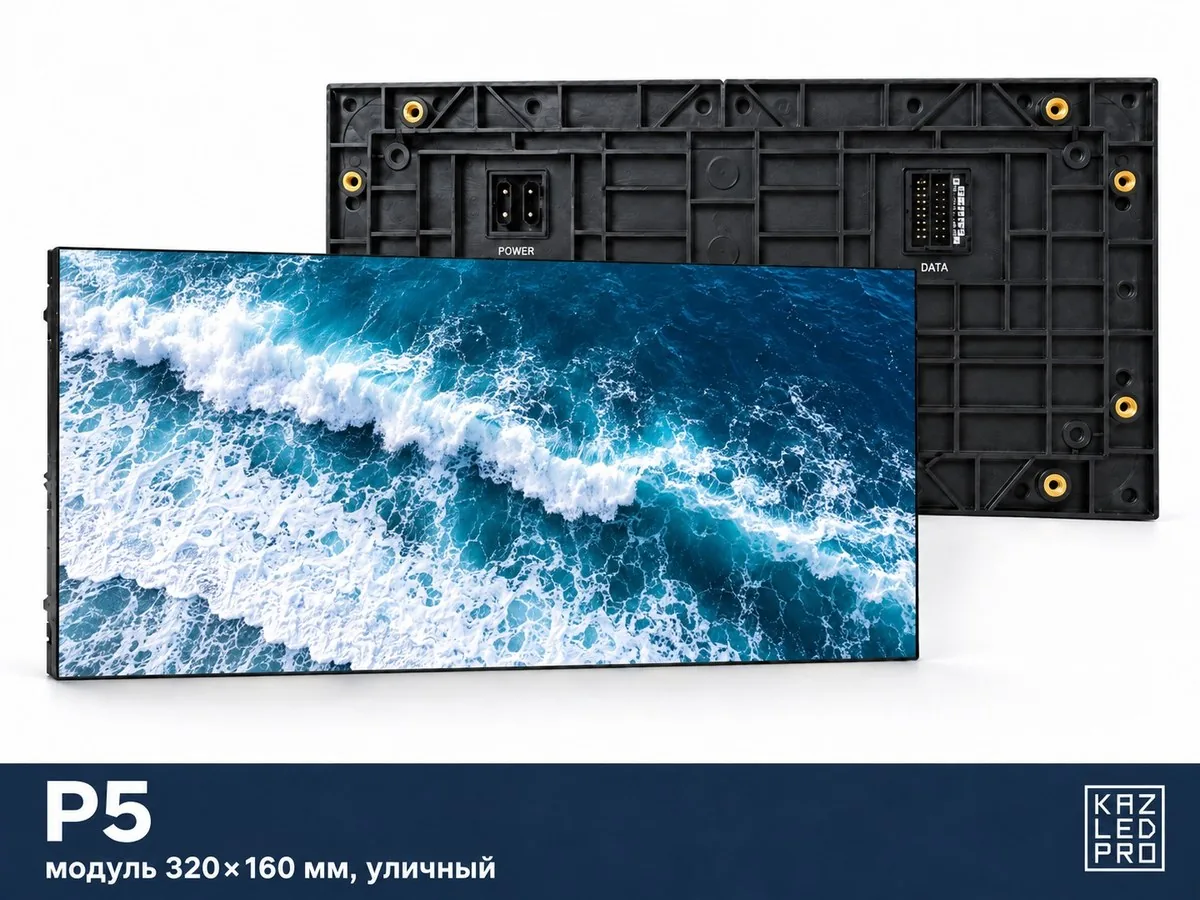 P5
P5Outdoor displays
LED screen P5 for outdoor use — 320×160 mm module
Outdoor screen P5 (320×160 mm module), brightness 5500–7800 cd/m², IP 68. Comfortable viewing from 5 m.
- Brightness
- 5500–7800 cd/m²
- Density
- 40 000 dots/m²
- Protection
- IP 68
Details →
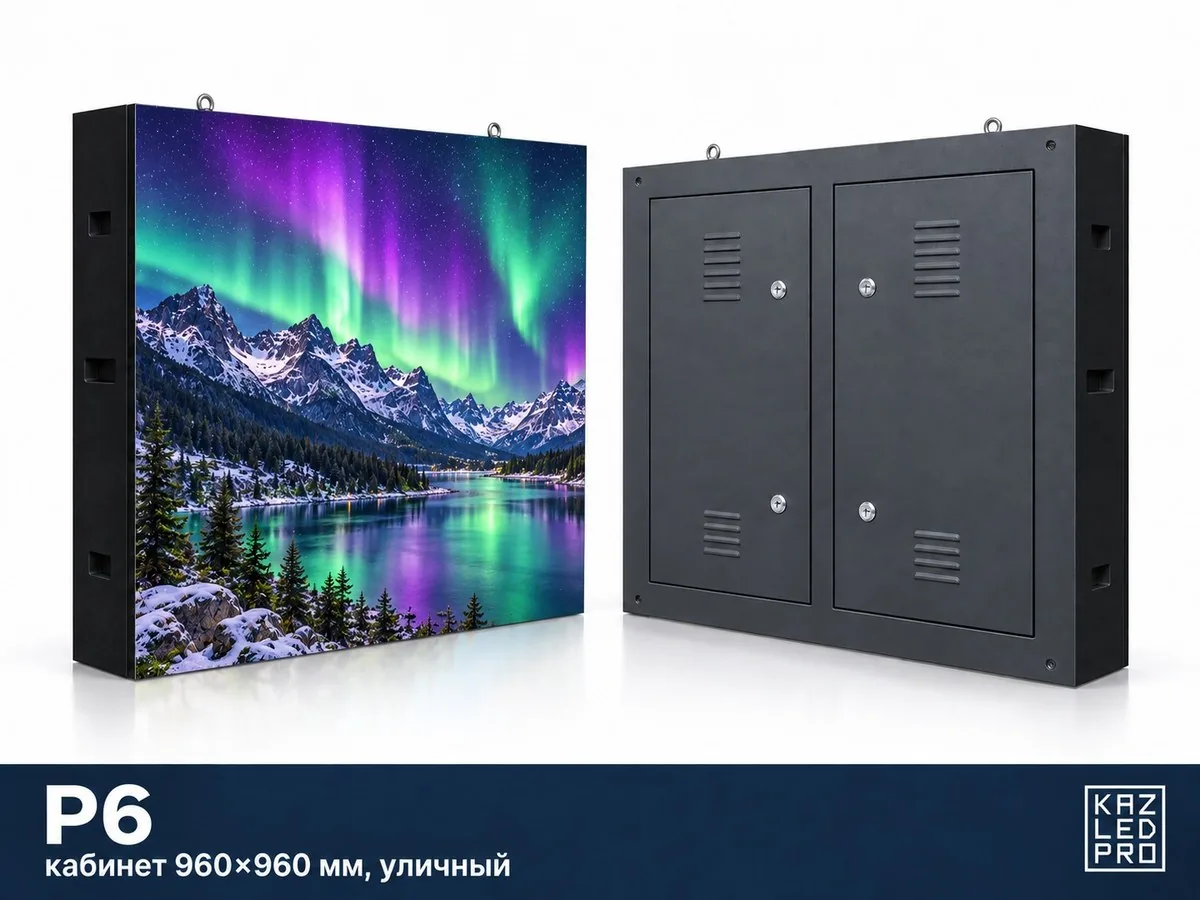 P6
P6Outdoor displays
LED screen P6 for outdoor use — 960×960 mm cabinet
Outdoor screen P6 (960×960 mm cabinet), brightness 5500–7800 cd/m², IP 68. Comfortable viewing from 6 m.
- Brightness
- 5500–7800 cd/m²
- Density
- 22 500 dots/m²
- Protection
- IP 68
Details →
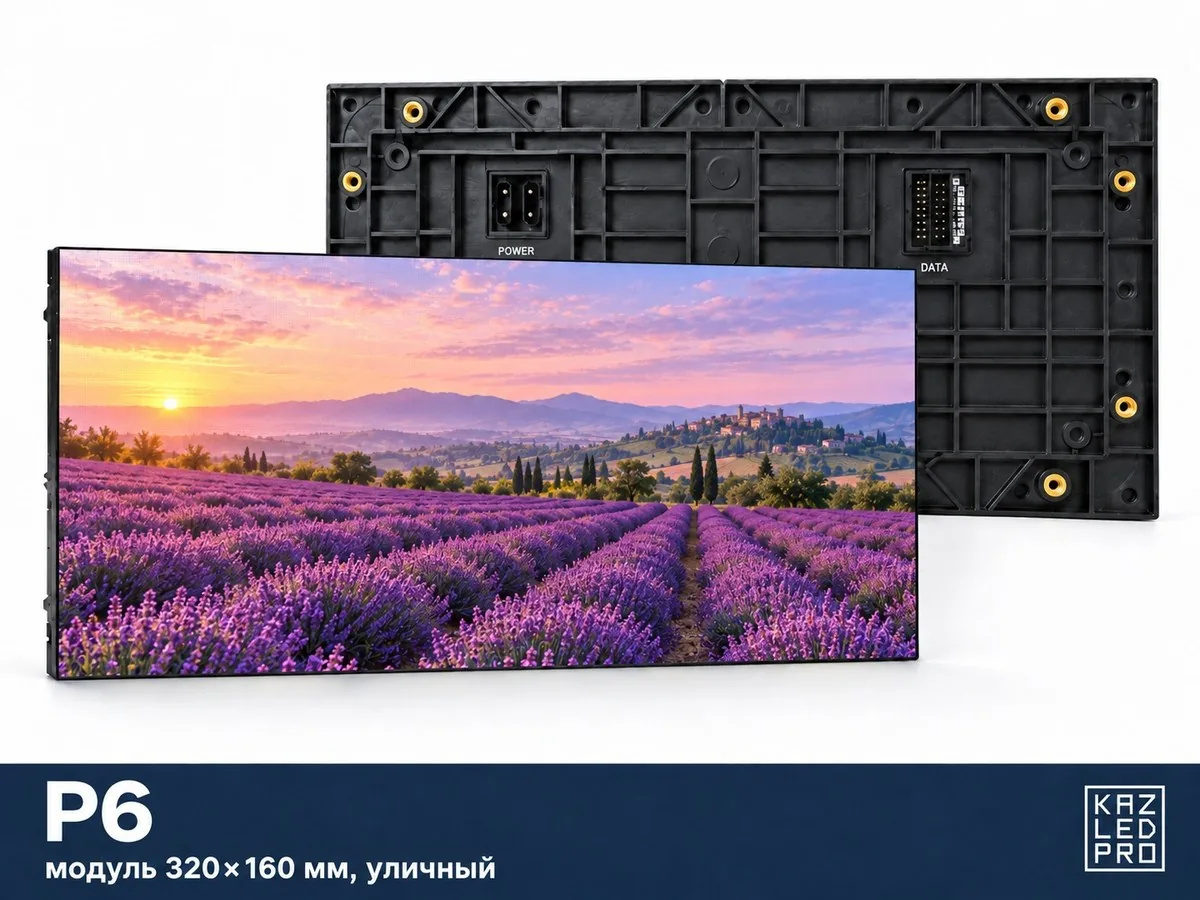 P6
P6Outdoor displays
LED screen P6 for outdoor use — 320×160 mm module
Outdoor screen P6 (320×160 mm module), brightness 5500–7800 cd/m², IP 68. Comfortable viewing from 6 m.
- Brightness
- 5500–7800 cd/m²
- Density
- 22 500 dots/m²
- Protection
- IP 68
Details →
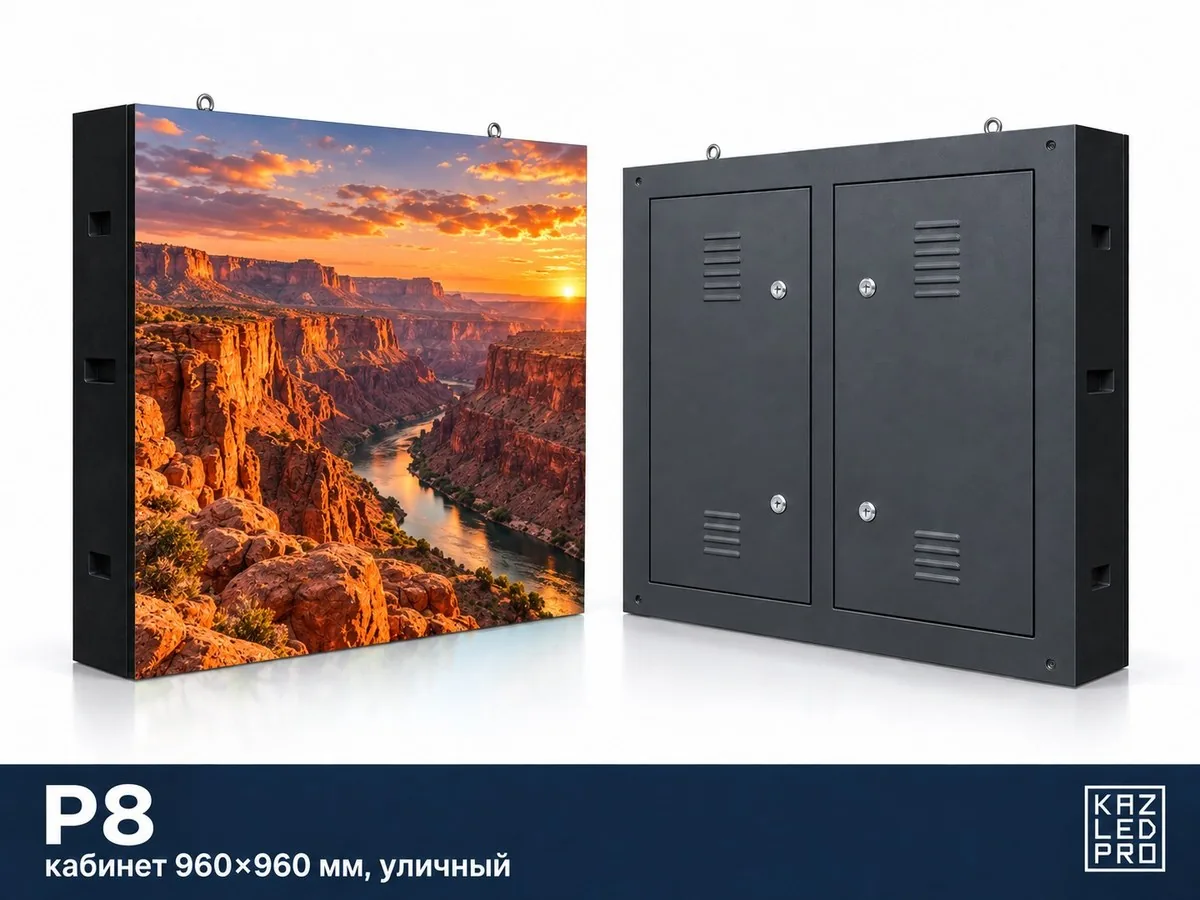 P8
P8Outdoor displays
LED screen P8 for outdoor use — 960×960 mm cabinet
Outdoor screen P8 (960×960 mm cabinet), brightness 5500–7800 cd/m², IP 68. Comfortable viewing from 8 m.
- Brightness
- 5500–7800 cd/m²
- Density
- 15 625 dots/m²
- Protection
- IP 68
Details →
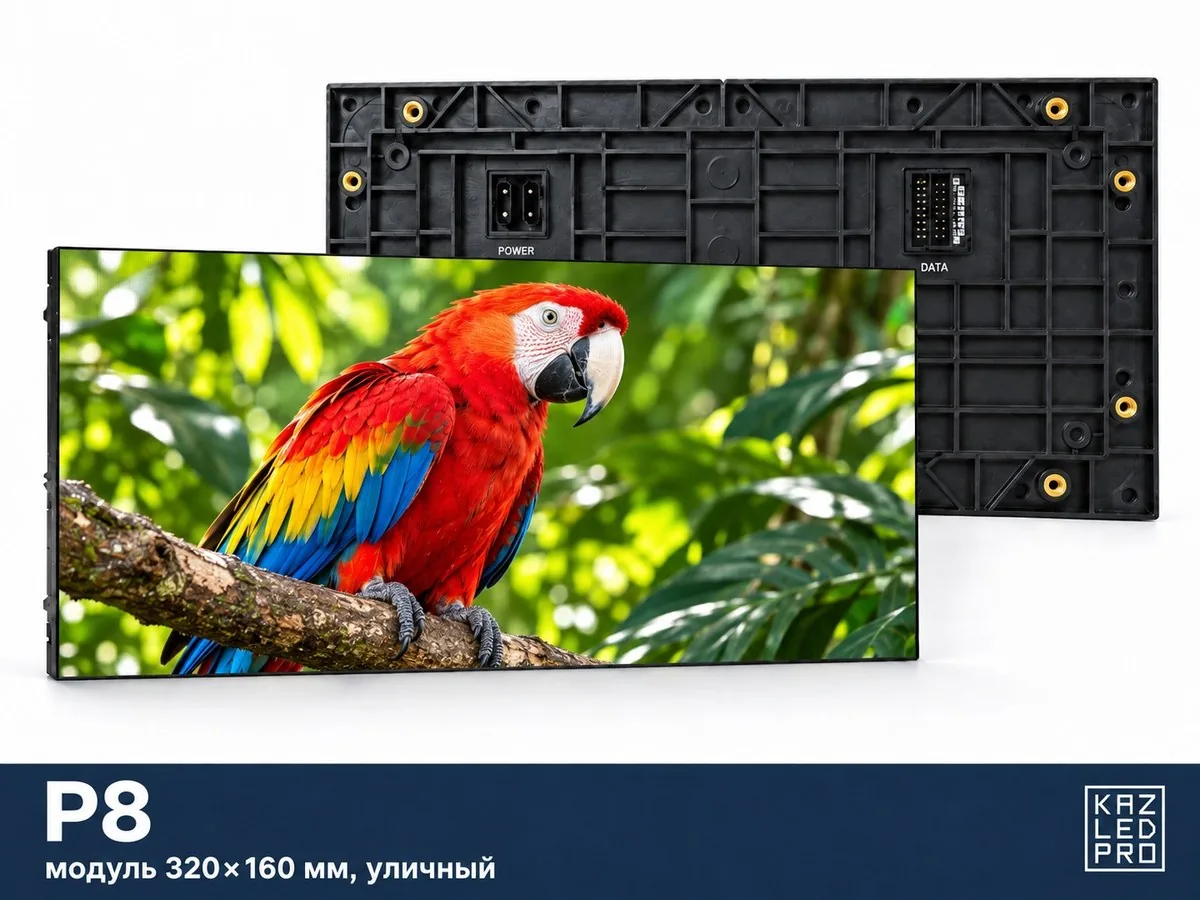 P8
P8Outdoor displays
LED screen P8 for outdoor use — 320×160 mm module
Outdoor screen P8 (320×160 mm module), brightness 5500–7800 cd/m², IP 68. Comfortable viewing from 8 m.
- Brightness
- 5500–7800 cd/m²
- Density
- 15 625 dots/m²
- Protection
- IP 68
Details →
Why this type
5,500–7,800 cd/m², IP68
Outdoor models stay readable against the sun above the stand; brightness drops by itself at night.
Refresh from 3,840 Hz
Perimeter and arena screen appear on TV without banding.
Ball-impact protection
Soft masks and a reinforced frame for the front row of the perimeter.
−40…+50 °C, 100,000 hours
Winter matches and summer sun without shelter; a module is swapped without dismantling.
Projects with such screens
Why an LED display
Warranty of up to 5 years
On screens of our own manufacture and on the equipment we supply.
Brightness control
Different by day and by night — the screen does not dazzle or flood windows with light, and consumption drops.
Service without dismantling
Front, rear or mixed — the module comes off and the structure stays in place.
Round-the-clock operation
LED life of 50–100 thousand hours in continuous use.
Vandal-resistant build
For places where the screen is within arm's reach.
Any shape and size
The screen is assembled from modules, so the dimensions fit the opening and the shape fits the task.
Wide temperature range
Outdoor models operate from −30 to +50 °C.
Installation on any surface
Brick, concrete, glass, an aluminium facade, a free-standing pylon or a roof.
LED screens for stadiums and sports arenas are built from outdoor models: there is no separate stadium series in our catalogue, and we do not invent one for the sake of a headline. The pitch perimeter, the main arena screen and the scoreboard are three different jobs, and each takes its own pixel pitch, panel height and mounting method. This page is about the equipment itself and choosing a model. The arena project as a whole — league regulations, broadcast, power and installation — is covered on the Stadiums and Arenas solution page.
KazLedPro has been building LED screens in Almaty since 2012. Outdoor screens of our series run on facades, squares and roadsides across Kazakhstan, from Aktobe to Astana, and a sports venue gets the same cabinets and modules as a shopping mall. We calculate and weld the steel frame ourselves, installation is done by our own crew, and the module and spares stock is in Almaty. Outdoor 960×960 mm cabinets with 5,500–7,800 cd/m² brightness and IP68 protection stay readable in direct sun above the stands and shrug off rain over the field.
Below: which outdoor P5–P8 screens are in the price list, which goes where, and which parameters drive the configuration. Sizes and resolution for your arena are calculated with the calculator on the site.
Three roles and the pixel pitch for each
The pitch perimeter is a ribbon of screens 0.9–1.2 m high along the edge of the grass. It is watched from the stands and through TV cameras, so what matters is not a fine pitch but even brightness and a refresh rate from 3,840 Hz, so that sponsor ads run on air without banding. We build a ribbon of the required height from outdoor 320×160 mm modules at P5 or P6.67 on our own frame: a 960×960 mm cabinet is too tall for a perimeter. The front row gets soft masks and a reinforced frame — the ball hits it regularly.
The arena screen is the big screen above the stands for replays, score and timing. The farthest spectator sits tens of metres away, so P6.67 or P8 grain is invisible from there, while area and a 16:9 broadcast resolution matter. The scoreboard is the simplest picture: large digits for score and time, pitch P8 and coarser. P10 screens are not listed in the catalogue at the moment, but we have installed them from 960×960 mm cabinets in Aktobe and Astana and supply them to order.
- Pitch perimeter: 320×160 mm modules at P5–P6.67, a 0.9–1.2 m ribbon, masks and a reinforced frame in the front row.
- Arena screen: 960×960 mm cabinets at P6.67–P8, area and resolution sized for broadcast.
- Score and time board: P8 and coarser, simple content, readable from the far stand.
- Fan zones and squares by the arena: a regular outdoor P5–P8 screen with auto-brightness and sound.
- School and university gyms: indoor P2.5–P4 models, covered on the indoor screens page.
What all outdoor models in the catalogue share
Outdoor P5, P6.67 and P8 screens come as 320×160 mm modules or 960×960 mm cabinets and are built on one platform. Brightness is 5,500–7,800 cd/m² with automatic dimming in the evening, so the screen does not dazzle the stands at a night match. IP68 protection front and rear: rain, dust, washing. Operating temperature −40 to +50 °C — winter matches and the summer sun over Kazakhstan are handled without a canopy. Refresh rate from 3,840 Hz, viewing angle 140° horizontally and vertically, so the picture does not fade from the side stands.
A 960×960 mm cabinet weighs 25 kg, a module 436–452 g depending on pitch; maximum power is 650 W/m², average 220 W/m². These figures go straight into the frame and power calculations: a 60 m² arena screen draws about 39 kW at peak and two to three times less on average. Cabinet lifespan is 100,000 hours, and a module is replaced without dismantling the screen.
How the configuration is chosen and where we have done it
We start with three questions: where does the farthest spectator watch from, where will the screen physically stand, and what will it show. Distance gives the pixel pitch; location gives the size, mounting height and frame type on the stand or roof; content gives the resolution and the number of video processor inputs: camera, scoring, advertising, broadcast feed. Then we calculate wind load, power with headroom and signal lines, and only after that quote the number of cabinets. Perimeter requirements differ from league to league, so we ask for the tournament regulations.
Outdoor screens of the same series stand on our sites: a 48 m² corner P5 screen on the facade of Atakent Mall in Almaty (2023), an outdoor P10 built from 960×960 mm cabinets at K. Zhubanov Aktobe Regional University (Aktobe, 2021), and an outdoor P10 for the Bazis company in Astana (2021). For school gyms we have indoor experience: a P4 screen in the sports hall of NGS private school in Almaty (2021). There is no published stadium perimeter in the portfolio yet — we say so plainly and price such a project on the same outdoor models.
How the project goes
- 1
Enquiry and tournament regulations
You send the arena dimensions, the distance to the far stand, where screens are needed and what the league requires of the perimeter. If there are no regulations, we match the typical requirements for your sport.
- 2
Calculation and quotation
We calculate the pitch, area and resolution of each screen, the power and number of lines, and the frame type. A quotation with models, kit and lead times is sent within a day.
- 3
Frame and power design
An engineer visits the site, measures the stand or roof, calculates wind load and fixings, draws the power and signal diagram and agrees it with the stadium operations team.
- 4
Delivery, installation and cabling
Modules and cabinets from the Almaty warehouse or to order, steel structure of our own making, installation by our crew including work at height, cable runs, processor installation.
- 5
Setup, training and service
Brightness calibration, input setup for camera and scoring, operator training, a test match. Warranty of 2–5 years, spares stocked in Almaty, service visits across Kazakhstan.
What the price depends on
The cost of a stadium screen is set not by its role but by its parameters: area, pixel pitch, frame and mounting height. A 200-metre perimeter and a 60 m² arena screen are priced differently. We build the exact estimate from your arena dimensions with the calculator on the site and send a quotation within a day.
Pixel pitch
P5 for the perimeter costs more per square metre than P6.67 and P8 for the arena screen and scoreboard. A fine pitch is justified only where the screen is watched from close range or through a camera.
Area and resolution
The arena screen is counted in square metres, the perimeter in linear metres of ribbon at a given height. A 16:9 broadcast resolution sets the minimum size at the chosen pitch.
Module or cabinet
The perimeter is built from 320×160 mm modules on its own frame, the arena screen from 960×960 mm cabinets. Cabinet assembly is faster to install; modular assembly is more precise in ribbon height.
Steel structure and mounting height
A frame on the stand, roof or a free-standing support, work at height, lifting equipment and wind-load calculation are a significant share of an outdoor arena screen estimate.
Power and control
A peak load of 650 W/m² needs dedicated lines and breakers; a multi-input video processor, camera, scoring system and a match operator are part of the calculation.
Warranty and service
A 2–5 year warranty depending on the model, spares for each delivery stocked in Almaty, pre-season inspections and remote monitoring of screen health.
Questions and answers
What pixel pitch does a stadium screen need?
Rule of thumb: viewing distance in metres roughly equals pitch in millimetres, and the stands watch from tens of metres. P6.67–P8 is enough for the arena screen and scoreboard; the perimeter, which appears in close-up on TV, takes P5–P6.67. Anything finer is money spent for no visible gain.
Do you have dedicated stadium models?
No, and we do not label ordinary outdoor screens as such. A stadium runs on the same outdoor P5–P8 models from the catalogue: 320×160 mm modules and 960×960 mm cabinets with brightness up to 7,800 cd/m² and IP68 protection. For the perimeter we add soft masks, a reinforced frame and a suitable ribbon height.
Is the brightness enough for a daytime match?
Yes. Outdoor models deliver 5,500–7,800 cd/m² — the level used for advertising screens facing the sun on facades and highways. In the evening brightness drops automatically so the screen does not dazzle the stands or the camera. A 140° viewing angle keeps it readable from the side sectors.
How does the screen behave in winter and rain?
Outdoor models operate from −40 to +50 °C with IP68 protection front and rear, so no canopy is needed in winter or in a downpour. Outdoor screens of our series run year-round in Astana and Aktobe. We recommend a pre-season inspection: fixings, seals, power-supply ventilation.
What does the stadium need to provide for power?
Outdoor models draw a maximum of 650 W/m² and an average of 220 W/m². A 60 m² arena screen takes about 39 kW at peak, so dedicated lines with breakers and earthing are needed, and a three-phase supply for larger areas. Exact figures and the number of lines are given in the technical specification that comes with the quotation.
Can a stadium screen be bought through a tender?
Yes. KazLedPro is listed in the register of domestic producers with an industrial certificate, which counts in public procurement. We prepare the full package: technical specifications, certificates of conformity, warranty obligations, proof of similar deliveries. After the award — delivery, installation, commissioning, acts and the screen passport.
How long do delivery and installation take?
It depends on the area and the frame. Modules and cabinets of popular outdoor models are in stock in Almaty; large batches and P10 come to order. The steel structure is fabricated in parallel with delivery. The exact schedule with a test-match date is fixed in the contract after the site survey.
Do you work with arenas in other cities of Kazakhstan?
Yes. We have installed outdoor screens in Astana, Aktobe, Taldykorgan and Aktau, and our travelling crew works nationwide. Survey, installation and commissioning are done on site; maintenance is by contract with visits or remotely through screen health monitoring.
A turnkey screen: quote, installation, launch.
Send us the dimensions and location — a quote today. WhatsApp around the clock.