
Products
Outdoor LED screens
Brightness 5,500–7,800 cd/m², IP68 protection, pitch P2–P10. Facades, pylons, squares, roads, stadiums — visible in direct sun and rain.
Where it goes
Advertising screens on facades
Sell airtime or run your own content — the screen pays for itself.
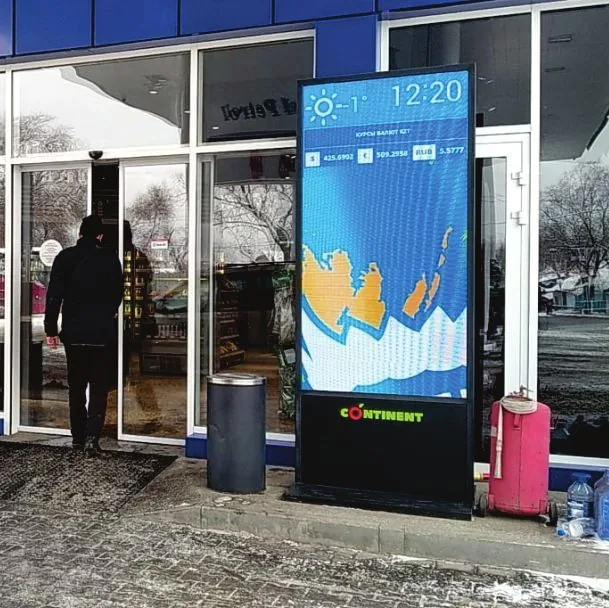
Pylons by roads and petrol stations
Prices and offers change in a minute from a phone.
Squares and parks
Broadcasts of holidays and matches, city information.
Mall entrances
Posters and wayfinding visible from the car park.
Price
from 300,000 ₸ per m²
The exact price depends on pixel pitch, area and structure. We send a quote within one working day.
Models from the price list
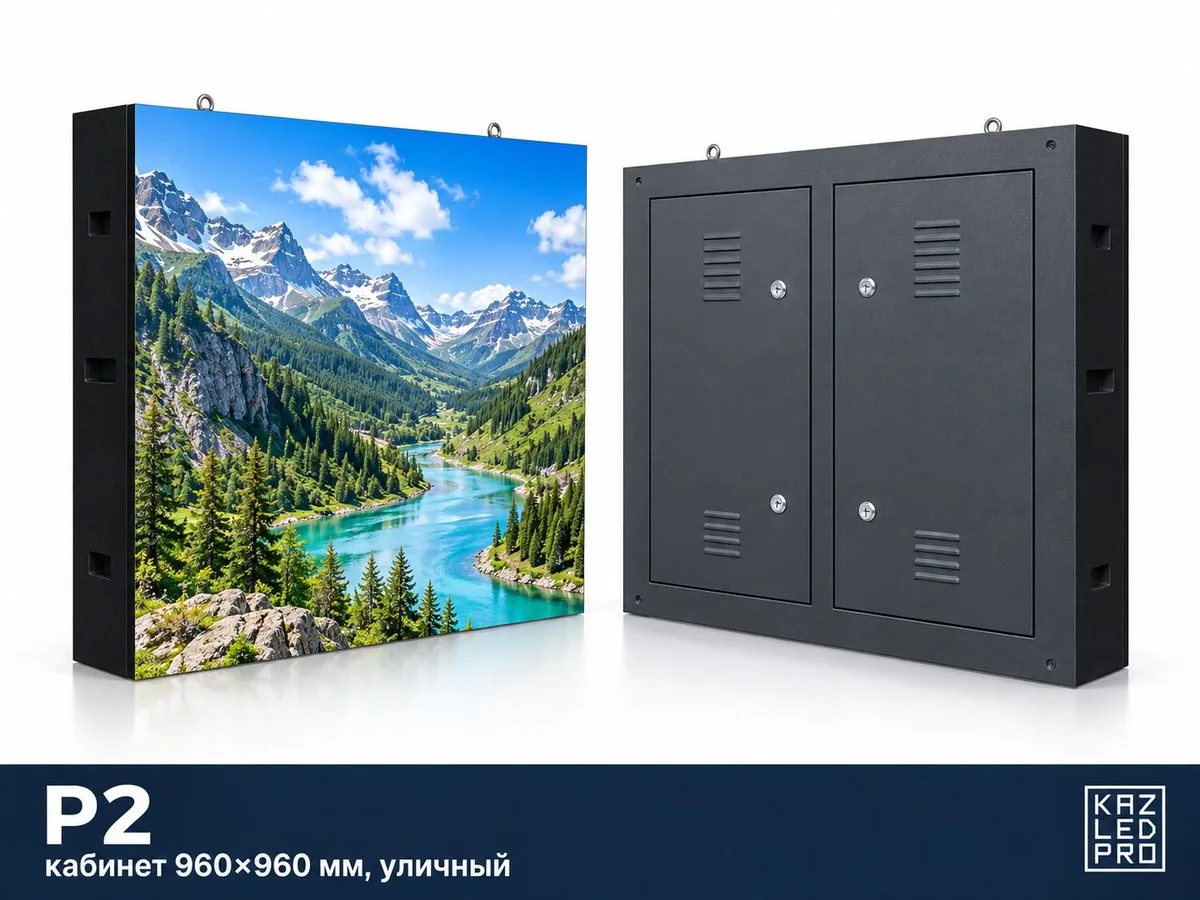 P2
P2Outdoor displays
LED screen P2 for outdoor use — 960×960 mm cabinet
Outdoor screen P2 (960×960 mm cabinet), brightness 5500–7800 cd/m², IP 68. Comfortable viewing from 2 m.
- Brightness
- 5500–7800 cd/m²
- Density
- 250 000 dots/m²
- Protection
- IP 68
Details →
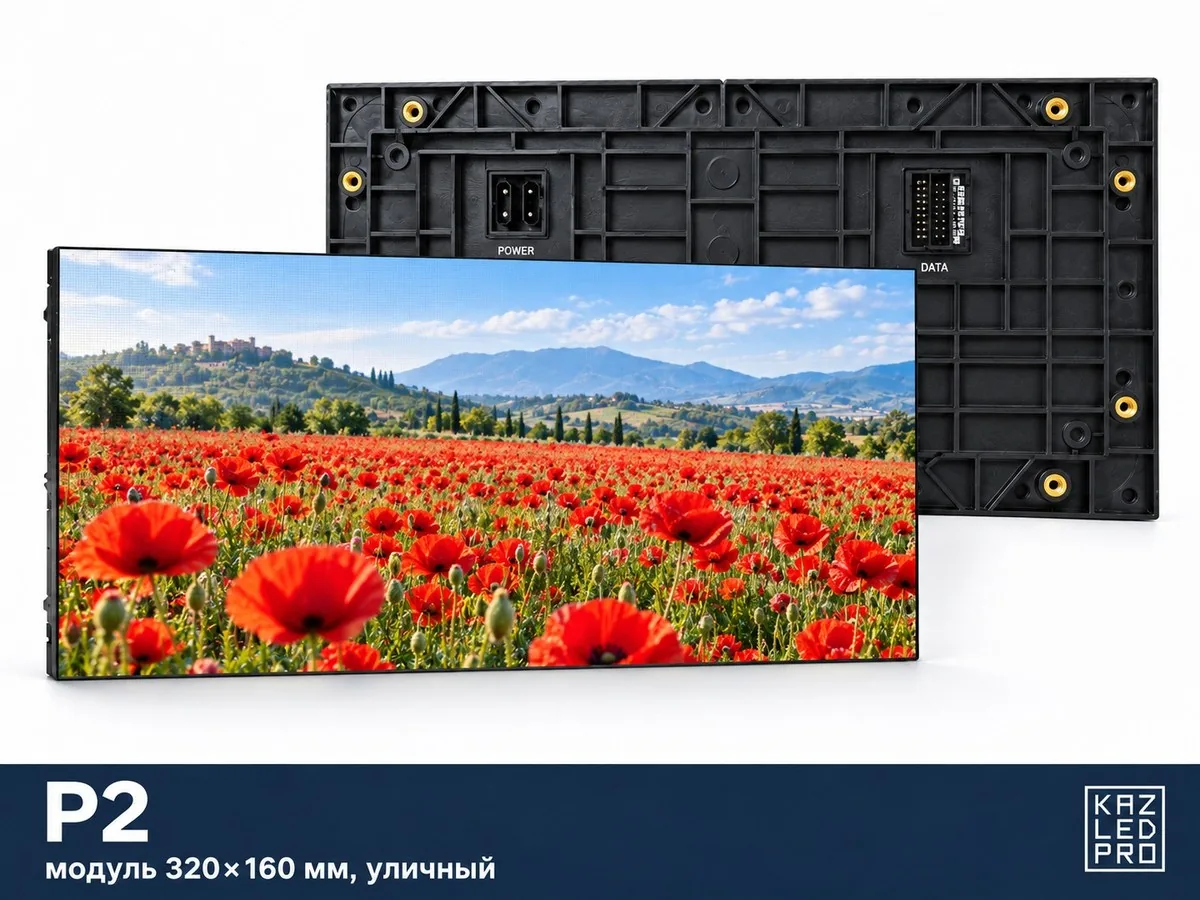 P2
P2Outdoor displays
LED screen P2 for outdoor use — 320×160 mm module
Outdoor screen P2 (320×160 mm module), brightness 5500–7800 cd/m², IP 68. Comfortable viewing from 2 m.
- Brightness
- 5500–7800 cd/m²
- Density
- 250 000 dots/m²
- Protection
- IP 68
Details →
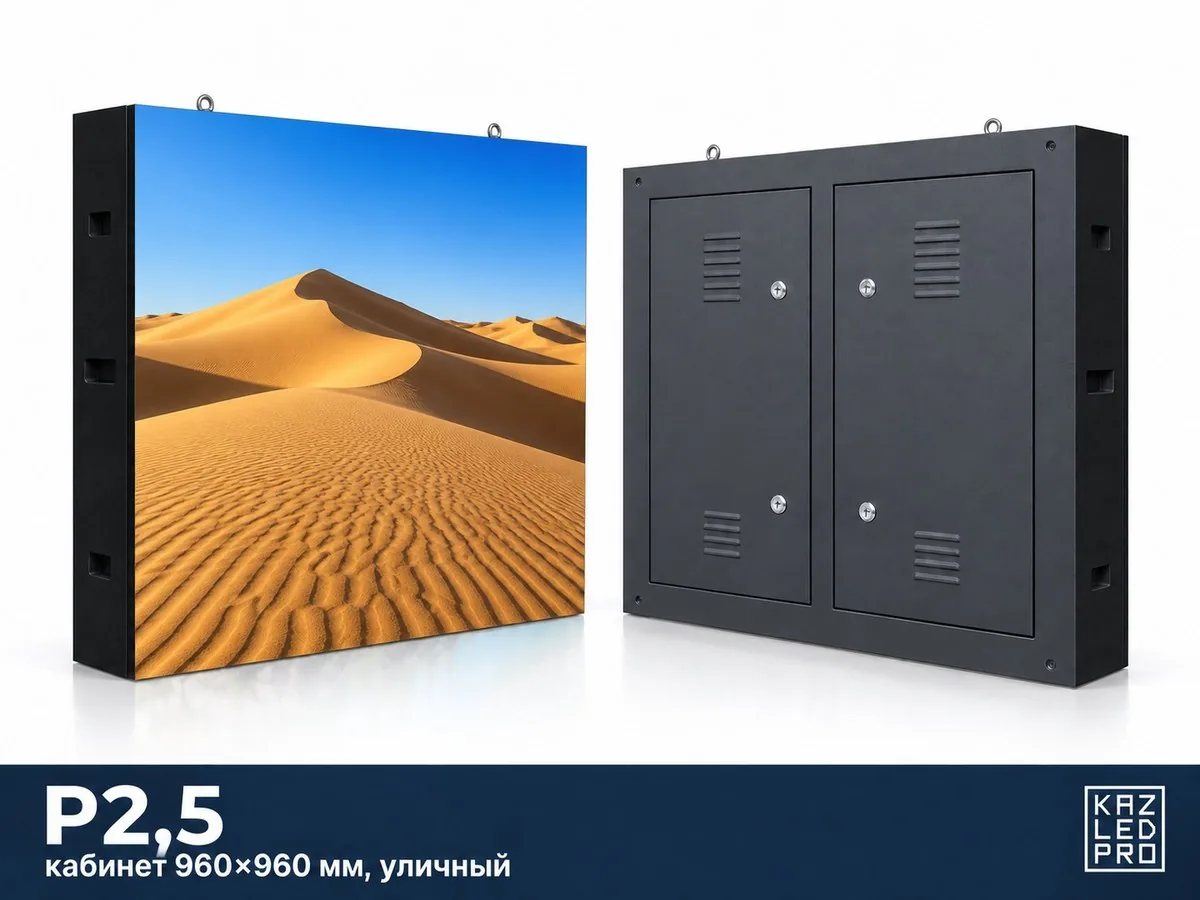 P2.5
P2.5Outdoor displays
LED screen P2.5 for outdoor use — 960×960 mm cabinet
Outdoor screen P2.5 (960×960 mm cabinet), brightness 5500–7800 cd/m², IP 68. Comfortable viewing from 2 m.
- Brightness
- 5500–7800 cd/m²
- Density
- 160 000 dots/m²
- Protection
- IP 68
Details →
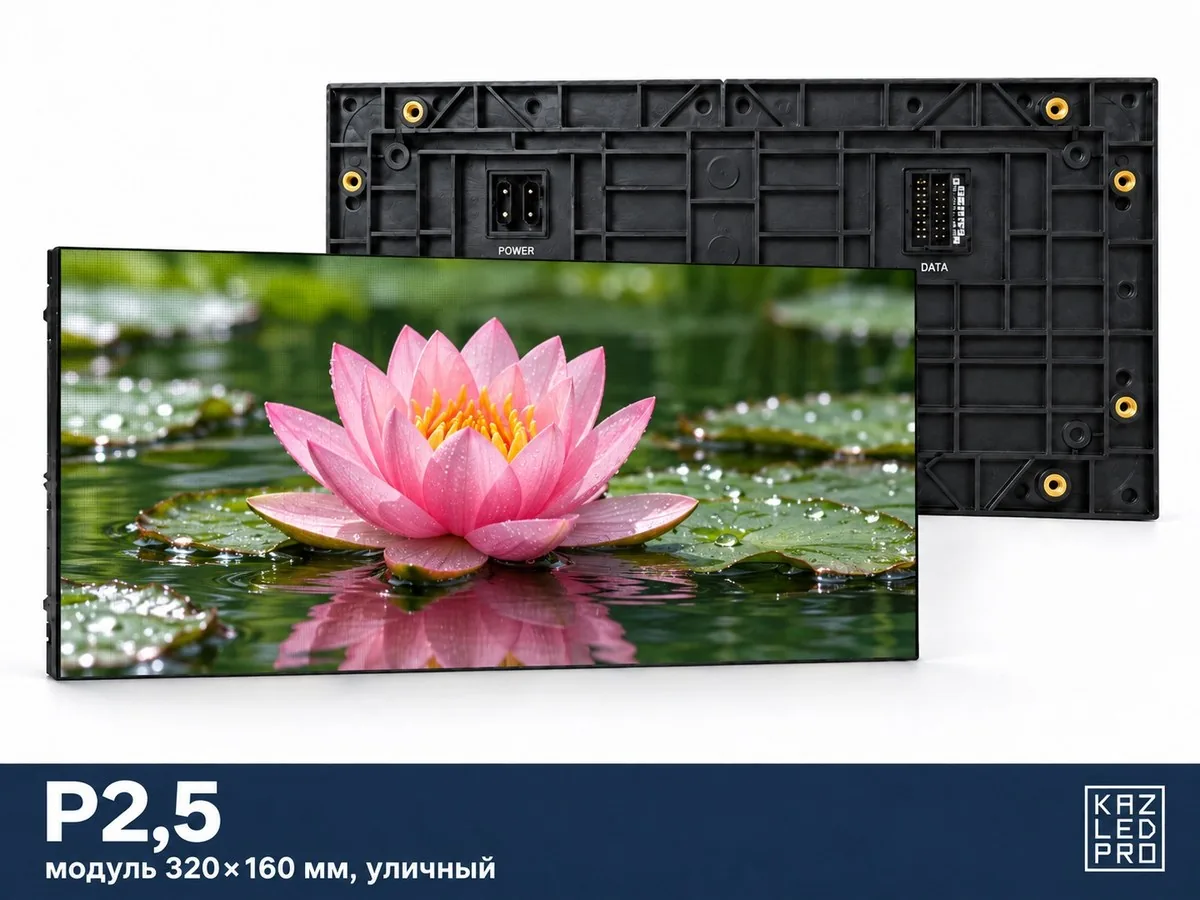 P2.5
P2.5Outdoor displays
LED screen P2.5 for outdoor use — 320×160 mm module
Outdoor screen P2.5 (320×160 mm module), brightness 5500–7800 cd/m², IP 68. Comfortable viewing from 2 m.
- Brightness
- 5500–7800 cd/m²
- Density
- 160 000 dots/m²
- Protection
- IP 68
Details →
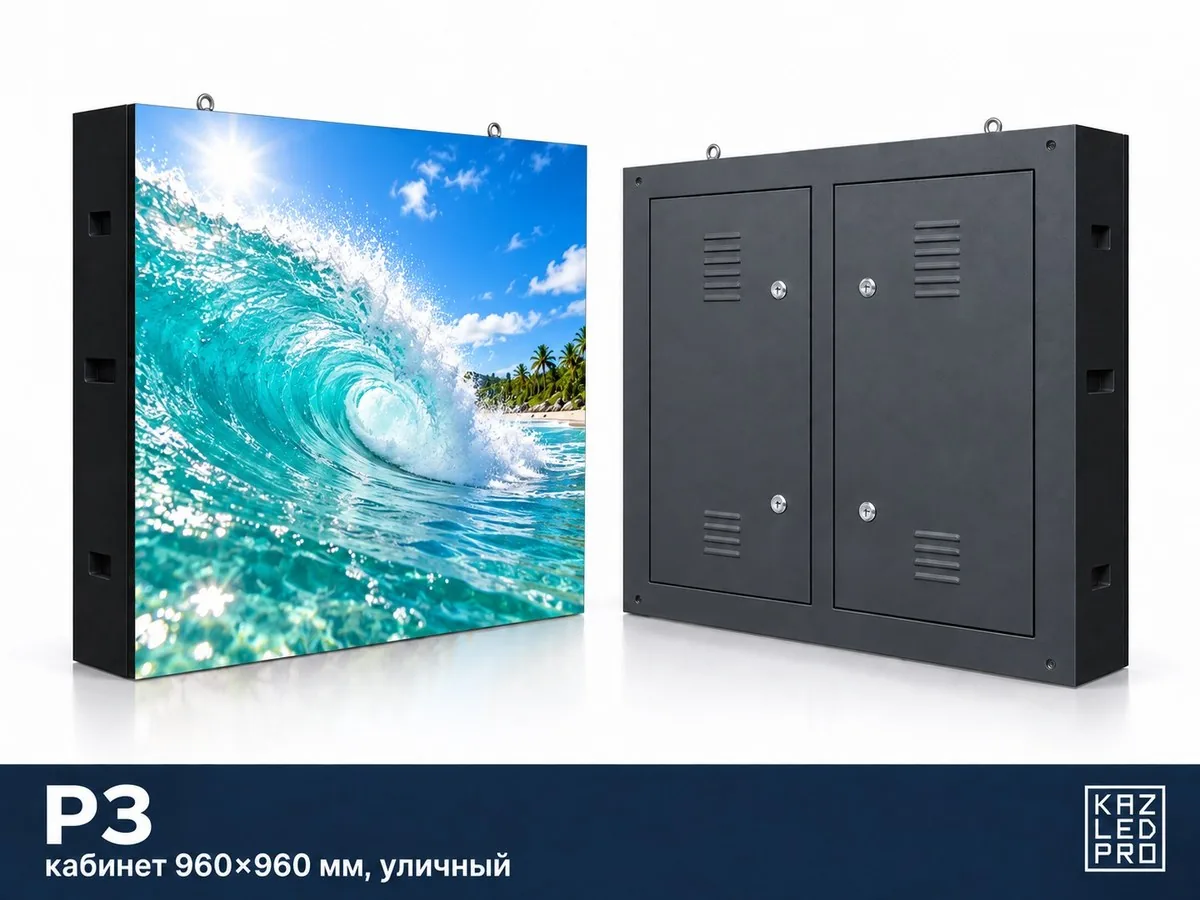 P3
P3Outdoor displays
LED screen P3 for outdoor use — 960×960 mm cabinet
Outdoor screen P3 (960×960 mm cabinet), brightness 5500–7800 cd/m², IP 68. Comfortable viewing from 3 m.
- Brightness
- 5500–7800 cd/m²
- Density
- 105 625 dots/m²
- Protection
- IP 68
Details →
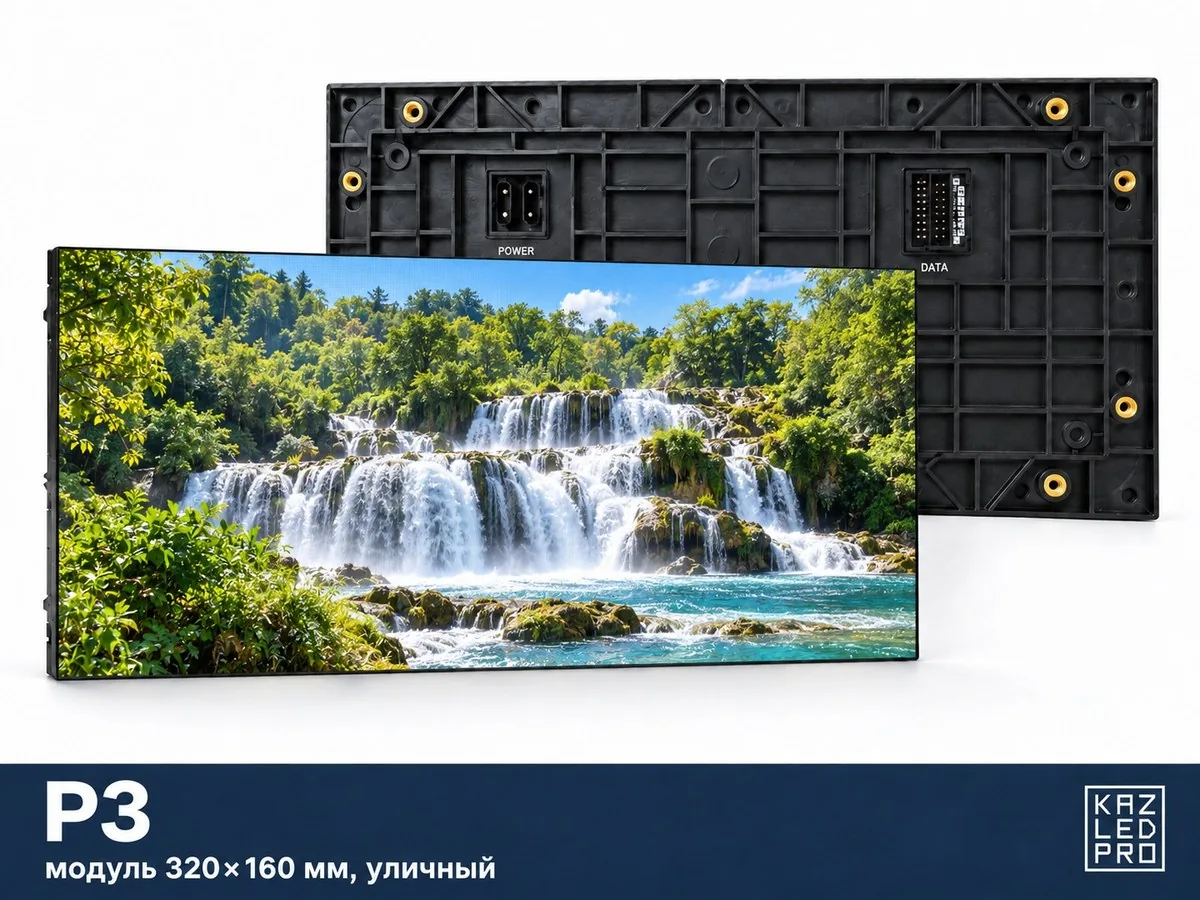 P3
P3Outdoor displays
LED screen P3 for outdoor use — 320×160 mm module
Outdoor screen P3 (320×160 mm module), brightness 5500–7800 cd/m², IP 68. Comfortable viewing from 3 m.
- Brightness
- 5500–7800 cd/m²
- Density
- 105 625 dots/m²
- Protection
- IP 68
Details →
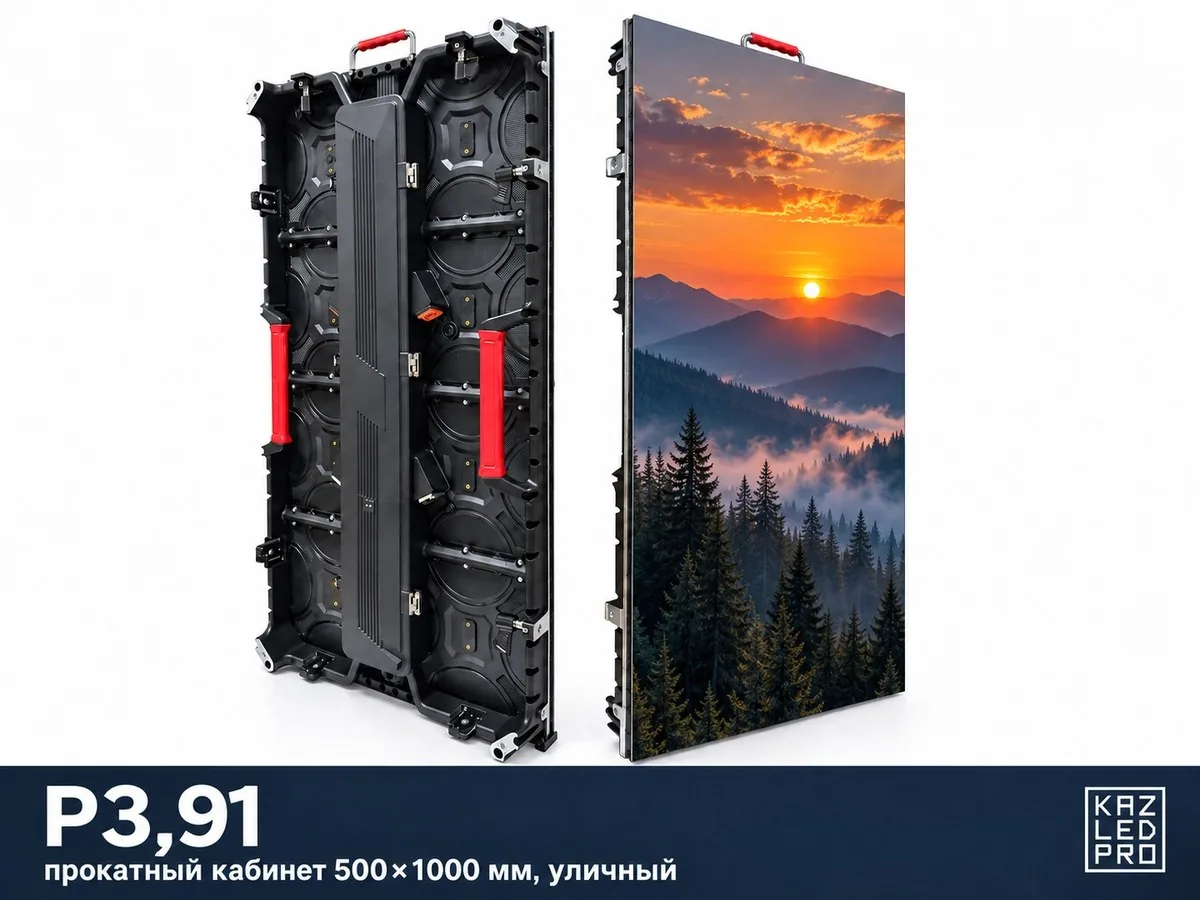 P3.91
P3.91Outdoor displays
LED screen P3.91 for outdoor use — 500×1000 mm cabinet
Outdoor screen P3.91 (500×1000 mm cabinet), brightness 5500–7800 cd/m², IP 68. Comfortable viewing from 4 m.
- Brightness
- 5500–7800 cd/m²
- Density
- 65 536 dots/m²
- Protection
- IP 68
Details →
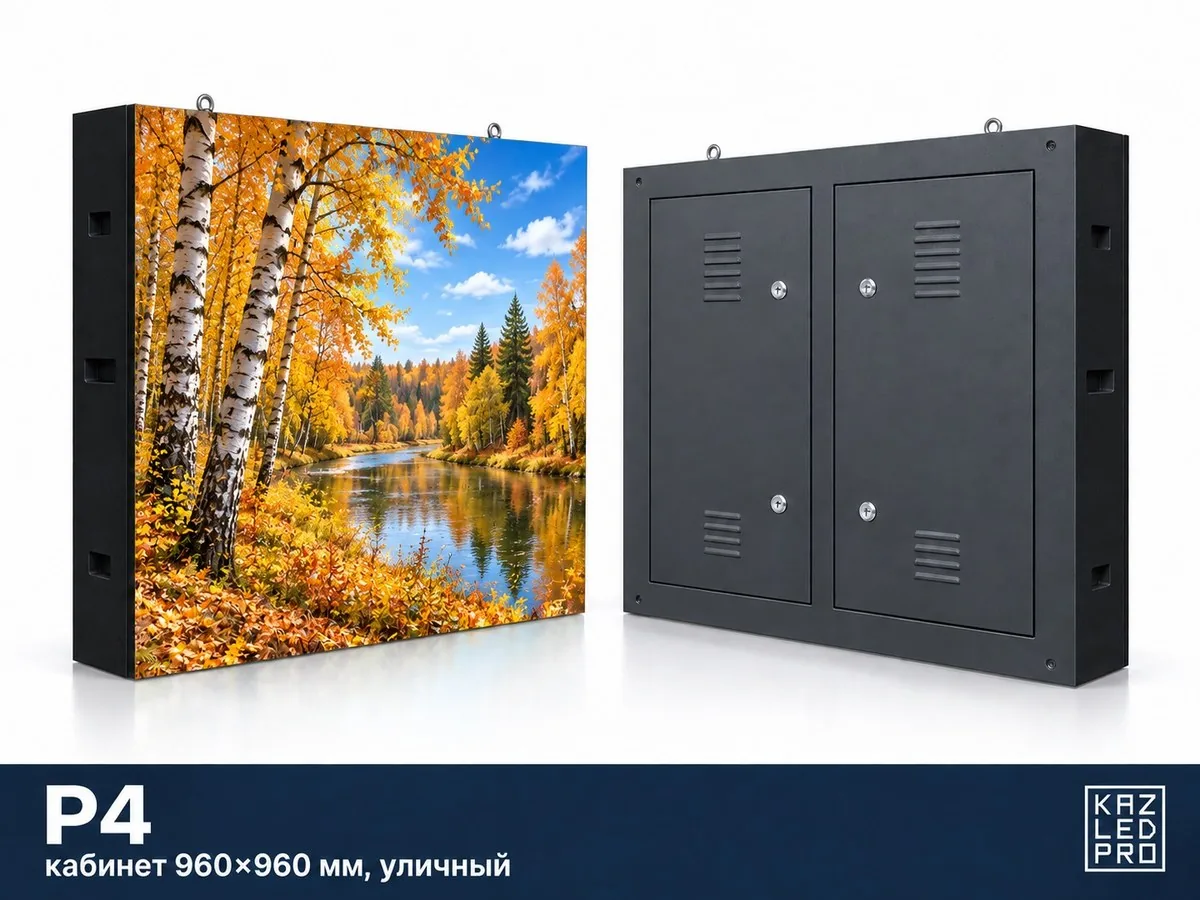 P4
P4Outdoor displays
LED screen P4 for outdoor use — 960×960 mm cabinet
Outdoor screen P4 (960×960 mm cabinet), brightness 5500–7800 cd/m², IP 68. Comfortable viewing from 4 m.
- Brightness
- 5500–7800 cd/m²
- Density
- 62 500 dots/m²
- Protection
- IP 68
Details →
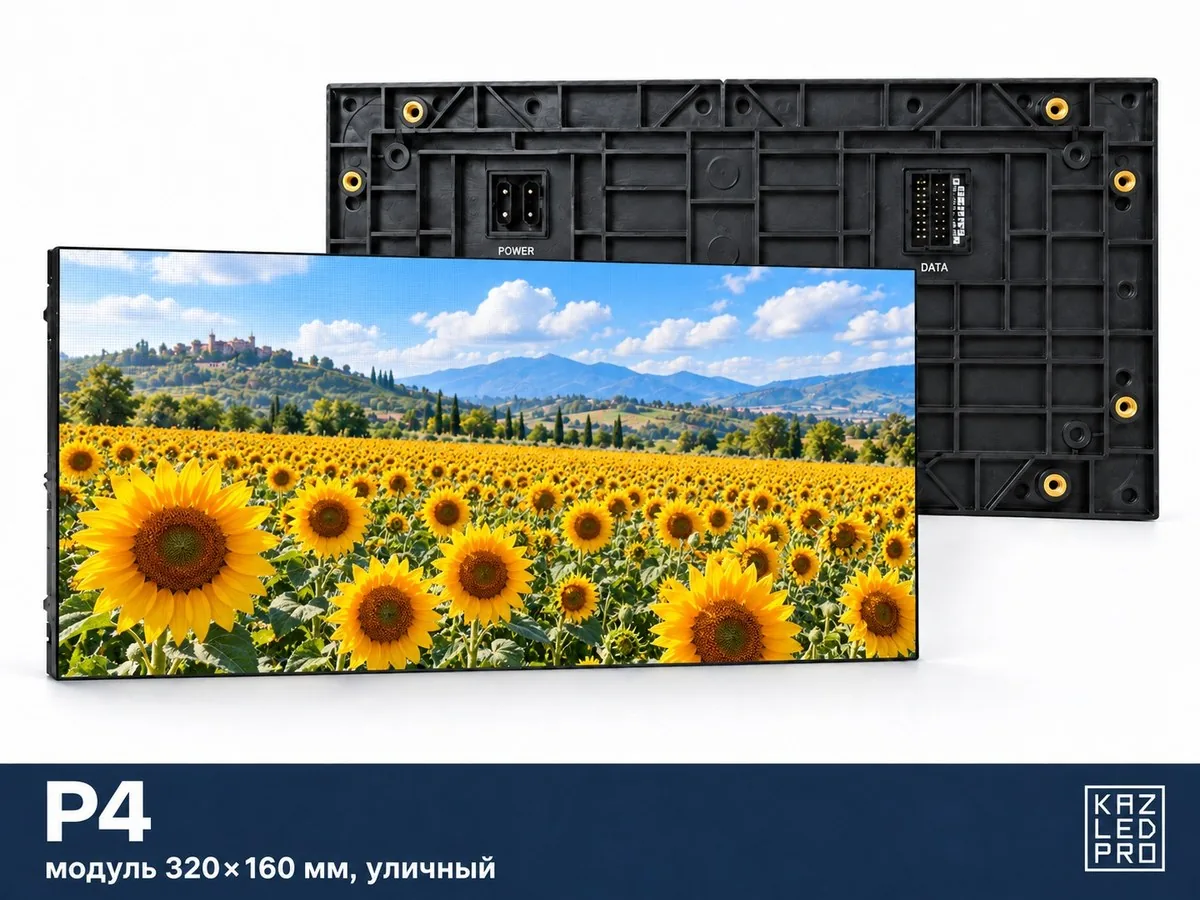 P4
P4Outdoor displays
LED screen P4 for outdoor use — 320×160 mm module
Outdoor screen P4 (320×160 mm module), brightness 5500–7800 cd/m², IP 68. Comfortable viewing from 4 m.
- Brightness
- 5500–7800 cd/m²
- Density
- 62 500 dots/m²
- Protection
- IP 68
Details →
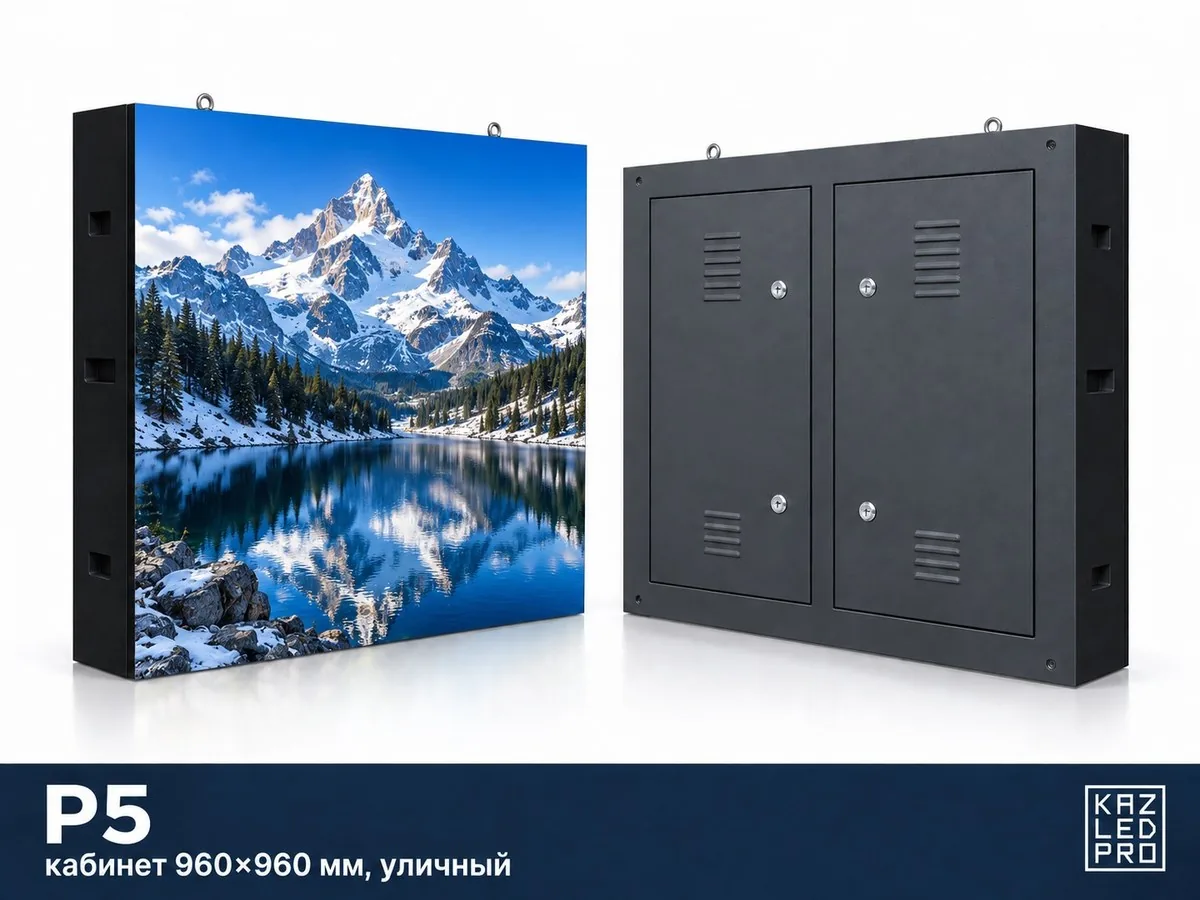 P5
P5Outdoor displays
LED screen P5 for outdoor use — 960×960 mm cabinet
Outdoor screen P5 (960×960 mm cabinet), brightness 5500–7800 cd/m², IP 68. Comfortable viewing from 5 m.
- Brightness
- 5500–7800 cd/m²
- Density
- 40 000 dots/m²
- Protection
- IP 68
Details →
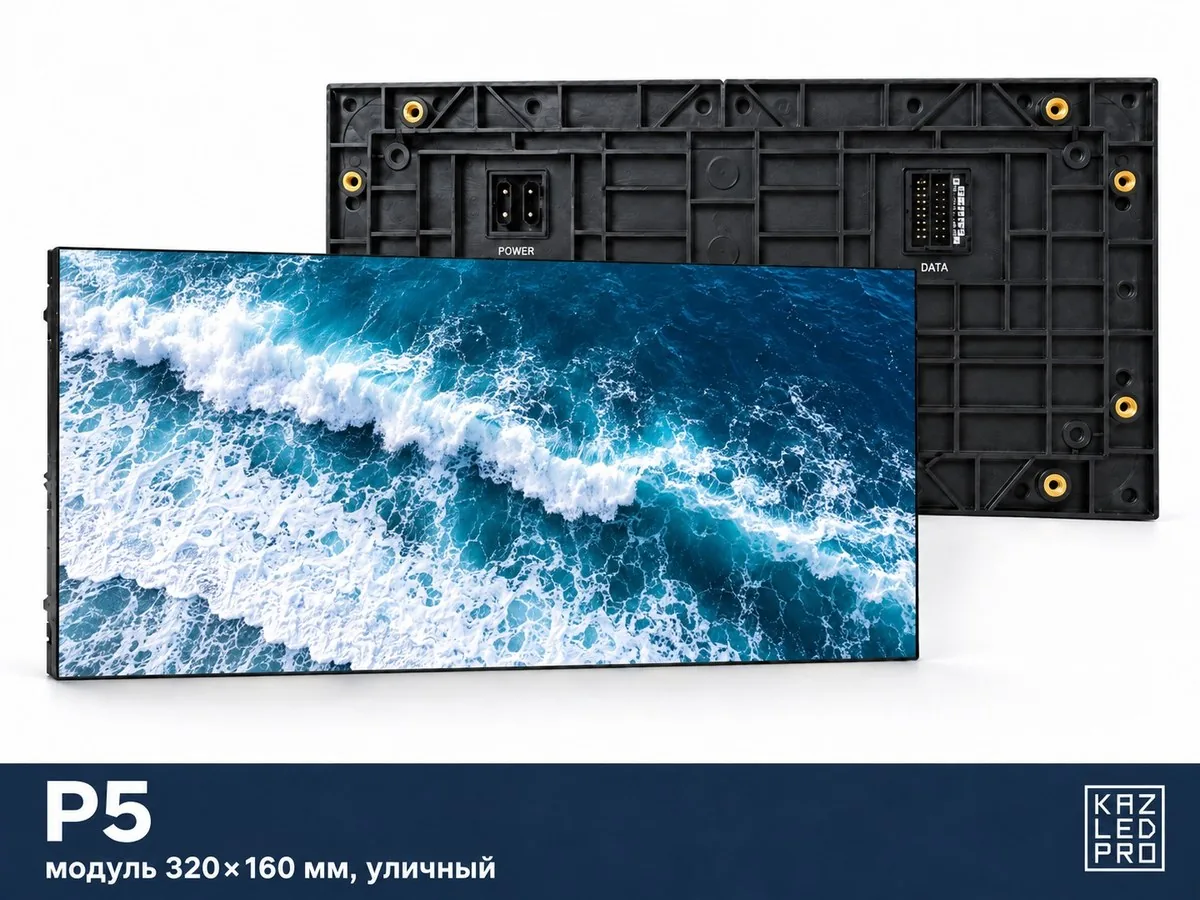 P5
P5Outdoor displays
LED screen P5 for outdoor use — 320×160 mm module
Outdoor screen P5 (320×160 mm module), brightness 5500–7800 cd/m², IP 68. Comfortable viewing from 5 m.
- Brightness
- 5500–7800 cd/m²
- Density
- 40 000 dots/m²
- Protection
- IP 68
Details →
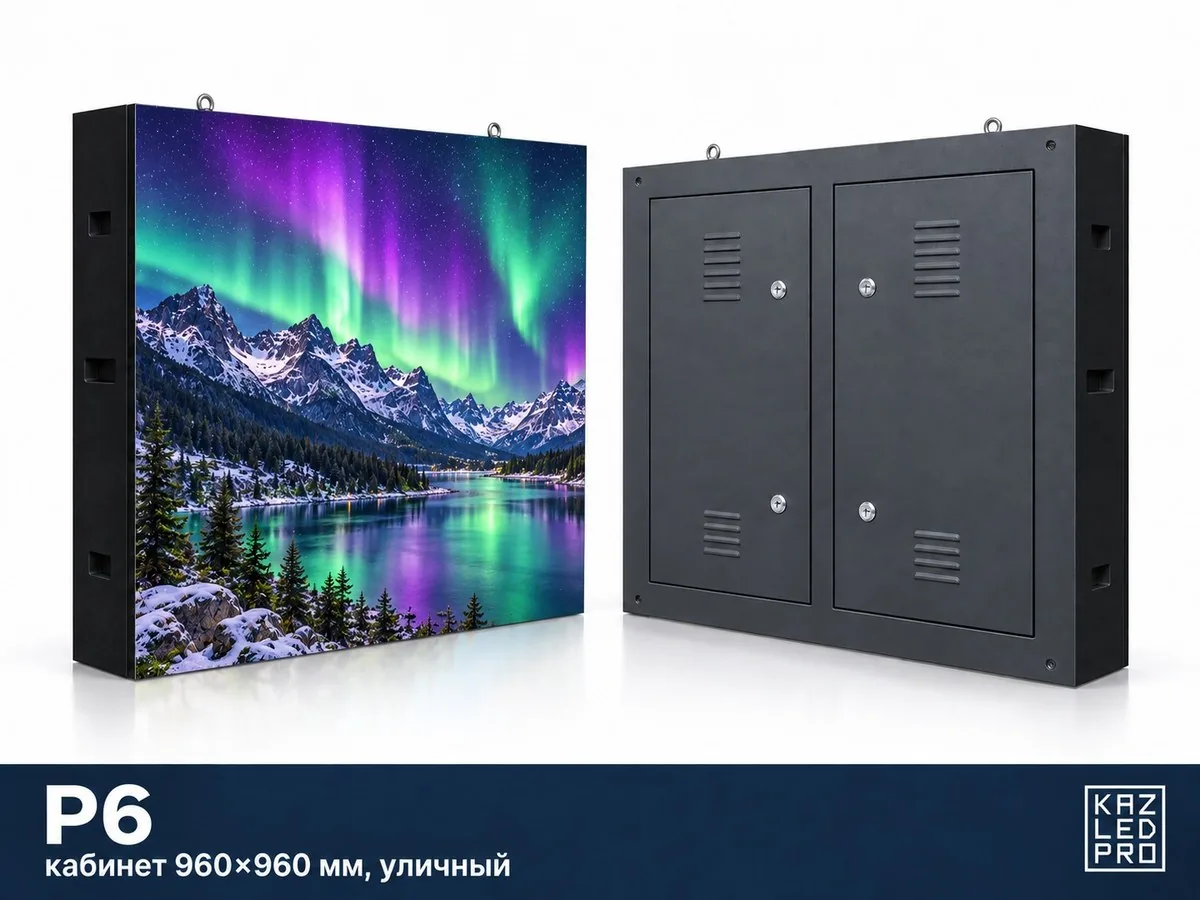 P6
P6Outdoor displays
LED screen P6 for outdoor use — 960×960 mm cabinet
Outdoor screen P6 (960×960 mm cabinet), brightness 5500–7800 cd/m², IP 68. Comfortable viewing from 6 m.
- Brightness
- 5500–7800 cd/m²
- Density
- 22 500 dots/m²
- Protection
- IP 68
Details →
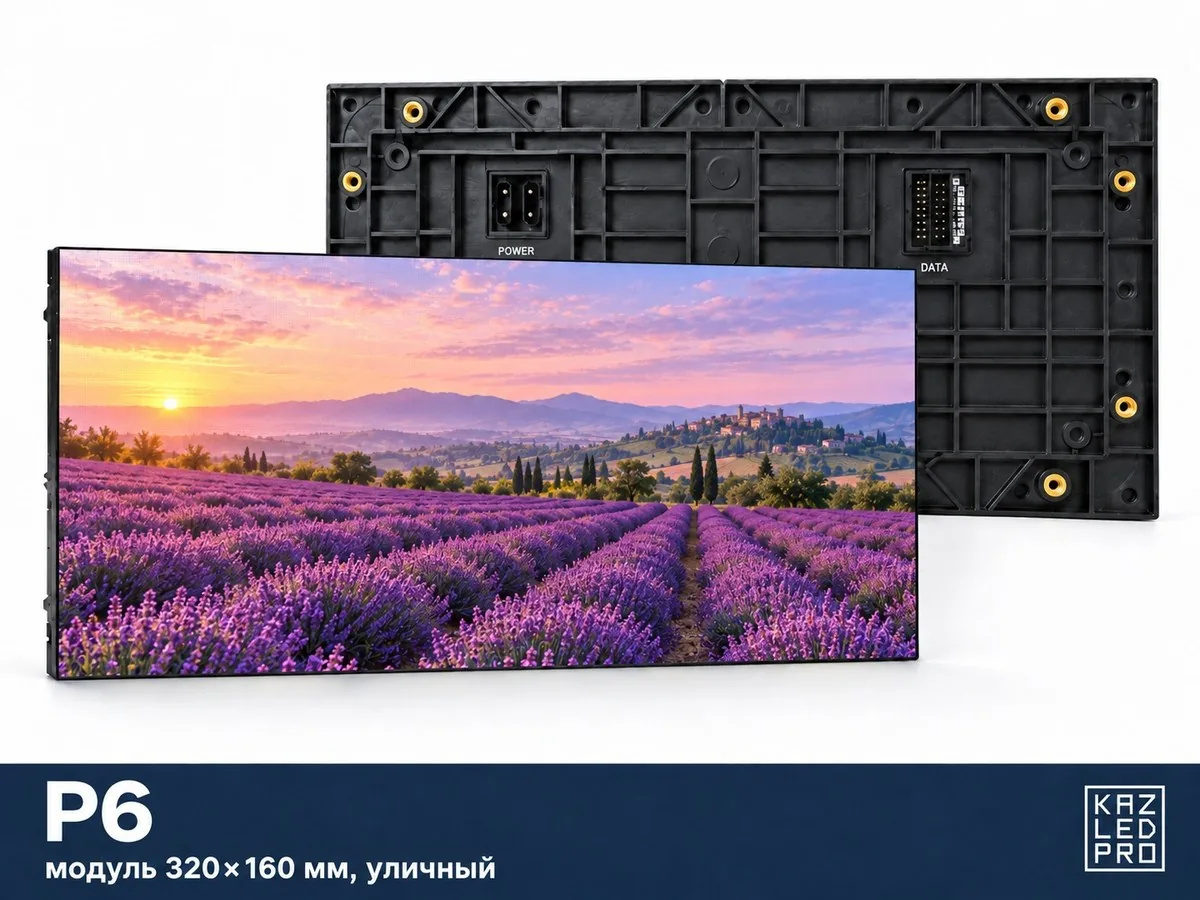 P6
P6Outdoor displays
LED screen P6 for outdoor use — 320×160 mm module
Outdoor screen P6 (320×160 mm module), brightness 5500–7800 cd/m², IP 68. Comfortable viewing from 6 m.
- Brightness
- 5500–7800 cd/m²
- Density
- 22 500 dots/m²
- Protection
- IP 68
Details →
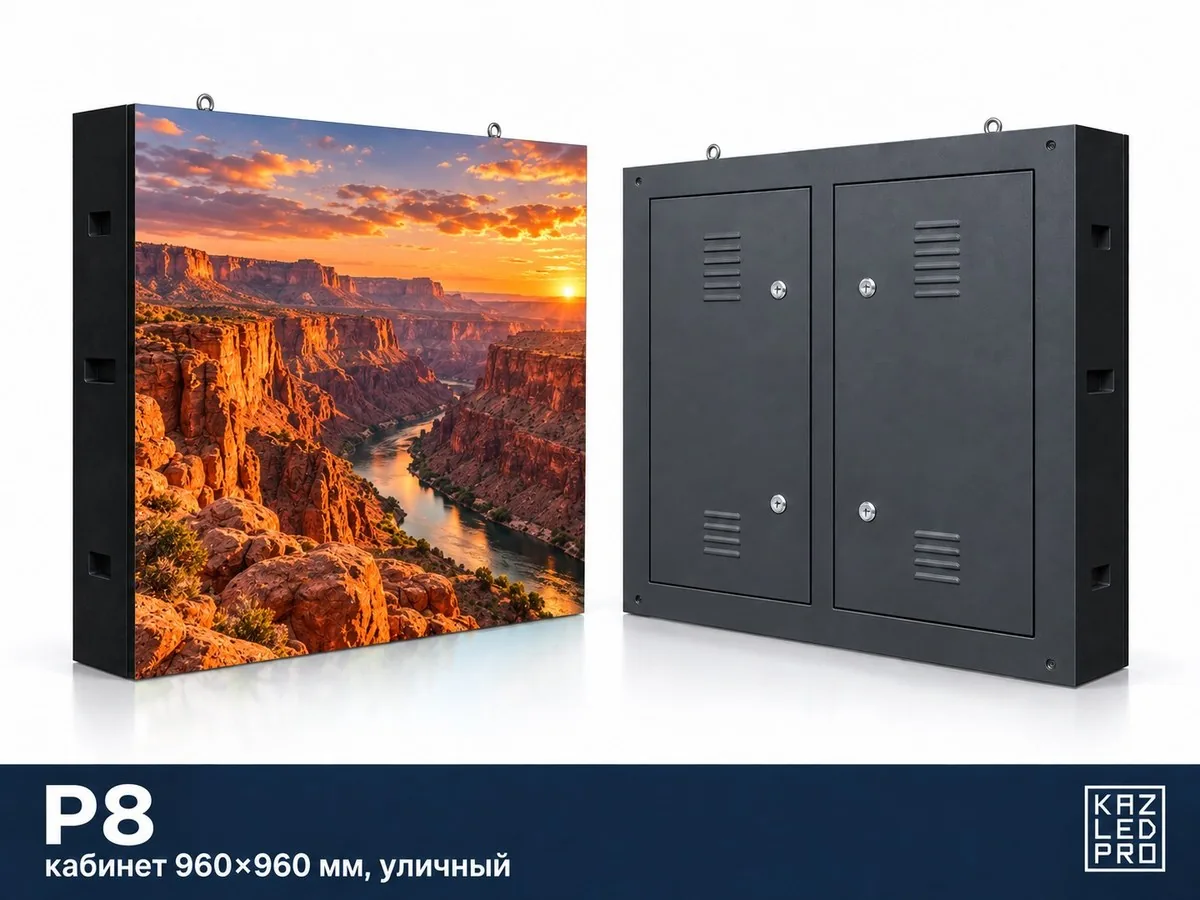 P8
P8Outdoor displays
LED screen P8 for outdoor use — 960×960 mm cabinet
Outdoor screen P8 (960×960 mm cabinet), brightness 5500–7800 cd/m², IP 68. Comfortable viewing from 8 m.
- Brightness
- 5500–7800 cd/m²
- Density
- 15 625 dots/m²
- Protection
- IP 68
Details →
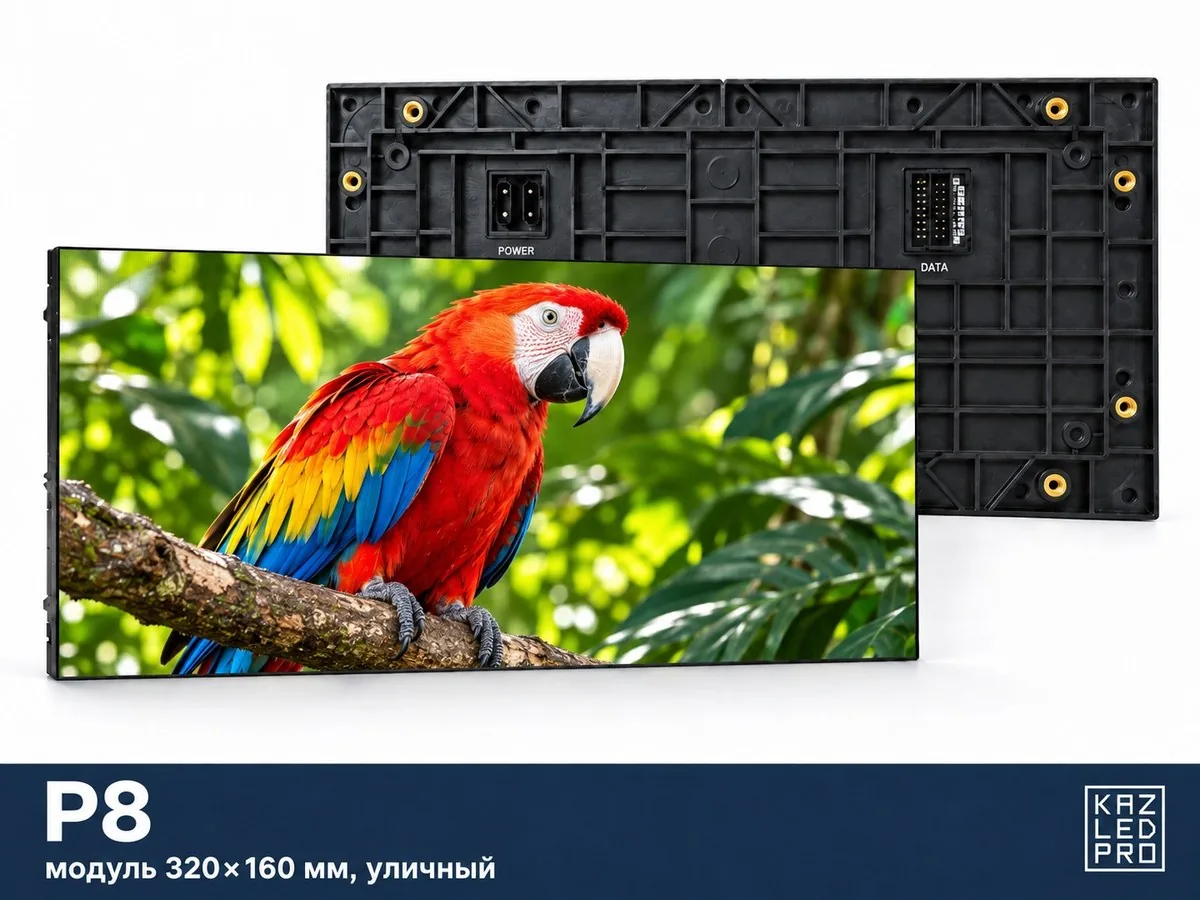 P8
P8Outdoor displays
LED screen P8 for outdoor use — 320×160 mm module
Outdoor screen P8 (320×160 mm module), brightness 5500–7800 cd/m², IP 68. Comfortable viewing from 8 m.
- Brightness
- 5500–7800 cd/m²
- Density
- 15 625 dots/m²
- Protection
- IP 68
Details →
Why this type
5,500–7,800 cd/m²
Readable against the sun; brightness drops automatically at night.
IP68 protection
Rain, dust, frost and heat: model passports give a −40…+50 °C operating range.
Frame included
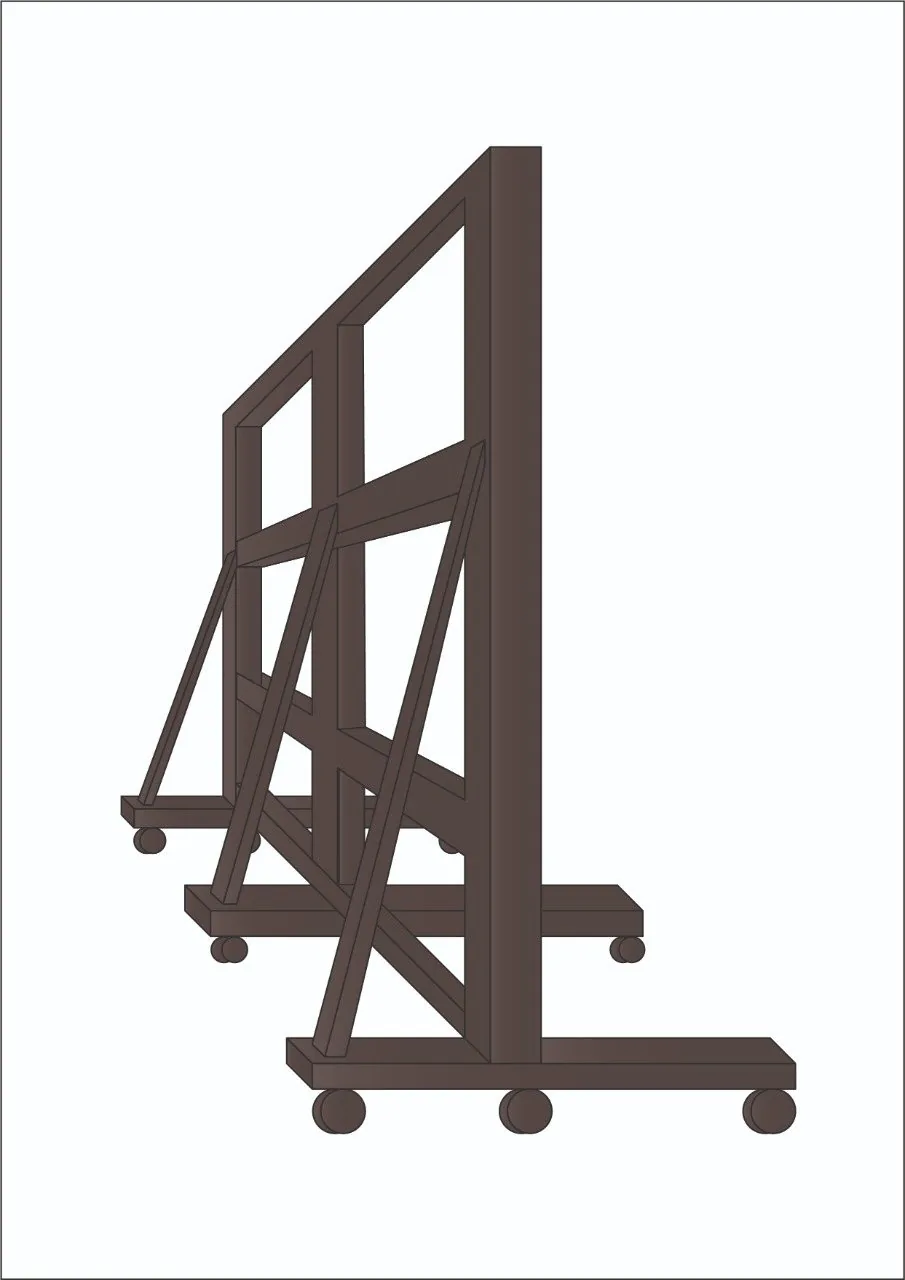
We calculate and weld the steel structure ourselves: facade, roof, free-standing.
100,000-hour lifespan
Years of round-the-clock work; a module is swapped without dismantling the screen.
Why an LED display
Warranty of up to 5 years
On screens of our own manufacture and on the equipment we supply.
Brightness control
Different by day and by night — the screen does not dazzle or flood windows with light, and consumption drops.
Service without dismantling
Front, rear or mixed — the module comes off and the structure stays in place.
Round-the-clock operation
LED life of 50–100 thousand hours in continuous use.
Vandal-resistant build
For places where the screen is within arm's reach.
Any shape and size
The screen is assembled from modules, so the dimensions fit the opening and the shape fits the task.
Wide temperature range
Outdoor models operate from −30 to +50 °C.
Installation on any surface
Brick, concrete, glass, an aluminium facade, a free-standing pylon or a roof.
Stadiums and sports venues
There is no separate “for stadiums” category in the price list — ordinary outdoor models do the job, simply in three different roles. Static banners around the pitch have had their day.
Pitch perimeter
A ribbon of screens along the edge of the pitch instead of banners: sponsor advertising changes during the match and appears in the broadcast. Every league sets its own perimeter requirements — send us the tournament regulations and we will match them.
Arena screen
The main screen for replays, the score and the clock. Refresh rate matters here: a low one puts banding across the screen on camera.
Fan zones and squares
A screen outside the arena — on a city square, in a park, wherever supporters gather. The job is the same as an outdoor advertising screen; the viewing distance is longer, so a coarser pitch will do.
An outdoor LED screen is a model with 5,500–7,800 cd/m² brightness, a sealed IP68 body and an operating range of −40…+50 °C: the picture holds up in direct sun, and rain, dust and January frost do not bother it. The KazLedPro catalogue has 15 outdoor models with pitch P2–P8: 960×960 mm cabinets weighing 25 kg, 320×160 mm modules and a 500×1000 mm cabinet for P3.91. We have also built P10 screens from 960×960 mm cabinets on a number of projects.
This kind of screen is bought for facade advertising, a pylon by a road or petrol station, an information display for a university or a city administration, mall posters, squares and stadiums. We have worked since 2012: we calculate and weld the steel structure, install with our own crew using a lift and work-at-height certification, and service the screen from the Almaty warehouse. Below: how to pick the pitch for the viewing distance, what stands behind brightness and ingress protection, and how an outdoor screen survives a Kazakhstan winter.
Pixel pitch: from P2 at the entrance to P10 on a square
Outdoors the pitch is chosen by the distance to the nearest viewer, not by the size of the screen: the comfortable distance in metres roughly equals the pitch in millimetres. A screen at an entrance, where people pass two or three metres away, calls for P2–P3. That is how the 36 m² P3 outdoor screen for Dubai Municipality Headquarters (2023) was built: a pedestrian at the door sees a continuous image, and from fifty metres it stays contrasty. A mall facade viewed from the pavement and the car park takes P4–P5: the 48 m² P5 corner screen at Atakent Mall in Almaty (2023) wraps the corner of the building and reads from both directions of traffic at once.
Roads, squares and a university block set back from the street are where P6.67–P10 work. We installed P10 outdoor screens from 960×960 mm cabinets for the Bazis company in Astana and for K. Zhubanov Aktobe Regional University (both in 2021), and the same year delivered P8 and P4 screens in Aktau. Buying a fine pitch «with a margin» makes no sense at that distance: from ten metres the eye will not tell P8 from P4, while pixel density differs fourfold — 15,625 against 62,500 pixels per m² — and the price differs with it.
- P2 and P2.5, 250,000 and 160,000 pixels per m²: entrances, pedestrian streets, screens behind glass.
- P3 and P4, 105,625 and 62,500 pixels per m²: office, university and car dealership facades; distance from 3–4 m.
- P5 and P6.67, 40,000 and 22,500 pixels per m²: shopping centres, squares, intersections.
- P8 and coarser, 15,625 pixels per m² and below: highways, roadside pylons, screens on large squares.
Brightness, auto-dimming and weather protection
Every outdoor model in the catalogue delivers 5,500–7,800 cd/m². That is an order of magnitude more than an indoor screen and exactly what it takes to keep white looking white at midday. At night such brightness dazzles and distracts drivers, so the screen runs with a light sensor and dims automatically; a schedule can be set as well when there are flats nearby. IP68 front and back means a sealed module rather than a canopy above it: downpours, facade washing, road dust and wet snow stay outside.
A refresh rate from 3,840 Hz means no banding when the screen is filmed on a phone or a broadcast camera. The viewing angle is 140 degrees horizontally and vertically, so a facade screen still reads when you approach along the street at an angle. Cabinet models are rated for 100,000 hours — years of round-the-clock operation — and a failed module is replaced without dismantling the screen. Most outdoor models draw 650 W/m² at peak and 220 W/m² on average; the P3.91 500×1000 mm cabinet draws 800 and 320 W/m².
Frame, pylon and work at height
A finished screen weighs 30–60 kg per square metre and catches wind like a billboard, so the structure is calculated for the specific wall instead of being welded on the spot. We calculate dead weight, wind and snow load to Kazakhstan building codes, prepare a drawing for approval with the building operator or designer, and fabricate the frame in Almaty: profile tube and angle, anti-corrosion treatment, powder coating. Service access is designed in from the start — rear doors or a walkway for cabinet screens, trunking for power and signal.
The type of structure follows the site: a wall frame for cabinets on a facade, a free-standing pylon for petrol stations, squares and roads, a roof structure with counterweights that needs no drilling through the roof. Installation is done by our own crew certified for work at height: a 22 m lift, rope-access technicians when needed, and outdoor work planned around the weather. The 960×960 mm cabinet speeds up hanging — fewer joints and fixings, which matters most in frost and at height.
- Wall frame on a facade — for cabinet and modular screens.
- Pylon and free-standing support — petrol stations, entrances, roadside sites.
- Roof structure with counterweights — without breaking the roof membrane.
- Frame in an opening and ceiling suspension — entrances, atriums, canopies.
Winter operation and service
The rated range of −40…+50 °C covers the whole Kazakhstan year: January in Astana or Kokshetau as well as summer heat in the south. We installed the screen for the Bazis company in Astana in the first weeks of January, on the coldest days of the year — a sealed 960×960 mm cabinet and a rigid frame are made for exactly this swing, from winter frost to summer sun. In winter the screen is usually not switched off at all: the brightness schedule and daily operating hours are set once in the control software.
The electrical side is prepared in advance. Before installation the customer receives our specification with the power lines calculated — for a typical outdoor screen that is 25 A lines for every 10 m² — along with breakers and data lines; the electrician brings power to the points and we arrive to a ready site. Then comes service: a 2–5 year warranty depending on the model, scheduled inspections, remote status monitoring, and spare modules and power supplies from the Almaty warehouse.
What the supply includes and how we deliver across Kazakhstan
An outdoor screen supply includes 960×960 mm cabinets or 320×160 mm modules with power supplies and receiving cards, a video processor, cabling, a steel structure for the specific wall, roof or pylon, installation with lifting equipment and work at height, commissioning with auto-brightness setup, training and documents: passport, wiring diagram, acts and a 2–5 year warranty card. We issue the electrical specification in advance — for a typical outdoor screen that is one 25 A line per 10 m².
Cabinets and modules ship from our Almaty warehouse; to other cities of Kazakhstan the equipment travels by freight company, the frame is welded in Almaty and shipped in sections or fabricated on site, and the crew travels to install. That is how the outdoor screen at Zhubanov University in Aktobe was built. Set, timing and delivery cost are fixed in the contract.
How the project goes
- 1
Enquiry and site review
Send photos of the facade or site, approximate dimensions and the distance to the viewer. In Almaty we come to measure ourselves; in other cities we work from photos, drawings and a phone video.
- 2
Pitch selection and quote
We calculate the pitch for the distance, plus resolution, power and cabinet layout, and outline the type of frame. A commercial proposal with specification and lead time is sent within a day.
- 3
Structural design
We survey the base, calculate wind and snow load, prepare the drawing and agree it with the building operator. In parallel we issue the electrical specification.
- 4
Installation and commissioning
We weld and erect the frame, hang the cabinets with flatness control, run power and signal, configure the processor, calibrate brightness and switch on auto-dimming.
- 5
Handover and service
Acceptance act, passport with serial numbers of cabinets and cards, video report, operator training. Then a 2–5 year warranty, scheduled inspections and spares from the Almaty warehouse.
What the price depends on
At KazLedPro indoor screens start from 260,000 ₸ per m² and outdoor screens from 300,000 ₸ per m². On the Kazakhstan market a square metre of LED screen costs roughly between 180,000 and 1,500,000 ₸: the lower end is a coarse pitch for outdoor use, the upper end a fine-pitch screen for a studio or meeting room. This is a market reference, not our price list: the exact figure is calculated from your dimensions and scope of work. The cost of an outdoor LED screen adds up from pitch and area, the steel structure, work at height and the electrical side — there is no single figure per metre here. We calculate an exact quote for your dimensions: the calculator on the site shows resolution and layout straight away, and the commercial proposal is ready within a day.
Pixel pitch
Between P8 and P2 the number of LEDs differs sixteenfold, and the price per metre follows. Choose the pitch by the nearest viewer: on a square a fine pitch simply cannot be seen.
Area and resolution
Area multiplies cabinets, frame, installation and power. Resolution decides whether one video processor is enough or a multi-port unit with headroom is needed.
Cabinet or module
The 960×960 mm cabinet costs more per metre but hangs faster and holds the plane more rigidly. The 320×160 mm module fits a non-standard opening more precisely and costs less.
Steel structure and height
A wall frame, a pylon on its own foundation and a roof structure with counterweights mean different steel and different hours. Height adds a lift or rope-access technicians.
Electrical work and control
Power lines, breakers, data cabling, the video processor and the control computer are separate lines in the quote. Bringing power to the points is usually done by the customer's electrician, which is cheaper.
Warranty and service
A 2–5 year warranty depending on the model, a spares kit, scheduled inspections and remote status monitoring are costed separately so the quote is clear before signing.
Questions and answers
Which pixel pitch should we choose for a facade?
Count from the nearest viewer: the distance in metres roughly equals the pitch in millimetres. A pedestrian entrance takes P2–P3, a mall facade seen from the car park P4–P5, a road or square P6.67–P10. The Atakent Mall facade in Almaty runs P5 for viewing from 5 metres and beyond; Dubai Municipality has P3 because people walk right past it.
Will the screen survive our winter?
Outdoor models in the catalogue are rated for −40…+50 °C with a sealed body and IP68 protection front and back. We installed the Astana screen in January frost and it has run all year round. No separate heating is needed, and the screen is normally not switched off: continuous operation and proper cabinet ventilation are its natural mode.
Will the screen dazzle people at night?
Not with auto-dimming enabled. A light sensor lowers brightness towards evening, and a daily schedule is set in the control software separately for day, evening and night. In daylight the screen puts out 5,500–7,800 cd/m² to read against the sun; at night that much light would cover a whole block, so it is dialled down to a comfortable level.
What power supply do we need?
Most outdoor models draw 650 W/m² at peak and 220 W/m² on average: a 20 m² screen takes up to 13 kW at maximum and around 4.5 kW in normal operation. Before installation we issue a specification with the power lines calculated — for a typical outdoor screen that is 25 A lines for every 10 m² — plus breakers and data lines.
Who makes the steel structure and handles approvals?
We design and weld the frame ourselves: dead weight, wind and snow load to Kazakhstan codes, drawings, anti-corrosion treatment and installation with a 22 m lift. The drawing and load calculation are exactly the package usually required for approval with the building operator or the designer of the building.
How is an outdoor screen maintained?
Once every six to twelve months: inspect the fixings, clean the surface and check module status in the control software. A module or a power supply is replaced on site without dismantling the screen; we keep spares in Almaty. The warranty is 2–5 years depending on the model, and cabinet models are rated for 100,000 hours.
How long does an outdoor screen take after ordering?
Common 960×960 mm cabinets and 320×160 mm modules are in stock in Almaty, so a standard facade screen is assembled and commissioned in two to three weeks. The longest item is not the screen but the steel structure and approvals: a pylon on a foundation needs concrete work. The exact lead time is fixed in the contract after the site review.
Do you work in other cities of Kazakhstan?
Yes. Outdoor screens installed by our travelling crew run in Astana, Aktobe, Aktau, Taldykorgan, Karaganda and other cities; among projects abroad there is the facade of Dubai Municipality Headquarters. Equipment and spares are shipped from the Almaty warehouse, and installation and commissioning are done on site.

A turnkey screen: quote, installation, launch.
Send us the dimensions and location — a quote today. WhatsApp around the clock.