
Services
LED screen installation with purchase or rental
Own crew, lifting equipment, cabling, commissioning. From unloading to the first video on the screen — in one visit.
Work sequence
- Preparation: frame check, marking, power and data run to our specification.
- Hanging cabinets or modules with flatness control — no gaps or steps between cabinets.
- Cabling: power lines sized to load, signal over twisted pair, trunking along the wall.
- Connecting the video processor and control computer, loading the configuration.
- Brightness and colour calibration, test video, check of every module.
- Staff training and handover of documents.
Electrical specification in advance
Before installation the customer receives our document with power line, breaker and data line calculations. The customer's electrician prepares the supply; we arrive to ready points.
Work at height
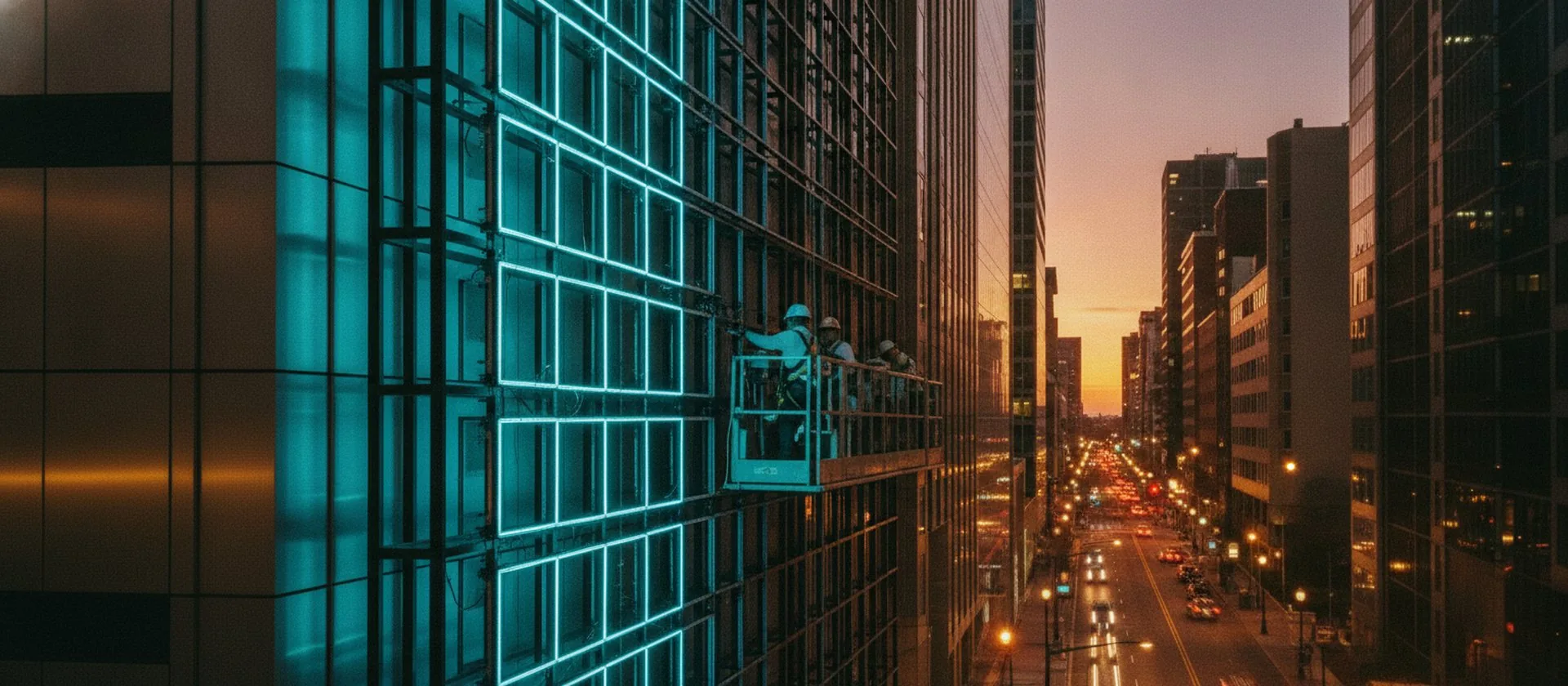
Facades, roofs, pylons — the crew is certified for work at height, with our own 22 m lift and rope-access technicians when needed.
Handover
Acceptance act, video report, passport with serial numbers of cabinets and cards, warranty card.
Installing an LED screen is not «hang it and switch it on». Between unloading and the first video there is a site survey, a steel frame, power supply, hanging with flatness control, cabling, video processor setup and calibration. KazLedPro has been installing LED screens in Almaty and across Kazakhstan since 2012: our own installation crew, our own lifting equipment, a module warehouse in Almaty and more than 1,000 completed sites.
Installation is part of a KazLedPro screen purchase or rental; we do not sell it separately and do not hang cabinets bought directly from elsewhere. In return, for our own screen we answer for everything at once — structure, hanging, cabling and the first video — and moving our screen to a new building or replacing an old canvas with a new one is part of the same work.
What turnkey installation includes
The work starts before the crew arrives. An engineer visits the site, measures the opening or wall, checks where the switchboard is and where the signal will come from, and verifies that the base can carry the weight: an outdoor 960×960 mm cabinet weighs 25 kg, a 500×1000 mm cabinet 11–15 kg, and that is before the frame. Based on the survey we issue an electrical specification and a structure drawing.
Then comes fabrication and erection of the frame, hanging cabinets or modules, running power and signal in trunking, connecting the video processor and computer, brightness and colour calibration and a test video. With power points ready, an indoor screen in a hall is usually hung and started in a single visit; an outdoor facade with work at height is planned separately, around the frame and the weather.
Installation experience: halls, facades, other cities
Most of our indoor installations are in assembly halls, restaurants and shopping centres of Almaty: for example, P3 screens totalling 48 m² in the Forum mall (2023) and 64 m² in Mall Aport (2023). Among outdoor jobs, a 48 m² corner P5 screen on the facade of Atakent Mall (2023): a corner joint needs precise frame geometry, otherwise the seam is visible from the street.
Our travelling crew works across Kazakhstan: P10 screens made of 960×960 mm cabinets at K. Zhubanov Aktobe Regional University in Aktobe (2021) and for the Bazis company in Astana (2021), the I. Zhansugurov Palace of Culture in Taldykorgan — 100 m² of P3 (2023), the Yassy banquet hall in Turkestan (2022), a school in Karaganda (2021). We travel with our own tools and a stock of spare modules so we never have to come back for a small part.
How the project goes
- 1
Enquiry and survey
An engineer visits the site in Almaty or receives photos, dimensions and a floor plan from you. We check the wall, power, signal route and access for equipment. The result is a calculation and a commercial proposal.
- 2
Specification and site preparation
We issue an electrical specification: power lines, breakers, data cabling. Your electrician prepares the supply while we agree the frame drawing. Points are ready when the crew arrives — that saves a day of installation.
- 3
Frame and hanging
We erect the steel structure, check its geometry and hang cabinets or modules with flatness control. On facades and roofs we work from a lift or with rope-access technicians, weather permitting.
- 4
Cabling and setup
We distribute power across lines sized to the load and run signal over twisted pair. We connect the video processor and computer, load the configuration, calibrate brightness and colour and check every module.
- 5
Handover and training
We show your staff how to switch the screen on, change content and what to do in case of a fault. We hand over the passport, wiring diagram, configuration files, acceptance act and warranty card.
What the price depends on
Installation is priced separately from the screen and depends on the location more than on the area: identical screens in a ground-floor hall and on a seventh-floor facade are installed very differently. We calculate an exact estimate from the dimensions and photos of the site — the calculator on the website gives a guide figure, and a commercial proposal is ready within a day.
Area and screen type
A modular screen is assembled on site from 320×160 or 256×256 mm modules; a cabinet screen from ready cabinets. Cabinets hang faster, modules give freedom of size but take longer to assemble.
Height and access
An indoor hall reached with a stepladder, a facade with a lift up to 22 m, or rope access above that — three different estimates. A roof or pylon adds equipment lifting and crew time.
Steel structure
A ready niche or an existing frame makes installation cheaper. A new facade frame, a roof structure with counterweights or a free-standing support is priced as a separate line.
Electrics and cable routes
Distance from the switchboard to the screen, the need for new lines and breakers, the length of trunking and data cabling. If your electrician prepares the supply to our specification, this part drops out of the estimate.
Questions and answers
How long does LED screen installation take?
With power points ready, an indoor screen in a hall is hung, cabled and started by the crew in a single visit. An outdoor screen with a new frame takes longer: structure fabrication, work at height, weather. We name the exact timeline after the survey and write it into the contract.
What does the customer need to prepare before the crew arrives?
Power and data supply to our specification, access to the installation point and a place for unloading. For a facade — the building owner's consent and, where required, a work permit. The control computer can be supplied by us or you can use your own.
How much power does a screen need?
It depends on the model and area. Maximum consumption of indoor screens in our catalogue is 600–800 W/m², outdoor cabinets 650–800 W/m², the P15 media facade up to 1,200 W/m²; average consumption in operation is roughly a third of that. The number of lines and breakers is calculated in the electrical specification.
Can a screen be installed in winter?
Indoors — at any time. Outdoors the limit is not so much frost as wind, precipitation and ice at height: we schedule the work around the forecast. The outdoor cabinets themselves are rated for −40…+50 °C, so once installed, winter is no obstacle to the screen.
Will you install a screen that was not bought from you?
No. Installation is part of the purchase or rental of our screen and is not done separately: the warranty only works when we answer for both the equipment and the work. If you have an old screen from another supplier and are thinking of replacing it, we will visit, assess the site and quote a new screen with installation.
Do you travel to other cities in Kazakhstan?
Yes. Our portfolio includes installations in Astana, Aktobe, Karaganda, Taldykorgan, Turkestan, Aktau and Semey. We bring our own tools and a stock of spare modules. Travel and accommodation of the crew appear as a separate line in the estimate.

A turnkey screen: quote, installation, launch.
Send us the dimensions and location — a quote today. WhatsApp around the clock.