
Solutions
Equipping stadiums and arenas with LED screens
Equipping the whole arena: from tournament regulations to the test match — several canvases, one control system, power and lightning protection, installation by our own crew.
The project starts with the tournament regulations and a survey of the arena: site plan, capacity, distance to the upper tier, positions for the canvases. From these we define the number of screens — perimeter, main screen, scoreboard, fan zone — and the pitch, area and resolution of each. Models come from the outdoor section of the catalogue.
All canvases are brought into one system: the video processor takes the camera, score and timing, ad player and broadcast feed; the operator switches presets. Power runs on separate lines, usually with a three-phase supply, with earthing and lightning protection: a screen on a mast is the highest point of the site.
We calculate and weld the frame for the specific location; installation and work at height are done by our own crew. Before the first game — a run-through on the empty arena and, if needed, standby at the test match. There is no published stadium perimeter in our portfolio yet — we say so plainly.
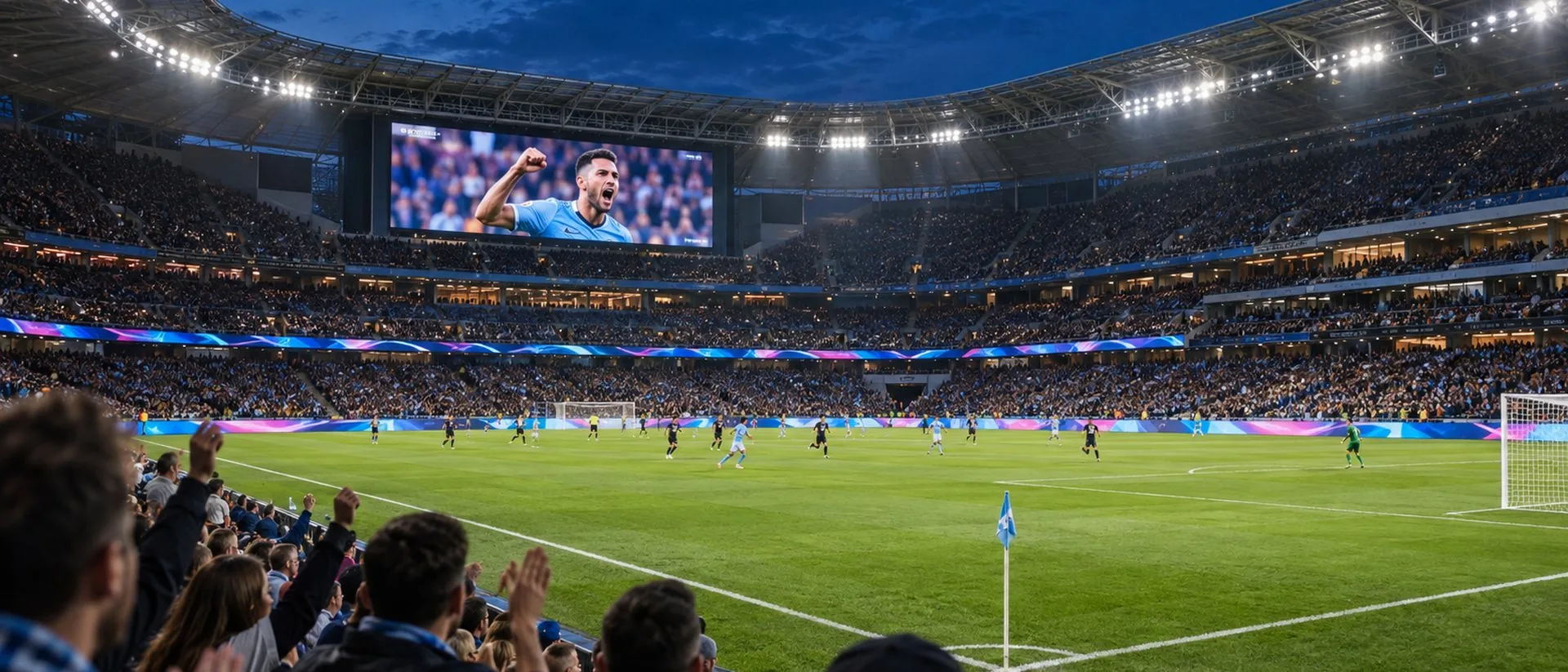
The scene visualisation is generated; the project photos below are real.
What matters here
- 1
From the tournament regulations
Number of canvases, pitch and height — to league requirements and the arena plan.
- 2
One control system
Camera, score, ads and broadcast — as presets for the operator.
- 3
Power and lightning protection
Separate lines, earthing, surge protection, a test match.
Which screens fit
Projects with such screens
Models from the price list
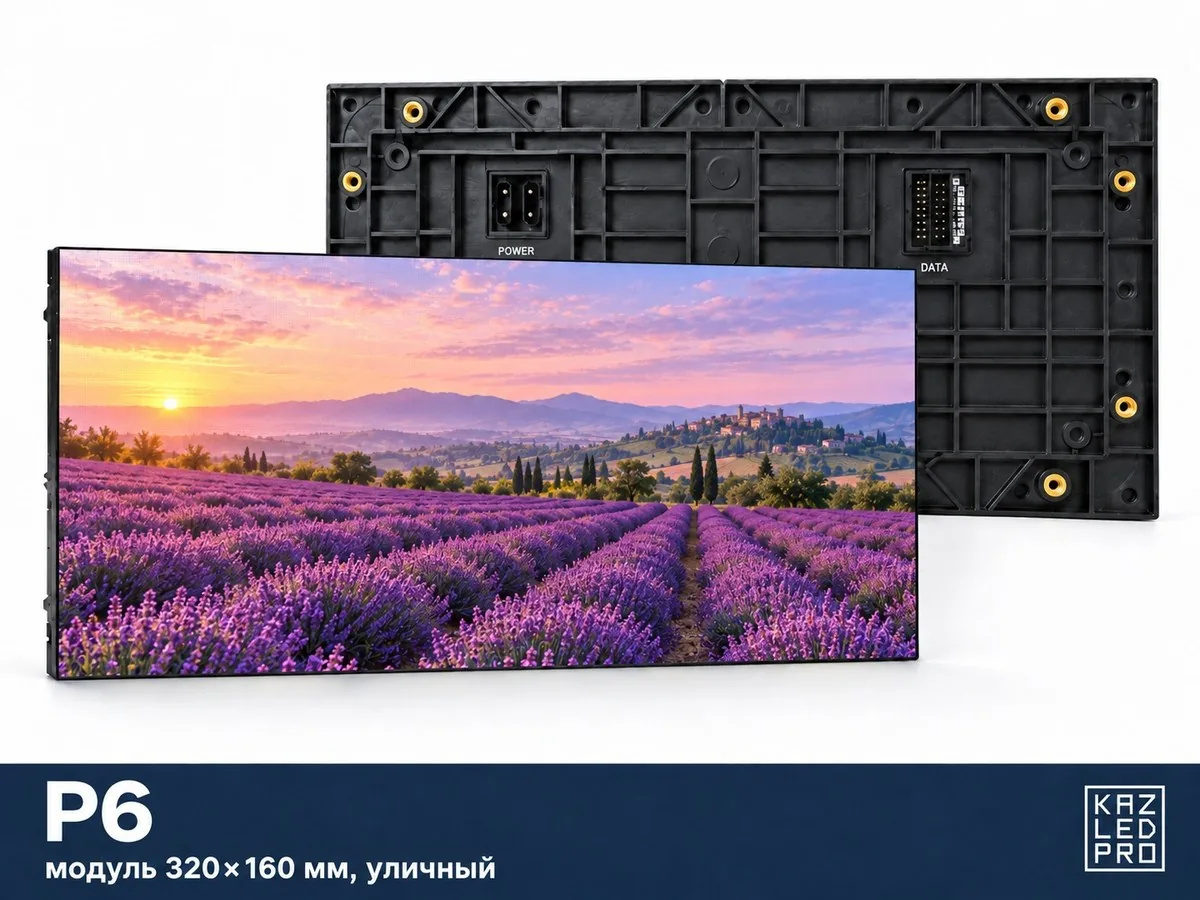 P6
P6Outdoor displays
LED screen P6 for outdoor use — 320×160 mm module
Outdoor screen P6 (320×160 mm module), brightness 5500–7800 cd/m², IP 68. Comfortable viewing from 6 m.
- Brightness
- 5500–7800 cd/m²
- Density
- 22 500 dots/m²
- Protection
- IP 68
Details →
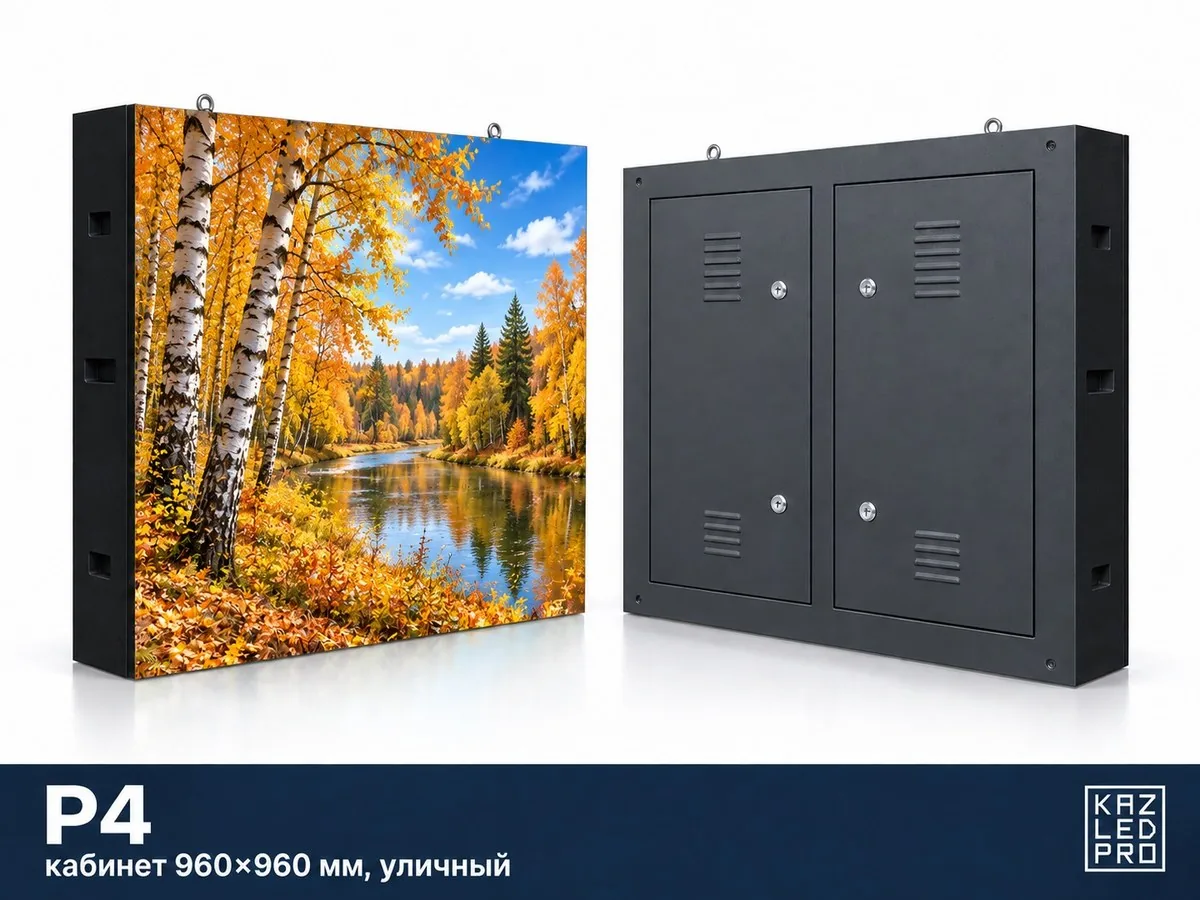 P4
P4Outdoor displays
LED screen P4 for outdoor use — 960×960 mm cabinet
Outdoor screen P4 (960×960 mm cabinet), brightness 5500–7800 cd/m², IP 68. Comfortable viewing from 4 m.
- Brightness
- 5500–7800 cd/m²
- Density
- 62 500 dots/m²
- Protection
- IP 68
Details →
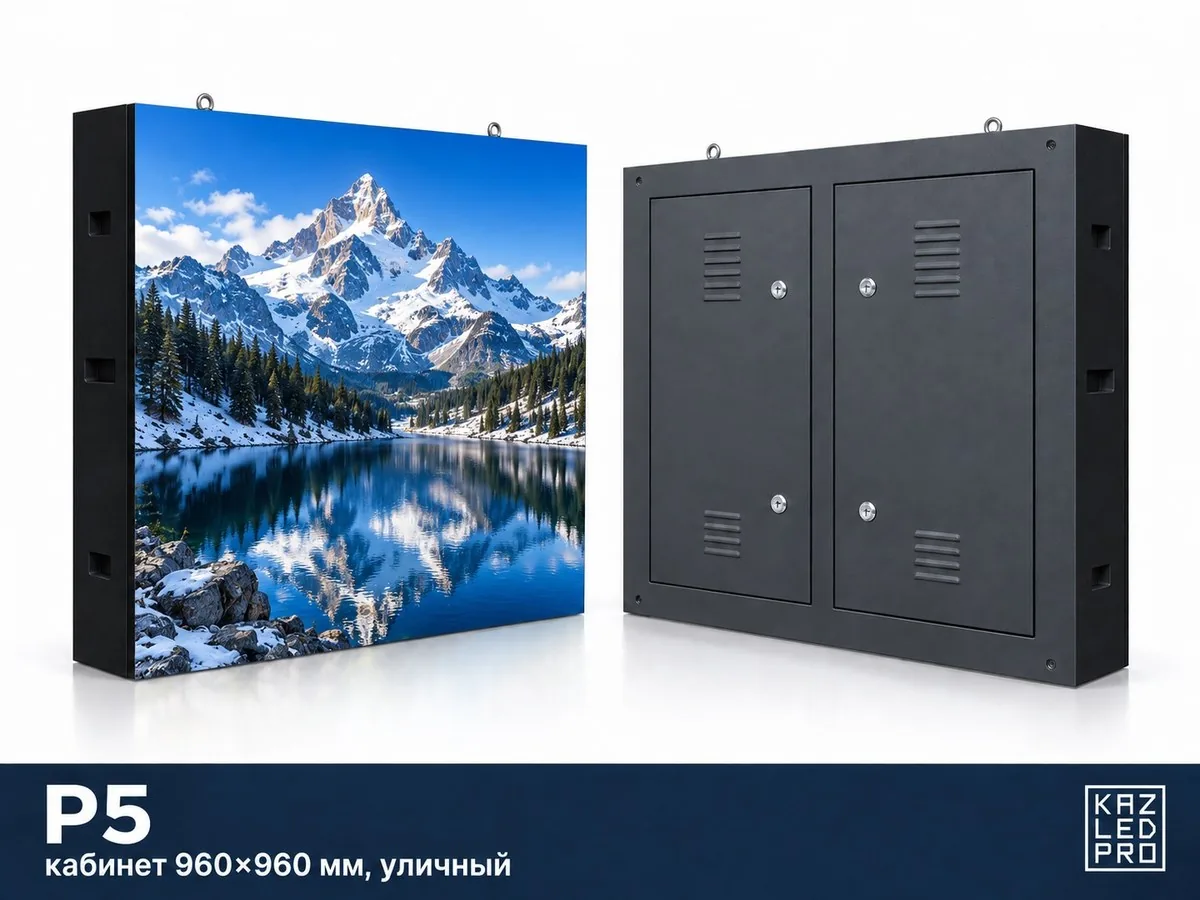 P5
P5Outdoor displays
LED screen P5 for outdoor use — 960×960 mm cabinet
Outdoor screen P5 (960×960 mm cabinet), brightness 5500–7800 cd/m², IP 68. Comfortable viewing from 5 m.
- Brightness
- 5500–7800 cd/m²
- Density
- 40 000 dots/m²
- Protection
- IP 68
Details →
An arena project is not one screen but several different panels on the same site: the perimeter ribbon along the edge of the pitch, the main screen above the stand, the score and time board, and a fan-zone screen on the square by the entrance. Each has its own job, its own pixel pitch and its own mounting method, and they are tied together by one control system and one operator on match day. This page covers the whole project, from tournament regulations to the test match.
KazLedPro has worked with LED screens since 2012: site survey, configuration, steel structure of our own making, installation by our own crew, commissioning and service. Module and spares stock in Almaty, more than 1,000 projects across Kazakhstan, 62 of them with photos on the site. We travel to Astana, Aktobe, Aktau, Taldykorgan and other cities. The size and resolution of each panel can be estimated with the calculator on the site, and a commercial proposal with the equipment list is ready within a day.
The equipment comes from the outdoor series in our catalogue: pitch P5–P10, brightness 5,500–7,800 cd/m², IP68 protection and an operating range of −40 to +50 °C, with 960×960 mm and rental-type 500×1000 mm cabinets. A detailed comparison of the models sits on the catalogue page for stadium screens; here we talk about the arena project and the work on site.
Pitch perimeter: a ribbon of screens instead of banners
The perimeter is a ribbon 0.9–1.2 m high along the edge of the grass. It replaces printed banners: sponsor advertising changes during the match, every partner gets measured airtime, and that time is sold in slots like broadcast advertising. A ribbon of the required height is built from outdoor 320×160 mm modules on our own frame — a 960×960 mm cabinet is simply too tall for this role.
The tournament regulations set the requirements: panel height, setback from the touchline, tilt angle and how the structure behaves when a player runs into it. They differ from league to league, so we ask for the document before the calculation, not after. The front row gets soft masks and a reinforced frame: the ball hits it regularly, and that is normal operation, not a failure.
- Ribbon height 0.9–1.2 m, built from 320×160 mm modules on a custom frame
- Pitch P5–P6.67: the perimeter appears in close-up on TV
- Soft masks and a reinforced frame in the front row, rounded edges facing the pitch
- Refresh rate from 3,840 Hz — sponsor ads air without banding
- Setback from the touchline and tilt angle set by the tournament regulations
Main arena screen, scoreboard and fan zone
The main screen hangs above the stand and carries replays, score, timing, line-ups and advertising between halves. The farthest spectator sits tens of metres away, so P6.67–P10 grain is invisible from the stand; what matters is area and format — a 16:9 canvas with enough resolution to take the camera feed without upscaling. The scoreboard is a simpler separate panel: large digits for score and time, pitch P8 and coarser, where readability from the upper tier beats detail.
The fan zone and the square in front of the arena take a regular outdoor screen with auto-brightness and sound: a match broadcast for those who did not get inside, city celebrations in the off-season. Screens like these run for us in an entertainment park in Almaty (2022) and as a 48 m² corner P5 panel on the facade of Atakent Mall (2023). School and university gyms are an indoor job: there we install P2.5–P4 screens, as in the sports hall of NGS private school in Almaty (P4 of 256×256 mm modules, 2021).
Match-day control: operator, score, replays
All the panels of the arena come together in one system. A video processor with several inputs takes the camera, the scoring and timing computer, the advertising player and an external broadcast feed, and the operator switches sources with ready presets. The perimeter runs its own ribbon: advertising blocks follow a schedule prepared before the match, while replays on the main screen are released by hand.
Playlists and the schedule are prepared in advance, so match day is only switching. We set up the inputs, build presets for the run of play and train the operator: showing the score, a replay, an advertising block, an emergency slide. Before the first game we run a rehearsal in an empty arena and, if the client asks, stand by at the test match.
Power, lightning protection, installation and maintenance
Outdoor models draw up to 650 W/m² at peak and about 220 W/m² on average. A 60 m² main screen takes around 39 kW at peak, and a hundred and fifty linear metres of perimeter ribbon is comparable, so power is split into dedicated lines with breakers and usually a three-phase supply. Earthing of the structure, surge protection on power and signal lines and inclusion of the screen in the stadium lightning protection are mandatory: a panel on a mast or on the roof of a stand is a high point of the site.
We calculate and weld the frame for the specific location: stand, roof, free-standing support, wind load. Installation is done by our own crew, including work at height. IP68 protection and the −40 to +50 °C range allow open-air operation without a canopy; before the season we recommend inspecting fixings, seals and power-supply ventilation. Warranty is 2–5 years depending on the model, spares are stocked in Almaty and service visits across Kazakhstan are covered by contract.
How the project goes
- 1
Enquiry, regulations and survey
You send the arena plan, capacity, the distance to the upper tier and the tournament regulations. In Almaty we visit the site; in other cities we work from drawings and photos, with an engineer travelling for large projects.
- 2
Configuration and proposal
We define the number of panels, the pitch and area of each, the resolution for broadcast, the power and the number of lines. A proposal with models, control kit and lead times is sent within a day.
- 3
Frame, power and lightning design
Steel structure and wind-load calculation, power and signal diagrams, earthing and surge protection, agreed with the stadium operations team and the site electrical engineer.
- 4
Delivery, installation and cabling
Modules and cabinets from the Almaty stock or to order, steel structure of our own making, installation including work at height, power and signal cable runs, processor installation.
- 5
Commissioning, test match and service
Brightness and colour calibration, input and preset setup, operator training, a rehearsal and a test match. Warranty 2–5 years, spares in Almaty, planned inspections before the season.
What the price depends on
The estimate for an arena project is made up of several panels, the steel structure, the electrics and the work on site, so it cannot be reduced to a single figure per square metre. We calculate it exactly from your arena dimensions: the calculator on the site gives a guide, and the commercial proposal follows within a day.
Number and role of panels
Perimeter, main screen, scoreboard and fan zone are costed separately: pitch, area and mounting differ for each. A project with one screen and a project with four differ in cost even at the same total area.
Pixel pitch and area
The finer the pitch, the more LEDs per square metre. The perimeter takes a finer pitch than the main screen because it appears in close-up on TV, while the area follows the distance to the upper tier.
Module or cabinet
The perimeter ribbon is built from 320×160 mm modules on a custom frame — more precise in height but slower to install. The main screen is assembled from 960×960 mm cabinets: faster on site and easier to service.
Steel structure and mounting height
A frame on the stand, on the roof or on a free-standing support, wind-load calculation, lifting equipment and work at height noticeably affect the estimate for an outdoor arena screen.
Power, lightning protection and control
Dedicated lines, a three-phase supply, earthing and surge protection, a video processor with the required inputs, the operator workstation and the scoring system are all separate line items.
Warranty and maintenance
A 2–5 year warranty depending on the model, spares for the delivery, pre-season inspections and a service-visit contract are counted together with the equipment.
Questions and answers
How does a stadium screen project start?
With the tournament regulations and a survey of the arena. We need the site plan, capacity, distance to the upper tier, the locations for the panels and the league requirements for the perimeter. From that we calculate configuration, power and frame. If there are no regulations, we work to the typical requirements of your sport and fix the decision in a technical specification.
What does a perimeter ribbon give over printed banners?
Advertising changes during the match instead of one board hanging for ninety minutes. Each sponsor's airtime is measured and confirmed in a report, and time is sold in slots. The ribbon is seen both from the stands and on TV, and between matches it shows the fixture poster, city information and public-service clips.
Will the screen survive being hit by the ball?
The front row of the perimeter is built with soft masks and a reinforced frame — a ball strike there is normal. A module is replaced without dismantling the whole ribbon, so even damage is dealt with in minutes between halves if spares are at hand. We include spares for such a site in the delivery.
What refresh rate is needed for broadcast?
The outdoor models in the catalogue provide from 3,840 Hz, which is enough to keep banding and flicker off the camera. For a perimeter that appears in close-up it is the key parameter — more important than a fine pitch. The value is fixed in the technical specification along with brightness and the 140° viewing angle.
Do we need a dedicated operator at the match?
Usually yes: someone has to release replays, run the score and keep the advertising schedule. It can be your own employee — we train them during commissioning and leave an instruction sheet with the presets. Playlists and advertising blocks are prepared before the game, so match day is only switching sources.
What does the stadium need to provide for power and lightning protection?
Dedicated lines with breakers, usually a three-phase supply, earthing of the structure and surge protection on power and signal lines. A screen on a mast or on a stand roof is a high point, so it is included in the site lightning protection. Exact figures and the number of lines are given in the technical specification.
Can a screen be installed in a school or university gym?
Yes, that is an indoor job with different models: pitch P2.5–P4 and rated brightness from 350 cd/m². The screen in the sports hall of NGS private school in Almaty has run since 2021, with P4 built from 256×256 mm modules. Such supplies often go through public procurement, and we prepare the document package.
Do you work with venues in other cities of Kazakhstan?
Yes. Outdoor screens of our series stand in Astana (the Bazis company, P10, 2021), Aktobe (K. Zhubanov Aktobe Regional University, P10, 2021), Aktau (P8 and P4, 2021) and Taldykorgan; we installed the screen for the EXPO-2017 venue in Astana back in 2017. Our travelling crew works nationwide.
A turnkey screen: quote, installation, launch.
Send us the dimensions and location — a quote today. WhatsApp around the clock.