
Solutions
LED screens for theatres, cinemas and culture halls
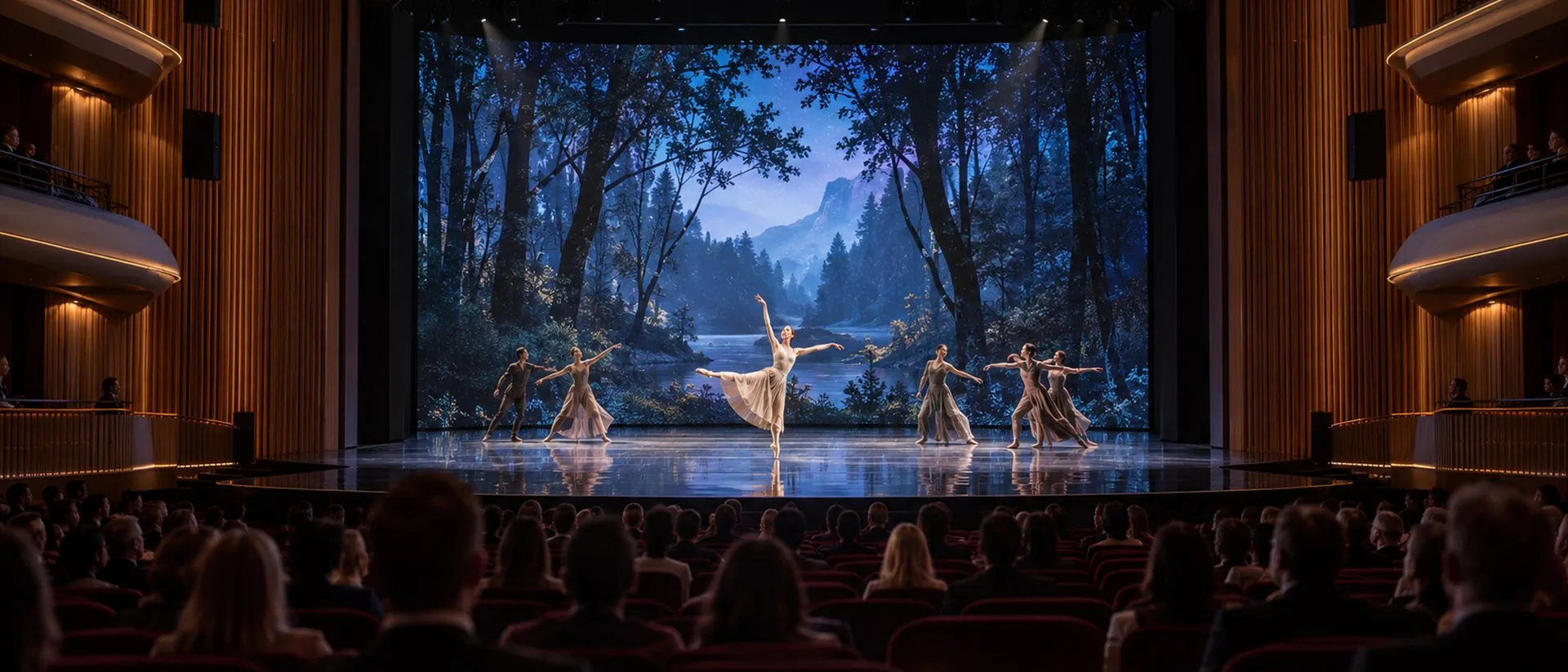
A stage backdrop that changes the set in a second, and a lobby screen instead of posters.
On stage the screen replaces painted backdrops: forest, city, sea — at one command from the lighting desk.
We installed screens at the Zhansugurov Palace of Culture, Aksai House of Culture and school assembly halls.
The scene visualisation is generated; the project photos below are real.
What matters here
- 1
A set in a second
Backdrop change from the desk.
- 2
Deep black
Masks and high contrast in a dark hall.
- 3
DMX / Art-Net
In sync with theatre lighting.
Which screens fit
Models from the price list
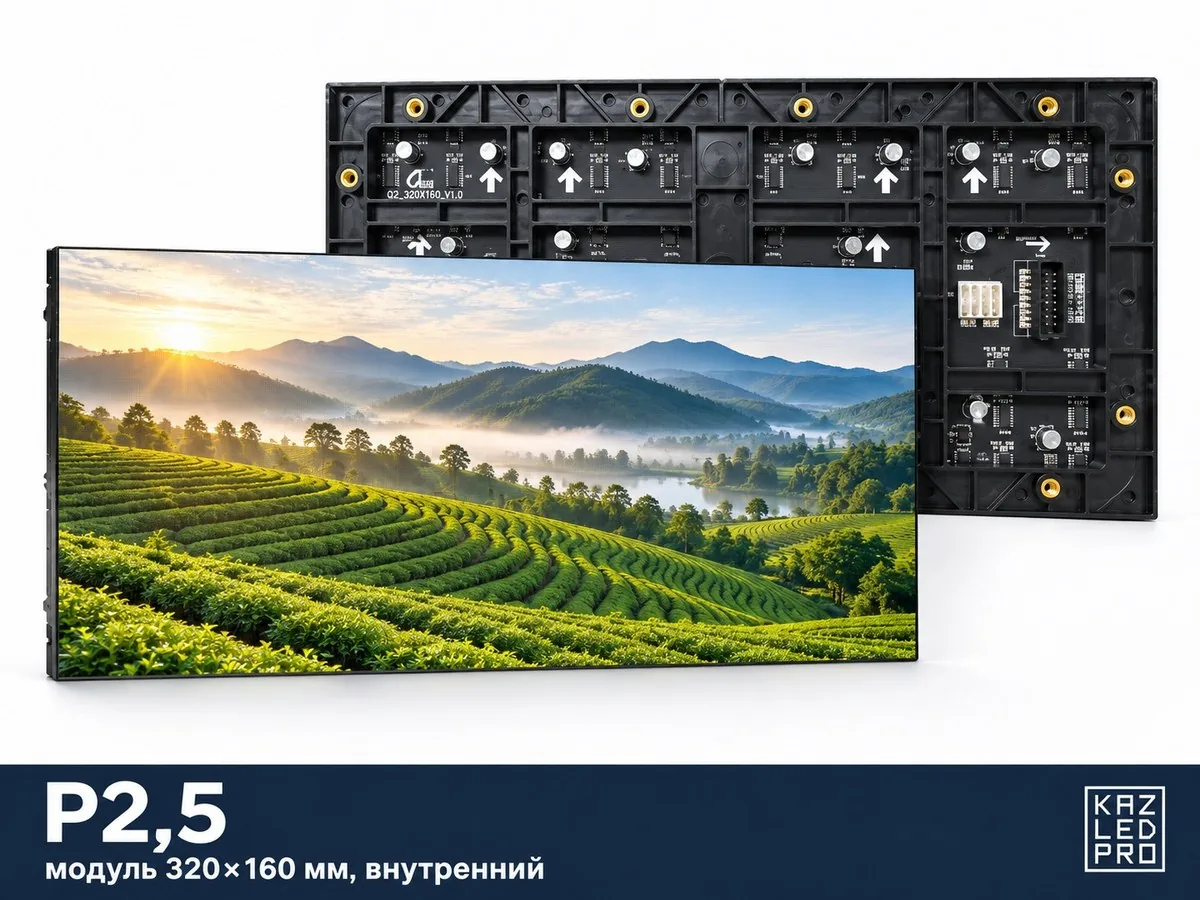 P2.5
P2.5Indoor displays
LED screen P2.5 for indoor use — 320×160 mm module
Indoor screen P2.5 (320×160 mm module), pixel density 160 000 dots/m². Comfortable viewing from 2 m.
- Brightness
- 350–550 cd/m²
- Density
- 160 000 dots/m²
- Protection
- IP 31
Details →
 P2.9
P2.9Indoor displays
LED screen P2.9 for indoor use — 500×1000 mm cabinet
Indoor screen P2.9 (500×1000 mm cabinet), pixel density 118 336 dots/m². Comfortable viewing from 3 m.
- Brightness
- 1000 cd/m2
- Density
- 118 336 dots/m²
- Protection
- IP40
Details →
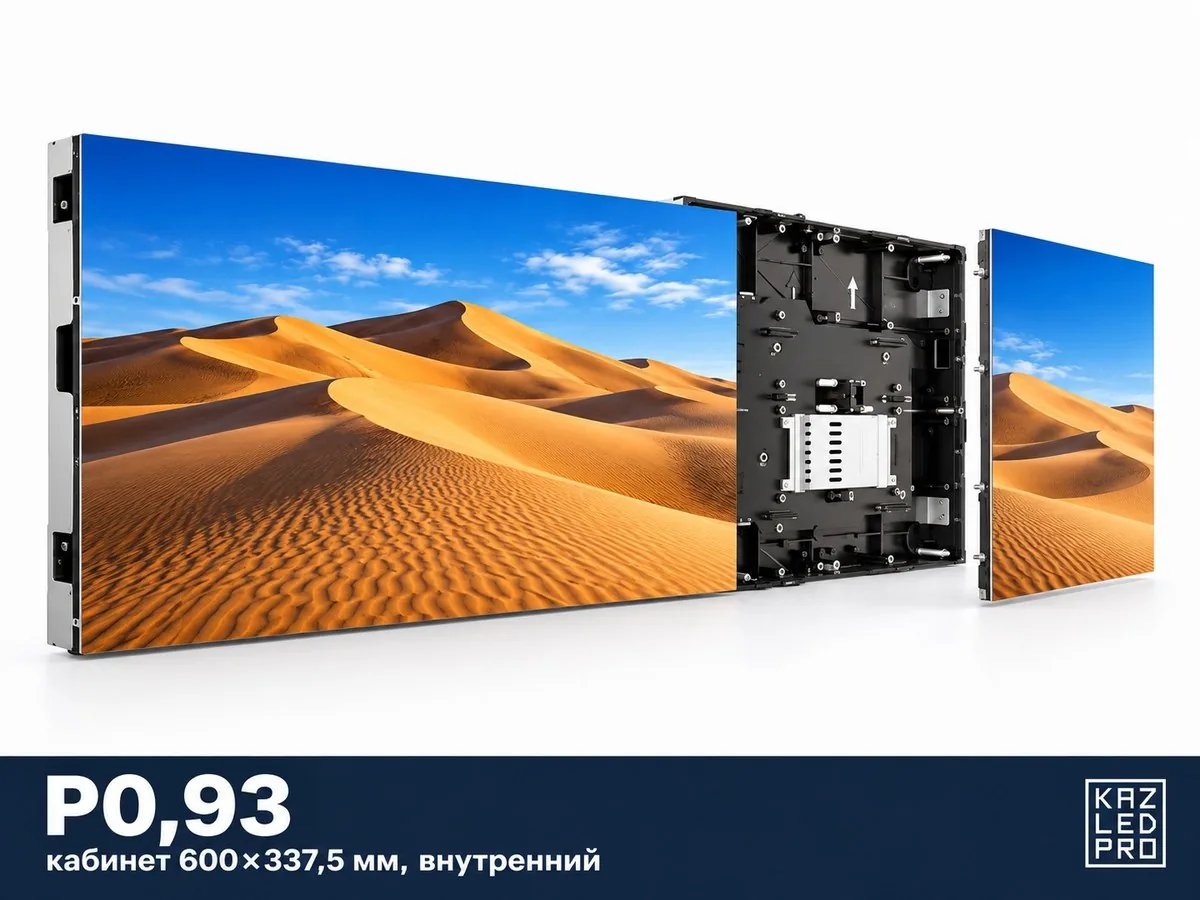 P0.93
P0.93Indoor displays
LED screen P0.93 for indoor use — 600×337.5 mm cabinet
Indoor screen P0.93 (600×337.5 mm cabinet), pixel density 1 137 778 dots/m². Comfortable viewing from 1 m.
- Brightness
- 600 cd/m²
- Density
- 1 137 778 dots/m²
- Protection
- IP40 (indoor version)
Details →
An LED screen for a theatre, cinema or house of culture solves two tasks at once: a stage backdrop that changes the set in a second, and a lobby screen instead of paper posters. An LED screen stays visible with the house lights on, is untroubled by haze and backlight, and no performer walks into the image the way they walk into a projector beam. KazLedPro has been building such screens in Almaty since 2012 and installs them with its own crew.
Our portfolio includes the Zhansugurov Palace of Culture in Taldykorgan (P3 screens totalling 100 m², 2023), the Aksai House of Culture (62 m² of 500×1000 mm cabinets, 2021), the House of Children and Youth in Karaganda with a full stage lighting package (2021), Children's Music School No. 5 named after Mukan Tulebaev in Almaty (2020) and the assembly hall stage of the private KIS school (2025).
Below: how to choose the pixel pitch for the depth of the hall, how a stage screen differs from a lobby screen, how it works together with theatre lighting, and what the venue must prepare in terms of power and rigging. The calculator on the site gives a preliminary estimate from screen width and height; a house of culture can also buy through public procurement.
Stage, proscenium and lobby are three different jobs
Pixel pitch follows the distance to the front row: the pitch in millimetres roughly equals the minimum viewing distance in metres. In a house of culture the front row usually sits four to six metres from the stage floor, so P3 or P3.91 is the common choice — that is how the Zhansugurov Palace of Culture and the Aksai House of Culture are built, both with viewing from four metres. A studio stage or small hall where the audience sits two metres away needs P2 or P2.5.
The lobby is a separate job. There the screen is seen in passing and at eye level, so area and brightness matter more than fine grain: session times, trailers and the coming-soon poster read perfectly at P2.5–P4. The proscenium, arches and lobby columns are built from flexible P2.5 modules: they bend to a radius and hold on magnets, so they follow the architecture instead of arguing with it.
- P2 and P2.5, 640×640 mm cabinet or 320×160 mm module — small halls and front rows closer than three metres, density 160,000–250,000 dots/m².
- P3, 320×160 or 192×192 mm modules — the standard stage backdrop; the Zhansugurov Palace of Culture is built this way.
- P3.91, 500×1000 mm cabinet — 65,536 dots/m², about 14 kg per cabinet, the screen comes apart and travels on tour.
- P2.6 and P2.9, 500×1000 mm cabinets — 1,000 cd/m², 13 kg per cabinet: a stage assembled for the event and struck afterwards.
- P4, 256×256 mm module — the economical option for large halls and the sports ground next to the venue.
- Flexible indoor P2.5 modules — proscenium, arch, lobby columns; they bend to a radius and mount on magnets.
A dark hall, theatre lighting and the camera
In a darkened hall the screen must not run at full brightness. Indoor models give 350–550 cd/m², and during a performance they are dimmed to roughly a fifth of that, otherwise the backdrop washes out the performers and ruins the camera exposure. Black module masks and high contrast keep the black deep: an unlit part of the canvas does not glow grey, so a set painted on the screen looks real rather than backlit.
A refresh rate from 3,840 Hz is what decides whether a concert recording comes out with banding or without it. Every indoor model in the catalogue holds that rate; on the Eurasia TV studio screens in Almaty and Astana it is proven by daily broadcast. Control links to the lighting desk over DMX or Art-Net, so the picture changes on the same cue as the light. Fixtures, truss and stage lighting go under the same contract — that is how the House of Children and Youth in Karaganda was done.
Procurement, installation and travel across Kazakhstan
Houses and palaces of culture most often buy through goszakup.gov.kz, and what actually arrives depends on the specification. We help draft the technical specification before the tender is announced: we calculate resolution, structure weight, power and the number of supply lines, and describe characteristics that can be verified at acceptance. KazLedPro is listed in the registry of domestic manufacturers and holds the KTP industrial certificate, so the bid receives a conditional price discount and priority under domestic-producer support rules.
Installation on a stage is work at height. The frame is fixed to the solid wall behind the backdrop, or the screen is flown on truss; rigging on the existing counterweight bars is agreed only with a load calculation, never by eye. Cables run in trunking and power comes on a dedicated line to our electrical brief. The crew travels from Almaty to any city: Taldykorgan, Aksai and Karaganda were done this way, with works planned between repertory dates.
Theatres, houses of culture and halls with our screens
Every site is in the portfolio with photographs, and several have video shot on location. You can call any of them and ask how the screen behaves a few seasons on.
- Palace of Culture named after I. Zhansugurov, Taldykorgan, 2023 — P3 LED screens totalling 100 m².
- Aksai House of Culture, 2021 — a 62 m² screen of 500×1000 mm cabinets, viewing from four metres.
- House of Children and Youth, Karaganda, 2021 — a P4 screen and a full stage lighting package, with video from the site on the case page.
- Children's Music School No. 5 named after Mukan Tulebaev, Almaty, 2020 — 256×256 mm modules, viewing from four metres.
- Screen for the assembly hall of the private KIS school, Almaty, 2025 — a stage for performances and celebrations, with a video testimonial on the page.
- Eurasia TV studios in Almaty and Astana, 2021 — screens that are filmed every day.
How the project goes
- 1
Survey of hall and stage
We measure the proscenium, the stage floor, the height to the grid and the distance to the front row, and check power and rigging points. For another city, photos, dimensions and a hall plan are enough.
- 2
Selection and quotation
We calculate pitch, resolution, weight and power and choose the video processor. For a tender we prepare a technical specification with verifiable characteristics and an estimate for setting the procurement budget.
- 3
Contract and assembly
We build the screen from modules held in our Almaty warehouse, fabricate the frame, prepare the cabling and send the venue an electrical brief for a dedicated line to the stage.
- 4
Installation
The crew mounts the frame or rigging, assembles the canvas and runs cable in trunking. With power points ready, a stage is built in one or two days, on dates between performances.
- 5
Commissioning and training
We calibrate brightness and colour for the hall, link the screen to the lighting desk, train the technician and sound engineer, and hand over the passport, wiring diagram, acts and a 2–5 year warranty card.
What the price depends on
The cost of an LED screen for a theatre, cinema or house of culture depends on pixel pitch, area, the type of structure and the work at height. We calculate the exact estimate from the dimensions of your hall: the calculator on the site gives an immediate guide, and a quotation with specification is ready within a day.
Pixel pitch
The finer the pitch, the more LEDs per square metre and the dearer the metre of canvas. A hall with the front row four to six metres away is served by P3–P3.91; P2–P2.5 is for studio stages and lobbies where people come close.
Area and resolution
Price grows almost linearly with area. A backdrop across the whole proscenium and a screen covering the centre of the stage differ several times over, so size is derived from the hall and from what will be shown.
Module or rental cabinet
320×160 and 256×256 mm modules fit the proscenium opening exactly and cost less. 500×1000 mm lock cabinets cost more, but the canvas comes apart and travels to a tour or a city square.
Structure and working height
A frame on the solid wall behind the stage is simpler than flying the screen on truss. Work at height, load calculations and coordination with the stage machinery are separate lines in the estimate.
Power and control
Video processor, supply lines to our electrical brief, a link to the lighting desk over DMX or Art-Net. Indoor models draw 700–800 W/m² at peak and 300–320 W/m² on average.
Light, sound and warranty
Stage lighting, fixtures, truss and speakers come under one contract and one acceptance act. The 2–5 year model warranty is included; a service contract with scheduled inspections is optional.
Questions and answers
Which pixel pitch should a house of culture hall use?
Count from the front row: the pitch in millimetres roughly equals the minimum distance in metres. Front row at four metres or further — P3.91 or P4; at three metres — P3; a studio stage with seats two metres away — P2 or P2.5. In a deep hall a finer pitch only shows up in the estimate.
Will an LED screen replace the cinema screen in an auditorium?
For showing films to cinema release standards you need projection or a specialised cinematic LED wall, which our catalogue does not include — we say so plainly. We build stage backdrops, lobby screens and halls for concerts, broadcasts and presentations. In the lobby an LED screen replaces posters and pays for itself through advertising faster than in the auditorium.
Will the screen wash out the stage in a dark hall?
Not once brightness is set. Indoor models give 350–550 cd/m² and are dimmed to about a fifth of that during a performance. Black module masks hold deep black, so an unlit part of the backdrop does not glow grey. Brightness levels for different scenes are stored as presets on the desk.
Can a concert be filmed without banding on camera?
Every indoor model in the catalogue refreshes from 3,840 Hz, which is enough to keep banding out of a recording at normal shutter speeds. The Eurasia TV studio screens in Almaty and Astana were installed precisely for filming. If a broadcast is planned, tell us in advance: we will pick the processor and match brightness to the studio lighting.
Can the screen be taken apart and moved to a tour or a square?
Yes, if it is built from 500×1000 mm lock cabinets: 13–14 kg per cabinet, tool-free assembly, any size in half-metre steps. The Aksai House of Culture works this way, its 62 m² screen assembled from exactly those cabinets. A modular screen on a frame costs less but stays where it is put.
How does the screen connect to theatre lighting and where does the picture come from?
Control connects to the lighting desk over DMX or Art-Net, and the backdrop changes on the same cue as the light. The usual source is a laptop or media server over HDMI through the video processor: clips, titles and a live camera feed switch between scenes without a black frame.
Can the screen be bought through public procurement?
Yes, and most houses of culture do exactly that. We help draft the technical specification before the tender is announced and provide an estimate for setting the budget. KazLedPro is in the registry of domestic manufacturers with a KTP industrial certificate, so the bid receives a conditional price discount and priority.
Do you work in other cities of Kazakhstan?
Yes, the crew travels from Almaty. The Palace of Culture in Taldykorgan, the House of Culture in Aksai, the House of Children and Youth in Karaganda and banquet and assembly halls in Turkestan and Kokshetau were all done on the road. Photos of the hall and dimensions are enough for a calculation, and the warranty applies nationwide.
A turnkey screen: quote, installation, launch.
Send us the dimensions and location — a quote today. WhatsApp around the clock.