
Solutions
LED screens for home cinema
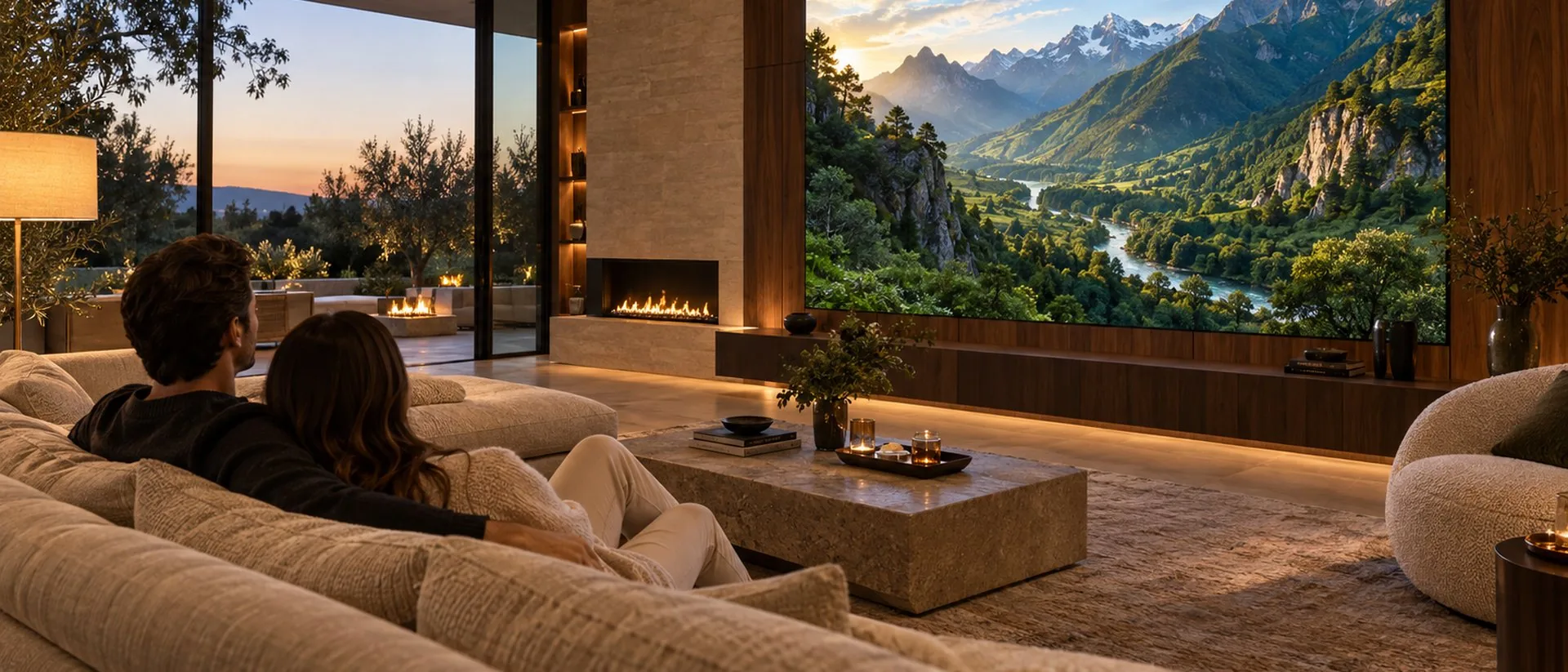
A home cinema without seams or edge glow — a wall that becomes a 3–5 metre screen.
An LED wall at home means pitch P0.93–P1.25 and deep black a projector cannot give. Viewed from three to four metres, so no grain.
The screen sits flush in the wall, from 60 mm thick, no fans, no heat.
The scene visualisation is generated; the project photos below are real.
What matters here
- 1
Pitch from 0.93 mm
TV picture, cinema size.
- 2
Flush
From 60 mm thick, no fans.
- 3
Any source
Set-top box, PC, satellite over HDMI 2.0.
Which screens fit
Projects with such screens
Models from the price list
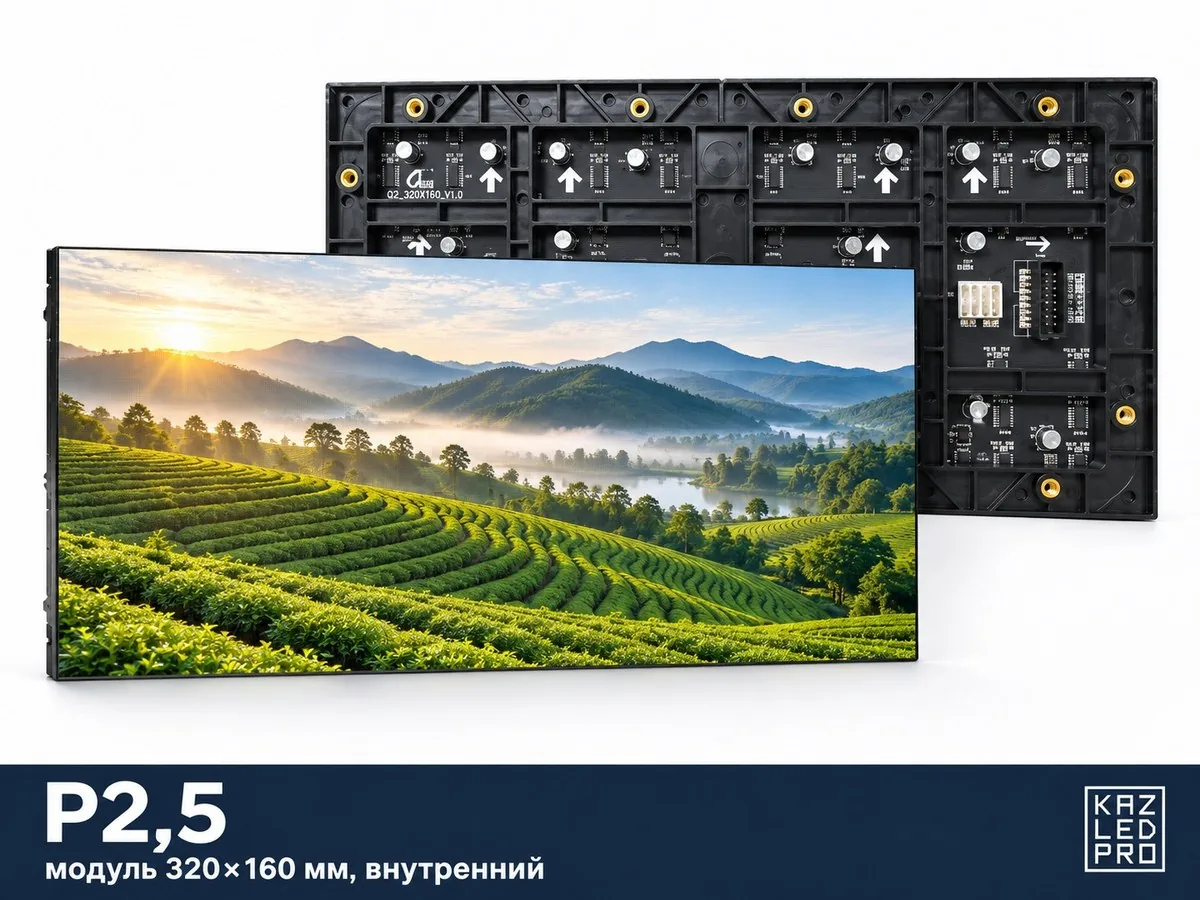 P2.5
P2.5Indoor displays
LED screen P2.5 for indoor use — 320×160 mm module
Indoor screen P2.5 (320×160 mm module), pixel density 160 000 dots/m². Comfortable viewing from 2 m.
- Brightness
- 350–550 cd/m²
- Density
- 160 000 dots/m²
- Protection
- IP 31
Details →
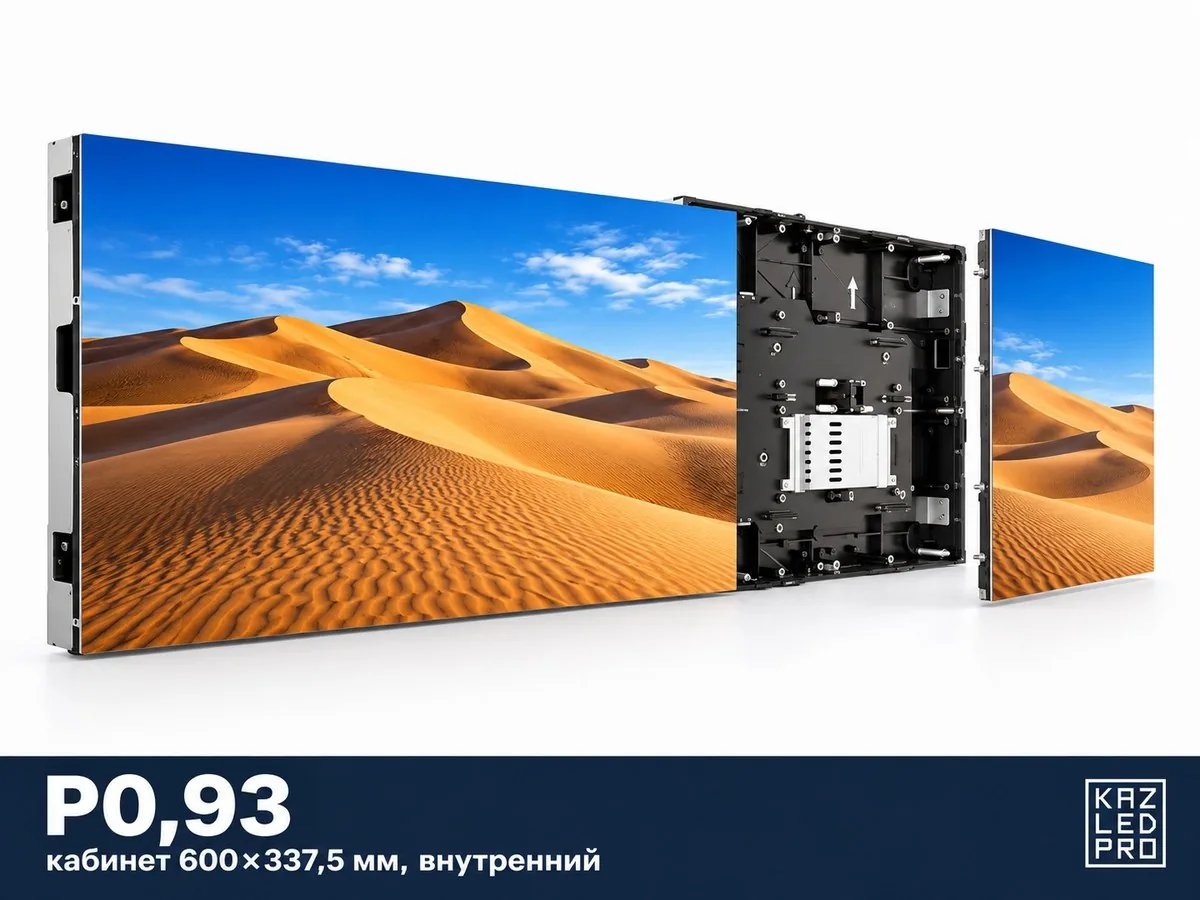 P0.93
P0.93Indoor displays
LED screen P0.93 for indoor use — 600×337.5 mm cabinet
Indoor screen P0.93 (600×337.5 mm cabinet), pixel density 1 137 778 dots/m². Comfortable viewing from 1 m.
- Brightness
- 600 cd/m²
- Density
- 1 137 778 dots/m²
- Protection
- IP40 (indoor version)
Details →
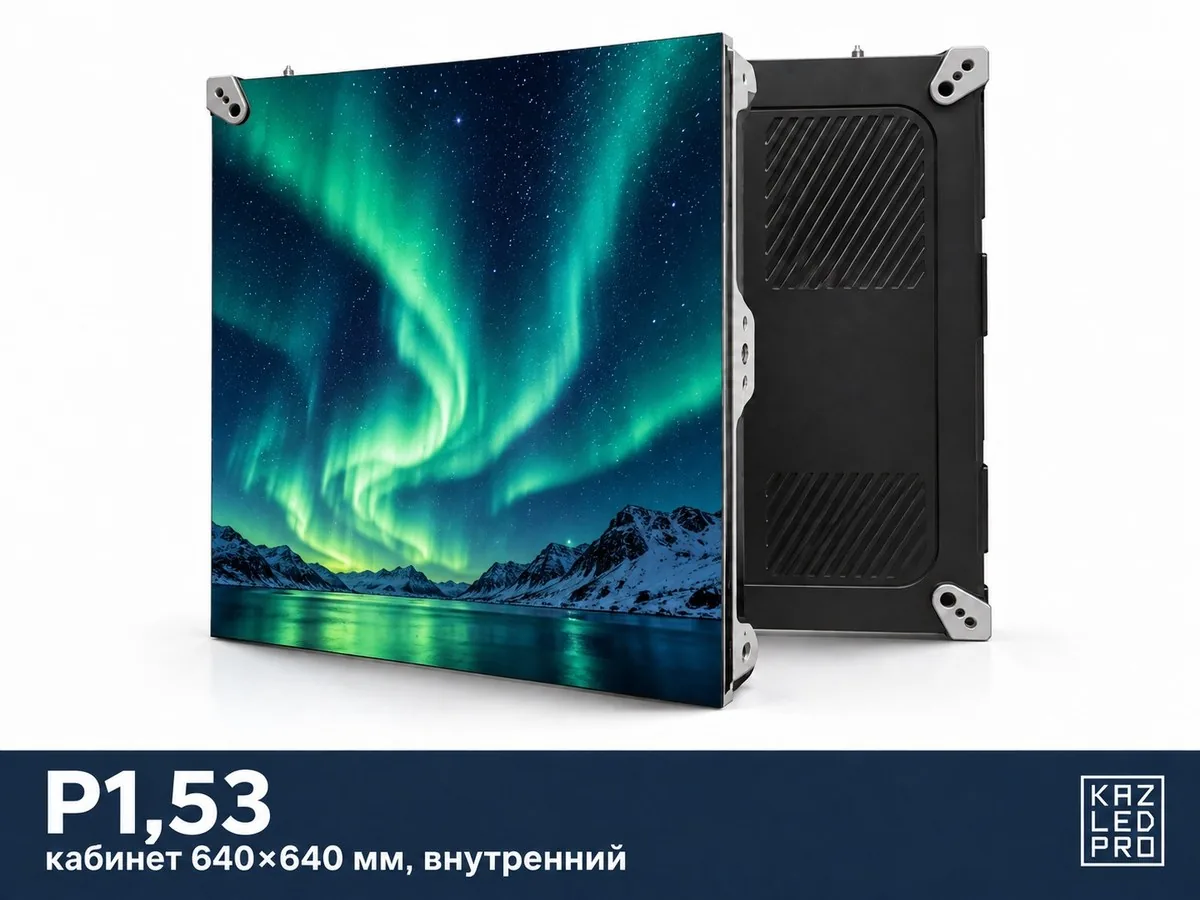 P1.53
P1.53Indoor displays
LED screen P1.53 for indoor use — 640×640 mm cabinet
Indoor screen P1.53 (640×640 mm cabinet), pixel density 422 500 dots/m². Comfortable viewing from 2 m.
- Brightness
- 350–400 cd/m²
- Density
- 422 500 dots/m²
- Protection
- IP 24
Details →
A home cinema on an LED wall means a picture with no seams, no beam over your head and no need to darken the room. An LED screen in an apartment or a country house works with the lights on, shows a black a projector cannot produce, and is assembled to exactly the size the wall needs rather than the size a shop happened to stock. KazLedPro has worked in Almaty since 2012: we specify, assemble, install with our own crew and maintain.
At home the usual choice is fine-pitch P0.93 cabinets built with COB technology, where the dies are encapsulated in compound and the front surface is continuous, or P1.53 and P1.86 in 640×640 mm cabinets. Comfortable viewing starts at one metre for P0.93 and at two metres for P1.53 and P1.86: from a sofa three or four metres away there is no visible grain at all, and a cabinet depth of 36–65 mm lets the screen sit flush in the wall.
Below: how to work out pitch and size for your room, how an LED screen differs from a projector and a television, what to prepare in terms of recess and power, and how much such a wall consumes. The calculator on the site gives a preliminary estimate from width and height; in Almaty we come out and measure.
Pitch, size and real resolution
It is easier to count in pixels per metre of width than in inches. P0.93 gives about 1,067 pixels per metre, P1.53 exactly 650, P1.86 about 537 and P2 exactly 500. That immediately shows which wall a genuine resolution needs: 4K, meaning 3,840 pixels across, lands on a 3.6-metre wall at P0.93, while at P1.53 it would take a wall of nearly six metres, which an apartment rarely has.
A P0.93 cabinet of 600×337.5 mm is exactly 640×360 pixels and a precise 16:9 shape. Six cabinets across and six rows give a canvas of 3.6 × 2.03 metres and a true 3840×2160 with no scaling. A smaller three-by-three set is 1.8 × 1.01 metres and Full HD, a size for a bedroom or a study. Pitch follows distance: watching from two metres, take P0.93; from three or four metres, P1.53 or P1.86 is enough.
- P0.93, 600×337.5×36 mm cabinet — COB, continuous front surface, 1,137,778 dots/m², 600 cd/m², viewing angle 160/160, viewing from 1 m.
- P1.53, cabinets 640×640, 640×480 and 640×320 mm — 422,500 dots/m², 65 mm deep, magnetic front service, viewing from 2 m.
- P1.86, 640×640 mm cabinet — 288,906 dots/m², brightness 400–450 cd/m², for a living room viewed from three metres.
- P2, 640×640 mm cabinet — 250,000 dots/m², an option for a large wall in a house lobby or a reception hall.
- Flexible indoor P1.53 module — bends to a radius and holds on magnets: a curved wall, a recess, a column in the interior.
- Outdoor P2.5–P4, IP68, brightness 5,500–7,800 cd/m², operating temperature from −40 to +50 °C — for a terrace, gazebo or yard.
How it differs from a projector and a television
A projector needs darkness and hangs a lamp above your head: by day the picture washes out, and anyone who stands up walks into the beam. An LED wall emits its own light, so a film is watched with the curtains open and the ceiling light on. Its black is real — where the frame is black, the LEDs simply do not light. P0.93 has a 160-degree viewing angle both horizontally and vertically, so the picture does not fade from the end seat.
The difference from a television is size, and the fact that the wall is built from cabinets: 3.6 metres across is six cabinets, not one enormous panel that has to fit in a lift. The other side deserves saying plainly: below the diagonal of an ordinary television an LED wall makes no sense; it starts to earn its place from about two and a half to three metres wide. The screen has no sound of its own — that comes from your audio system, and we can supply a receiver, speakers and lighting under the same contract.
Installation in an apartment and a country house
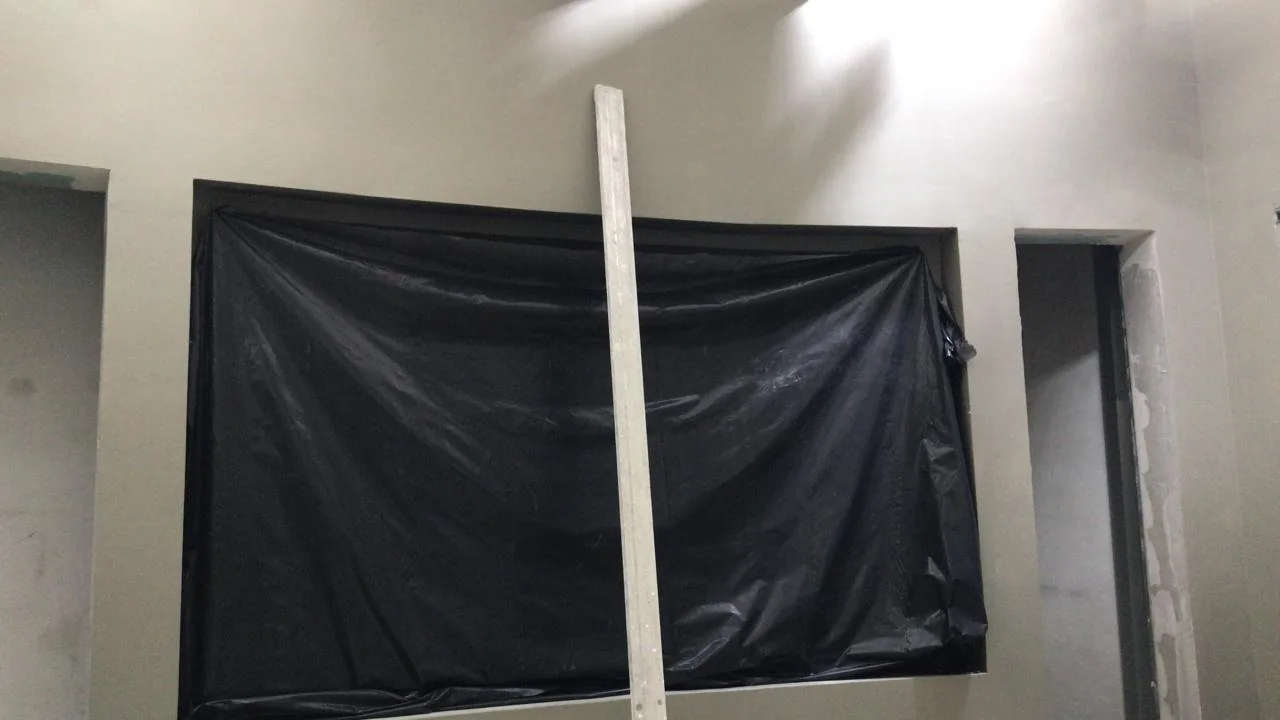
The wall is assembled from cabinets on a frame, 36 mm deep for P0.93 and 65 mm for the 640×640 series, so the screen is recessed flush with the finish. The recess, the cable routes and a dedicated supply line are prepared before the final finish — this is the one stage that cannot be left until later. Weight is calculated in advance: a P0.93 cabinet weighs about 4.3 kg, roughly 21 kg per square metre of canvas, and plasterboard without embedded supports will not hold it.
The electrics are more modest than expected. P0.93 draws 300 W/m² at peak and 100 W/m² on average: a 7.3 m² wall takes about 2.2 kW at maximum and around 700 W during an ordinary film. A dedicated line with its own breaker is enough, and the screen needs no air conditioning of its own. There are no fans, so the room stays quiet. Sources — a set-top box, PC, satellite receiver or games console — connect over HDMI through the video processor, and the rack usually moves to the next room or a cupboard. Service is from the front: a module comes off its magnets without opening the wall.
Where the same equipment already runs
We do not publish private apartments and houses in the portfolio: our clients prefer it that way. There are, however, sites running the same fine-pitch cabinets and the same signal processing, and those can be viewed.
- Dubai Police Command and Control Centre, 2023 — fine-pitch P0.93 screens totalling 48 m², the very cabinets that go into home cinemas.
- ENOC situation centre, Dubai, 2022 — a 20 m² P1.53 screen, the pitch chosen at home for walls from three metres.
- Highvill residential complex, Astana, 2021 — a P3 LED screen, with video from the site on the case page.
- An institute in Almaty, 2021 — 192×192 mm modules with viewing from 2.5 metres: an example of how a fine pitch behaves in a small room.
How the project goes
- 1
Measuring the room
We measure the wall, the distance to the sofa and the seated eye height, and check sockets and where the cables will run. From photos and dimensions we can also calculate remotely, for any city.
- 2
Calculation and proposal
We choose the pitch for the viewing distance, work out the canvas size in cabinets, the resolution, weight and power, select a video processor for your sources and send a quotation.
- 3
Preparing wall and power
We supply a recess drawing with embedded supports and an electrical brief: a dedicated line, a breaker and routes for HDMI and power. All of it happens before the final finish.
- 4
Installation
The crew fits the frame, assembles the canvas from cabinets, runs the cables and connects the video processor. A 6–8 m² wall goes up in a day, with the furniture and finish left alone.
- 5
Setup and handover
We calibrate brightness and colour temperature for evening and daylight, connect the set-top box, console and receiver, show the controls and hand over the passport and a 2–5 year warranty card.
What the price depends on
The cost of a home LED screen is set by pixel pitch, canvas area, cabinet type and the amount of preparatory work on the recess and the electrics. We calculate the exact estimate from the dimensions of your wall: the calculator on the site gives an immediate guide, and a quotation is ready within a day.
Pixel pitch
The price per metre between P0.93 and P1.53 differs by a multiple: the first has over a million dots per square metre, the second 422,500. A fine pitch is worth choosing only when the sofa really does sit close to the wall.
Area and resolution
The canvas is built from cabinets, so price grows almost linearly with area. At one pitch, a Full HD wall and a true 4K wall differ fourfold in area and by roughly the same in the estimate.
Cabinet type and frame
600×337.5 mm cabinets in a 16:9 step and 640×640 mm cabinets assemble into different proportions. Flush mounting into a recess with embedded supports costs more than a frame hung on the wall.
Sources and signal processing
The video processor is chosen for what you connect: set-top box, PC, console, satellite. Multi-window mode and scaling of non-standard aspect ratios add to the equipment cost.
Electrics and preparation
A dedicated line with a breaker, cable routes and embedded supports for about 21 kg per square metre. If the wall is already finished, opening it up and making good is added.
Warranty and service
A 2–5 year warranty depending on the model is included and modules are replaced from the Almaty warehouse. A contract for scheduled inspections and call-outs is arranged separately.
Questions and answers
Which pixel pitch should I choose for a living room?
Look at the distance to the sofa. Three or four metres — P1.53 or P1.86 is enough, and no grain shows from there. Two metres or closer, or a study or bedroom with a small wall — take P0.93, comfortable from one metre. A pitch finer than the distance requires only raises the estimate.
How large must the wall be for genuine 4K?
At P0.93 that is 3.6 metres wide and 2.03 metres high: six 600×337.5 mm cabinets across and six rows give exactly 3840×2160 pixels with no scaling. A smaller three-by-three set is 1.8 metres and Full HD. At P1.53 a 4K image would need a wall of nearly six metres.
How much power does such a screen use, and does it get hot?
P0.93 draws 300 W/m² at peak and around 100 W/m² on average. A wall of 7.3 square metres takes about 2.2 kW at maximum and roughly 700 W during an ordinary film. A dedicated line with a breaker is enough. Heat output is modest and the room needs no extra cooling.
Does an LED wall make noise?
The screen itself is silent: it has no fans, so there is nothing to hum. Noise can only come from external equipment — a games console, a receiver or a computer. That is why the source rack usually moves to the next room or a cupboard, leaving only HDMI and power cables running to the screen.
Will it replace a television, and can I play on a console?
The screen connects over HDMI through a video processor and behaves like a large monitor: set-top box, PC, satellite receiver, console. A refresh rate from 3,840 Hz keeps flicker out of video and photos taken on a phone. Below the diagonal of an ordinary television, though, an LED wall is not justified: it starts to make sense from about three metres wide.
Do I need separate speakers?
Yes, the sound comes from your audio system: there are no speakers in the canvas. A receiver and speakers are chosen for the room separately, and since we also supply lighting and sound equipment, the acoustics and stage lighting for a home hall can be taken under the same contract and one acceptance act.
Can a screen be installed on a terrace or in the yard?
Yes, but the model must be an outdoor one. Such screens with P2.5–P4 pitch carry IP68 protection, 5,500–7,800 cd/m² brightness and an operating range from −40 to +50 degrees, so rain, snow and direct sun are no threat. Indoor cabinets must never go outside, even under a canopy.
What happens if one module fails?
Modules are replaced from the front: they hold on magnets, come off in a minute, and neither the wall nor the finish has to be opened. Spares are held in the Almaty warehouse, the warranty is 2–5 years depending on the model, and LED life starts at 100,000 hours. Call-outs in Almaty happen within one working day.
A turnkey screen: quote, installation, launch.
Send us the dimensions and location — a quote today. WhatsApp around the clock.